
Finance
China’s EV price war is heating up. What’s behind the big discounts?

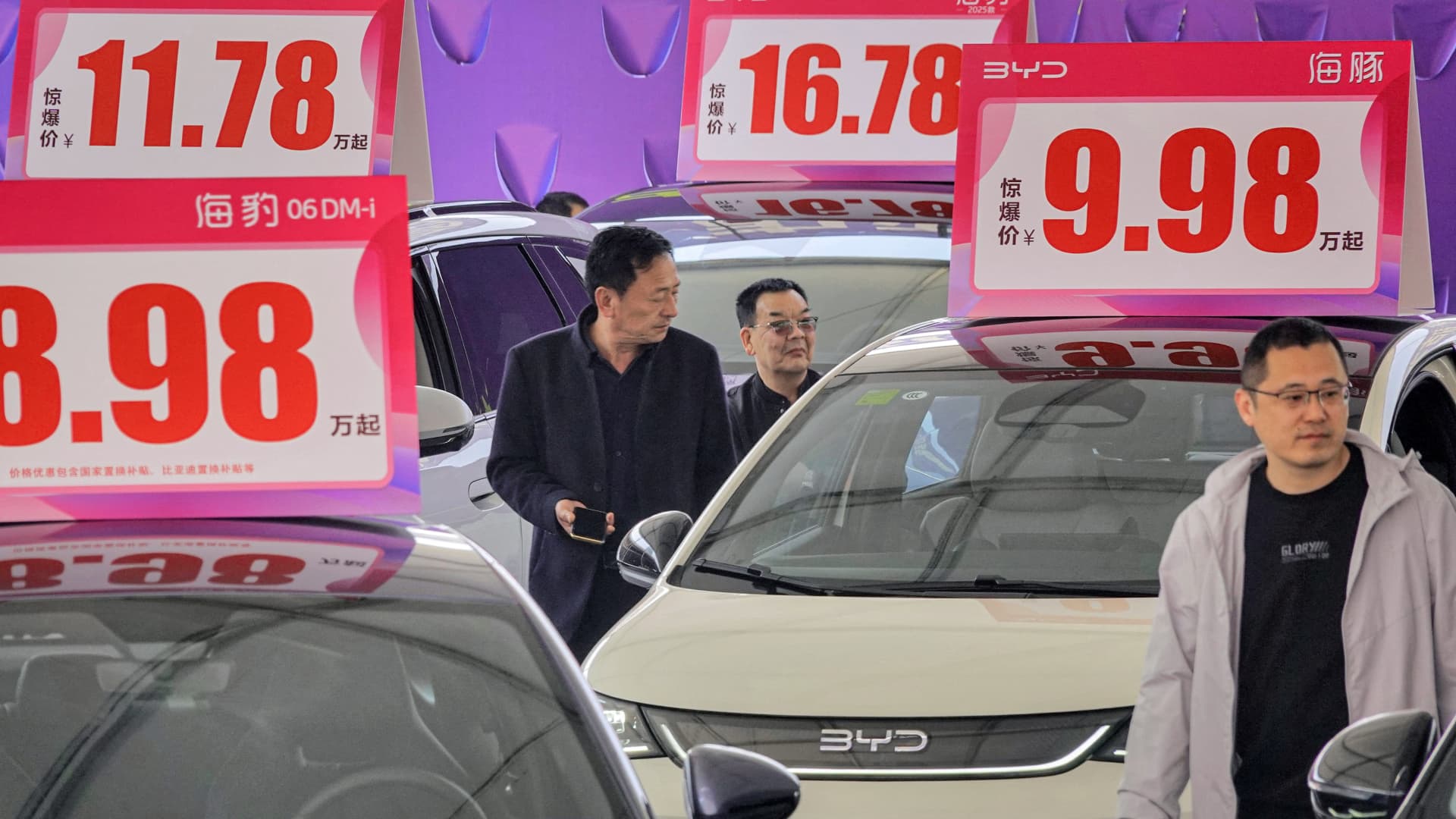
Customers look at BYD electric cars at an auto show in Yantai, in eastern China’s Shandong province on April 10, 2025.
Stringer | Afp | Getty Images
BEIJING — Competition in China’s electric car market just got fiercer with consequences for the domestic economy and even the global auto market.
Industry giant BYD last week announced a slew of discounts — some of nearly 30% or more — across several of its lower-end battery-only and hybrid models. The budget-friendly Seagull compact car saw its price drop to 55,800 yuan ($7,750).
Other major Chinese automakers have begun following suit.
“BYD’s action this time has made the industry rather nervous,” Zhong Shi, an analyst with the China Automobile Dealers Association, said in Mandarin, translated by CNBC.
“The industry is in [a state of] relatively large shock,” he said, noting smaller automakers are now more worried about their ability to compete.
The industry has been a rare bright spot in an economy that has been seeing slower growth and lackluster consumer demand. Part of Beijing’s latest attempt to spur consumption included subsidies for new energy vehicles, a category that includes battery-only and hybrid-powered cars.
“The latest car price competition underscores how supply-demand imbalance continues to fuel deflation,” Morgan Stanley’s Chief China Economist Robin Xing said in a report Wednesday.
“There is growing rhetoric about the need for rebalancing [to more consumption], but recent developments suggest the old supply-driven model remains intact,” he said. “Thus, reflation is likely to remain elusive.”

China’s electric car market has already been in a price war for the last two years, partly fueled by Tesla.
But this time, traditional automakers, including state-owned ones, are feeling significant heat as the share of new energy vehicles has come to account for about half of new passenger cars sold in China.
Last week, Great Wall Motors Chairman Wei Jianjun warned of an “Evergrande” in China’s auto industry that had yet to explode, comparing the fast-growing EV industry to the country’s bloated real estate sector. The outspoken private sector autos executive was speaking to Chinese media outlet Sina in an interview posted on May 23.
Once China’s real estate giant, Evergrande defaulted on its debt in late 2021 as the property market slumped after Beijing cracked down on the company’s high debt levels. Demand for homes also fell following tighter government regulations, leaving the developer struggling to finance the remaining construction of pre-sold units.
As Chinese media scrutiny on automakers’ financial situation rose, BYD on Wednesday refuted reports that it excessively pressured one of its dealers on cash flow. The dealer, Jinan Qiansheng in the eastern province of Shandong, did not immediately respond to a CNBC request for comment. BYD referred CNBC to its statement to Chinese media.
In the early years of China’s state-supported efforts to become a global leader in the emerging electric vehicle industry, the Ministry of Finance said it found at least five companies cheated the government of over 1 billion yuan ($140 million). The high-level policy encouraged a flood of startups, of which only a handful survived.
A 19% price drop over two years
In China, the average car retail price has fallen by around 19% over the past two years to around 165,000 yuan ($22,900), according to a Nomura report this week, citing industry data from Autohome Research Institute.
Price cuts were far steeper for hybrid or range-extension vehicles, at 27% over the last two years, while battery-only cars saw prices slashed by 21%, the report said. It noted that traditional fuel-powered cars saw a below-average 18% price cut.
In contrast, the average price of a new car in the U.S. was $48,699 in April, up nearly 1% from two years earlier, according to CNBC calculations of data from Cox Automotive. The average electric car price last month was an even higher $59,255.
BYD’s latest round of price cuts didn’t include the company’s higher-end models priced around 200,000 yuan, such as its flagship Han electric sedan. Reuters pointed out the newest model of the Han released in February was about 10% cheaper than its previous version, according to its calculations.
The Chinese auto giant, which was backed by Warren Buffett in its early years, has rapidly captured market share in China with its wide range of cars at various price points. The company reported a net profit increase of 49% to 14.17 billion yuan last year. Total current liabilities rose by more than 60% to 57.15 billion yuan. Cash and cash equivalents fell slightly to 102.26 billion yuan.
Price war to continue
Rather than reflecting market expansion, double-digit growth of new energy vehicles sales in China is just eating into internal combustion engine cars’ slice of the pie, Ying Wang, Fitch managing director, APAC Corporate ratings, told reporters Tuesday. She noted how the country’s auto market hasn’t grown much since 2018, and expects autos retail sales to only increase by low single digits this year.
Automakers will keep on using price cuts to gain market share in China this year, she said. Wang pointed out another option is for companies to include more features, such as advanced driver-assist systems, for free instead of asking consumers to pay more for them as an add-on.
Geely-backed Zeekr in March said it was releasing its advanced driver-assist system for free, while Tesla has attempted to charge its customers for a similar feature. A month earlier, BYD announced it was rolling out driver-assist capabilities to more than 20 of its car models.

Subscribe now
In the last several months, China’s top leaders have increasingly called for efforts to address non-productive business competition, known as “involution.” The term was mentioned in the premier’s annual work report in March and in the market regulator’s meeting last week which called for “comprehensively rectifying ‘involutionary’ competition.”
However, the massive effort to produce lower-cost electric cars in China, and the automakers’ subsequent move to expand into other markets, has increased worries about the impact on other countries’ auto industries.
The European Union slapped tariffs on imports of China-made electric cars after probing the companies over the use of government subsidies in their manufacture. The U.S. also imposed duties of 100% on China-made electric cars, quashing hopes that the vehicles might enter the world’s second-largest auto market.
But in the EU, tariffs have had limited effect. In April, BYD outsold Tesla in Europe for the first time, according to JATO Dynamics. Tesla’s Europe sales plunged by 49% that month, according to the European Automobile Manufacturers’ Association.
— CNBC’s Bernice Ooi contributed to this report





Treasury Bond Volatility Forces Bessent to Double Debt Buyback Size as Yields Swing

Nvidia Earnings Preview: What Wall Street Expects From the AI Bellwether’s Q2 Report

SEC’s Semiannual Reporting Proposal Faces Investor Pushback: What CFOs Need to Know

Armanino adds Strategic Accounting Outsourced Solutions

New 2023 K-1 instructions stir the CAMT pot for partnerships and corporations

Tax Strategy: Employee Retention Credit update
-

 Economics1 week ago
U.S. Retail Sales Fall for the First Time in Nine Months as Consumer Spending Slows
-

 Economics1 week ago
Nvidia’s Potential $3 Billion SB Energy Investment Could Reshape AI Infrastructure
-

 Economics4 days ago
Top 10 Largest Economies by 2030: IMF & World Bank GDP Projections for Global Powerhouses
-
 Stock News4 days ago
How to understand Intel $15B Stock Offering
-
 Technology1 week ago
U.S.-China AI Competition Intensifies as Washington Pushes Allies to Choose Sides
-

 Economics4 days ago
Economic Profile of the United States of America (2026–2030 Horizon)
-
 Stock News20 hours ago
Nvidia Earnings Preview: What Wall Street Expects From the AI Bellwether’s Q2 Report
-

 Leaders3 days ago
Jackson Hole 2026: What the First Symposium Under Fed Chair Kevin Warsh Means for Markets