
Finance
China’s Golden Week holiday signals persistent consumer caution

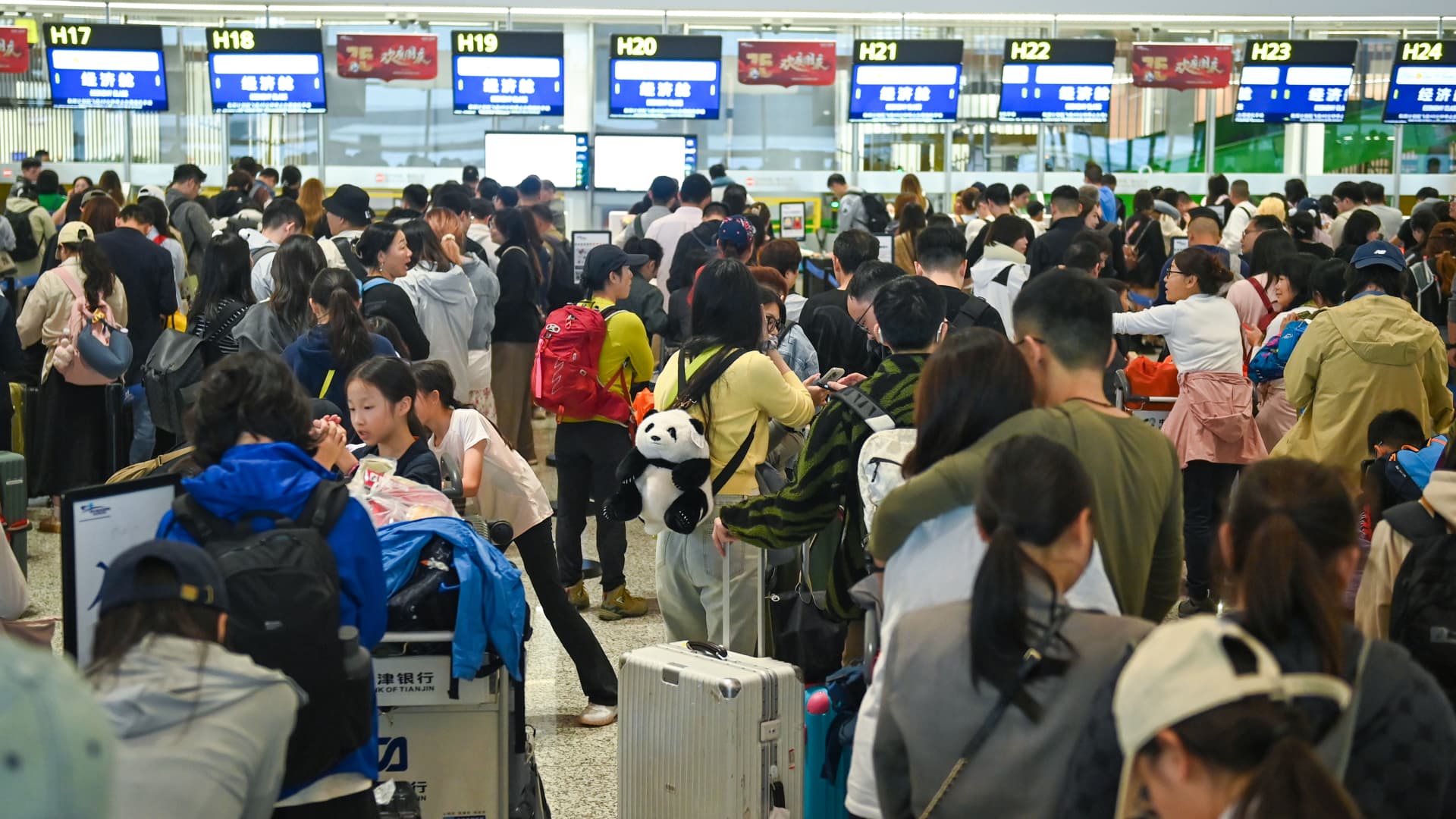
Passengers line up to check in at Chengdu Tianfu International Airport on October 6, 2024 as China’s week-long National Day holiday draws to a close.
China News Service | China News Service | Getty Images
BEIJING — China’s Golden Week holiday affirmed a trend in more cautious spending, while consumers put greater emphasis on experiences.
The seven-day public holiday that ended Monday recorded about 2% less spending per domestic trip than the pre-pandemic level, according to Goldman Sachs analysis published Tuesday.
“Low tourism spending per head and subdued services prices highlighted still weak domestic demand and continued consumption downgrading,” the analysts said.
The decline was an improvement from a gap of more than 10% during holidays in the spring, the Goldman report said.
The Golden Week holiday in China commemorates the founding of the People’s Republic of China on Oct. 1. It is the last public holiday of the year for the country.

Nearly one-fifth of bookings on Trip.com for the holiday came from users ages 20 to 25, making them the main consumer group, the company said. It noted more than 90 concerts were held during the holiday, and that daily growth in orders for performances and exhibitions grew by an average of more than 80% during the period.
However, a lack of blockbusters resulted in a drop in box office earnings, to 2.1 billion yuan ($300 million) this year, from 2.7 billion yuan last year, according to state media, citing the China Film Administration.
Consumers were also more spontaneous.
Trip.com said nearly 30% of travelers booked travel on the same day, or one day in advance, a 6 percentage point increase from last year. The average number of days customers booked in advance fell to 6 days this year, down from 6.8 days last year, the company said.
The holiday this year followed a flurry of policy announcements and promises, and a stock market surge. Consumer spending in China has been lackluster since the pandemic due to uncertainty about future income and economic growth.
“People become more cautious with spending. Also they opt for more affordable options of travel and affordable locations,” Kenneth Chow, principal at Oliver Wyman, told CNBC on Wednesday.
“People are much more interested in spending on things they can talk about, things they can post [on social media] about, rather than just the big ticket items,” he said. He said such shifts mean brands, including luxury ones, need to focus more on communicating the benefits to potential Chinese consumers.
“When people are becoming much more sophisticated, the proposition has to change, and whoever is able to adapt to that new trend first will be able to win,” Chow said. “It’s not just about Chinese brands. It’s not just about overseas brands. It’s about who’s going to react first and who’s going to capture the attention of Chinese consumers first.”
Appliance sales climb
Christine Peng, head of the Greater China consumer sector at UBS, pointed out Wednesday that Golden Week figures indicated recovery in spending was tied to trade-in policies for appliances.
Retail sales rose by 9% during the holiday, while sales of home appliances surged by 149.1%, according to state media, citing figures from the tax administration. It did not provide the amount spent.
“The Golden Week consumption could still suggest a modest recovery versus August, in our view, due to trade-in subsidies (for appliances and autos) and consumption vouchers issued by the local governments,” Peng said. “For example, Shanghai’s retail sales rose 3%, a recovery versus -3% YoY this August.”
During Golden Week, mainland China recorded 765 million domestic trips, up from both the prior year and before the pandemic, according to the Ministry of Culture and Tourism.
However, by another measure of counting from the ministry, China had received 782 million domestic visits in 2019. It was not immediately clear whether the figures were comparable.
The average number of mainland China residents traveling across the border rose to 1.08 million a day during this year’s holiday, up from 1.01 million a day in 2019, according to CNBC calculations of official data.
Japan, Thailand and the U.K. were among the more popular destinations, according to booking site Trip.com.
Chinese mobile pay expands
Overseas transactions by China’s Alipay users surged by 60% during the first four days of the holiday versus the year-ago period, according to the mobile payments operator, owned by Alibaba-affiliate Ant Group.
Malaysia, Korea, Thailand, Hong Kong and Singapore were the top destinations for Chinese tourists by transaction volume growth, Alipay said. It noted that rather than shopping, the Chinese travelers also spent significantly on entertainment, food and beverage, services and transportation.
Foreign visitors to mainland China using Alipay spent more than twice the amount during the first four days of the holiday, versus a year ago, the company said. China has introduced visa-free travel for more countries, while Alipay and WeChat Pay — the two dominant mobile pay apps in the country — have in the last two years made it easier for foreigners to use the apps.
Hong Kong said that visitors from mainland China visitors averaged 170,000 per day during the holiday, 27% more than a year ago. On Oct. 1, Hong Kong said it received 220,000 visitors from the mainland, the highest since the end of Covid-19 border controls.
Oliver Wyman’s Chow noted how hotels, especially those in Hong Kong, were adapting to lower prices per night by selling more food or other experiences.




Treasury Bond Volatility Forces Bessent to Double Debt Buyback Size as Yields Swing

Nvidia Earnings Preview: What Wall Street Expects From the AI Bellwether’s Q2 Report

SEC’s Semiannual Reporting Proposal Faces Investor Pushback: What CFOs Need to Know

Armanino adds Strategic Accounting Outsourced Solutions

New 2023 K-1 instructions stir the CAMT pot for partnerships and corporations

Tax Strategy: Employee Retention Credit update
-

 Economics1 week ago
U.S. Retail Sales Fall for the First Time in Nine Months as Consumer Spending Slows
-

 Economics1 week ago
Nvidia’s Potential $3 Billion SB Energy Investment Could Reshape AI Infrastructure
-

 Economics4 days ago
Top 10 Largest Economies by 2030: IMF & World Bank GDP Projections for Global Powerhouses
-

 Stock News4 days ago
How to understand Intel $15B Stock Offering
-

 Technology1 week ago
U.S.-China AI Competition Intensifies as Washington Pushes Allies to Choose Sides
-

 Economics4 days ago
Economic Profile of the United States of America (2026–2030 Horizon)
-

 Leaders3 days ago
Jackson Hole 2026: What the First Symposium Under Fed Chair Kevin Warsh Means for Markets
-
 Economics3 days ago
U.S. National Debt Surpasses $40 Trillion for the First Time: What It Means for the Economy