
Finance
China’s Nio to expand battery swap services to gain EV infra edge

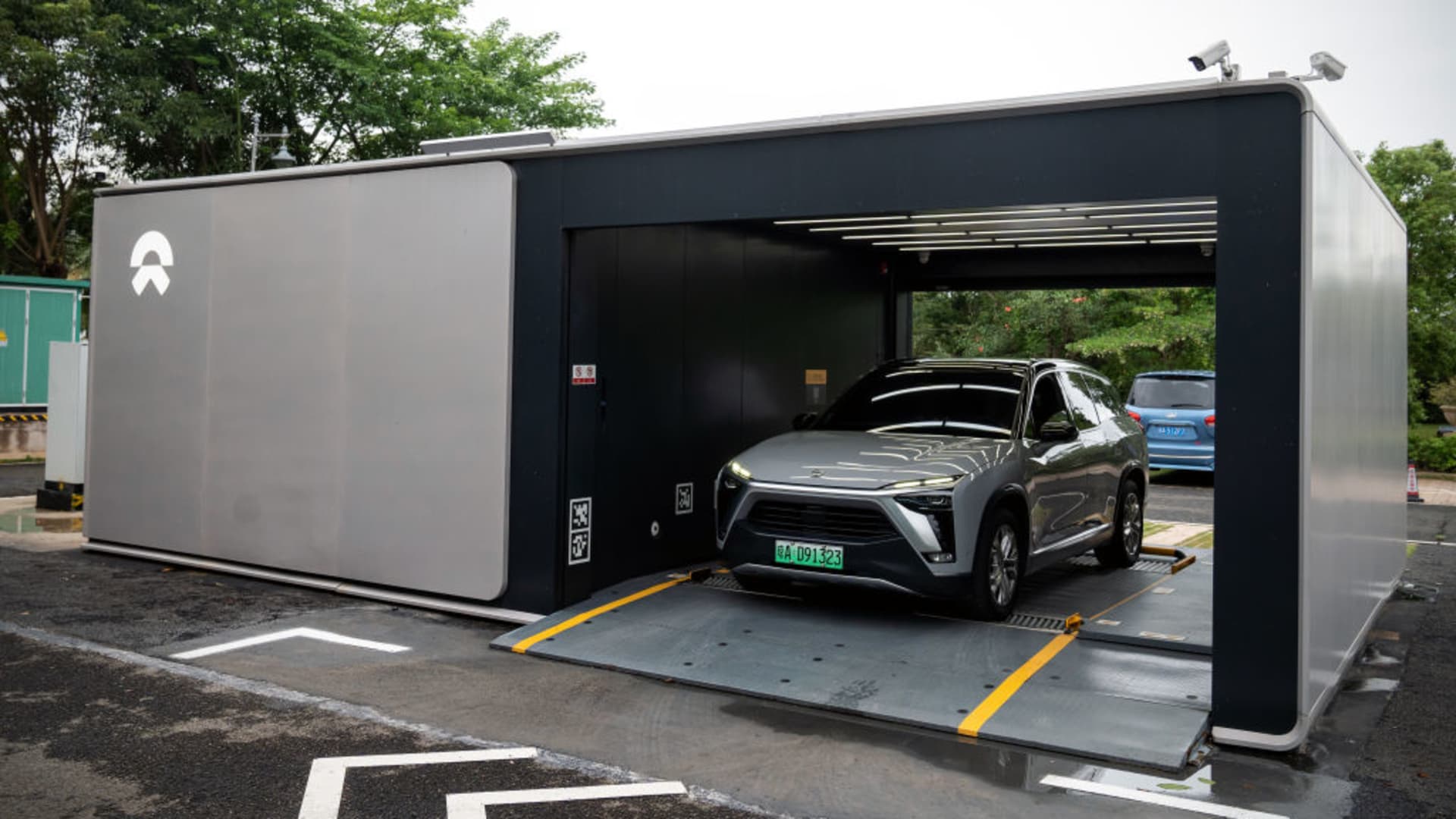
Pictured here is a Nio battery swapping station in Haikou, Hainan province, China, on May 9, 2023.
Bloomberg | Bloomberg | Getty Images
BEIJING — Chinese electric car company Nio has been expanding its battery swap partnerships in a bid to gain an edge on the infrastructure side of the EV ecosystem.
Since November, Nio has partnered with at least four Chinese automakers — Changan, Geely, Chery and JAC — for developing battery swap standards and expanding the network in China. Nio also announced agreements earlier this year to work with two local battery companies on battery swap services.
All these efforts are aimed at alleviating consumers’ anxiety about driving range. While having a large network of battery charging stations helps address those concerns, battery swapping is a faster method as it takes only a few minutes.
“Swapping right now is mainly driven by Nio. Of course, Nio found out this is an ecosystem,” CLSA’s deputy head of research Ding Luo said in an interview. “If only one player is trying to build up the whole ecosystem, it’s impossible for [them]. That’s why they’re thinking whether they can invite some partners.”
Battery swapping still isn’t mainstream because the car batteries need to be standardized, he added.
While a charging station resembles a typical gas station, battery-swap technology is housed in a shed-like structure. It uses machines to automatically exchange depleted batteries for pre-charged ones in compatible cars.
Nio said in mid-March that it completed 40 million battery swaps compared with nearly 37 million charges at its public stations — Nio consumers can also access third-party charging stations, or install one at home.
“I think our outlook is very simple,” Shen Fei, senior vice president of Nio’s power division, said in Chinese translated by CNBC. “The first thing is to serve Nio’s users, and then provide a good battery charging and swapping experience, make charging more convenient than refueling, and at the same time help the company sell more cars.”
The company claims that with battery swap, drivers can get a fresh charge in three minutes, if they opt in for a paid battery service plan.
Shen said more car models will be added to Nio’s battery swap network, while adding that swapping can allow drivers to keep abreast with improvements in battery technology. He did not specify which automakers will likely be added to its network.
Power services and other products account for just about 10% of Nio’s total revenue. The company said that category of “other sales” for 2023 grew by 69% to 6.36 billion yuan ($895.9 million). Nio does not break out swap station revenue.
Battery swap’s checkered past
Battery swapping has been tried by the industry with mixed success, especially in the U.S.
Tesla and a startup called Better Space tried out swapping more than 10 years ago, but the venture soon closed.
In 2021, another startup, Ample, opened its battery swap stations in the San Francisco area — aimed at Uber drivers using the Nissan Leaf car.
While it’s not clear how much headway Ample has made in the U.S., the company has since expanded its partnerships overseas. Last month the company announced it would serve corporate car fleets in Kyoto, Japan, while it teamed up with Stellantis to roll out battery swaps this year in Madrid, Spain.
“For swapping to work it can’t be niche,” Tu Le, head of consultancy Sino Auto Insights, said. “Battery inventory investment is massive, so it needs to be amortized over lots of swapping.”
But he was cautious on whether Nio could sell enough of its own premium-priced cars to make the economics work. “For now I still think the combination of swapping and charging makes for a pretty attractive feature set, but swapping alone likely doesn’t help them sell that many more cars.”
“I think the nudge the Chinese government gave to encourage others to join forces with Nio on swapping could create the necessary pool of vehicles to make swapping viable,” he added.
The business of charging
Nio is the first major electric car company to roll out battery swap stations in addition to charging stations, alongside its own vehicles in mainland China and Europe.
The company has installed more than 2,300 battery swap stations, and plans to install 1,000 more this year.
Nio’s investment in battery swap stations is about two years ahead of market demand, CEO William Li said last month, adding that less than a fifth of battery swap stations that Nio operates are processing 60 orders a day, likely the minimum orders needed for a station to break even.
Nio’s battery charging stations, on the other hand, reached profitability last year, according to the company. It plans to build 20,000 more this year.
Passenger car battery swap stations can cost around $500,000 to build, while a relatively basic charging station with two ports costs around $200,000 to $300,000, according to Shay Natarajan, a North America-based partner at Mobility Impact Partners, a private equity fund that invests in transportation.
CLSA’s Luo said businesses also prefer to invest in normal charging stations than swap stations because they make a higher return. But if businesses want to install faster-charging stations, he said they might face power grid challenges.
CLSA’s analysis found that the power required for five superchargers in one location would be more than what 300 families would normally consume.
Tesla is also collaborating with automakers in battery charging, with its over 50,000 superchargers worldwide that claim to restore about two-thirds of a battery’s charge in 15 minutes.
In February, Ford reached a deal that allows its electric cars to use Tesla’s superchargers in North America. General Motors announced a similar agreement last year.
Sustainability considerations
The rapid development of electric cars, ostensibly aimed at reducing carbon emissions, also raises questions about battery waste.
Nio pointed out that recent growth of new energy vehicles, which include hybrids, means nearly 20 million batteries will be reaching the end of their eight-year warranty period between 2025 and 2032.
Last month, the company announced a partnership with battery giant Contemporary Amperex Technology to develop batteries with a longer lifespan, particularly for those used in swap stations.
Nio claimed that by using battery swap and big data, it can retain 80% of a battery’s capacity after 12 years of use. Nio also said last month that CATL will develop batteries with longer lives for the company.
— CNBC’s Lora Kolodny and Michael Wayland contributed to this report.





U.S.- Canada Trade Talks Collapse; Carney Says Retaliatory Tariffs Begin September 8

Flock Cameras and the Future of Public Security

AI Infrastructure Boom Hits Physical Limits: Power, Financing, and Supply Chain Strain

Armanino adds Strategic Accounting Outsourced Solutions

New 2023 K-1 instructions stir the CAMT pot for partnerships and corporations

Tax Strategy: Employee Retention Credit update
-

 Stock News1 week ago
Nvidia Earnings Preview: What Wall Street Expects From the AI Bellwether’s Q2 Report
-

 Accounting1 week ago
SEC’s Semiannual Reporting Proposal Faces Investor Pushback: What CFOs Need to Know
-

 Stock News1 week ago
Nvidia Q2 FY2027 Earnings beats Wall Street Expectation with Record $96.2 Billion Revenue
-

 Finance1 week ago
Treasury Bond Volatility Forces Bessent to Double Debt Buyback Size as Yields Swing
-
 Technology5 days ago
AI Infrastructure Boom Hits Physical Limits: Power, Financing, and Supply Chain Strain
-
 Technology2 days ago
Flock Cameras and the Future of Public Security
-
 Economics2 days ago
U.S.- Canada Trade Talks Collapse; Carney Says Retaliatory Tariffs Begin September 8