
Finance
China’s plan to boost consumption by encouraging trade-ins has yet to show results

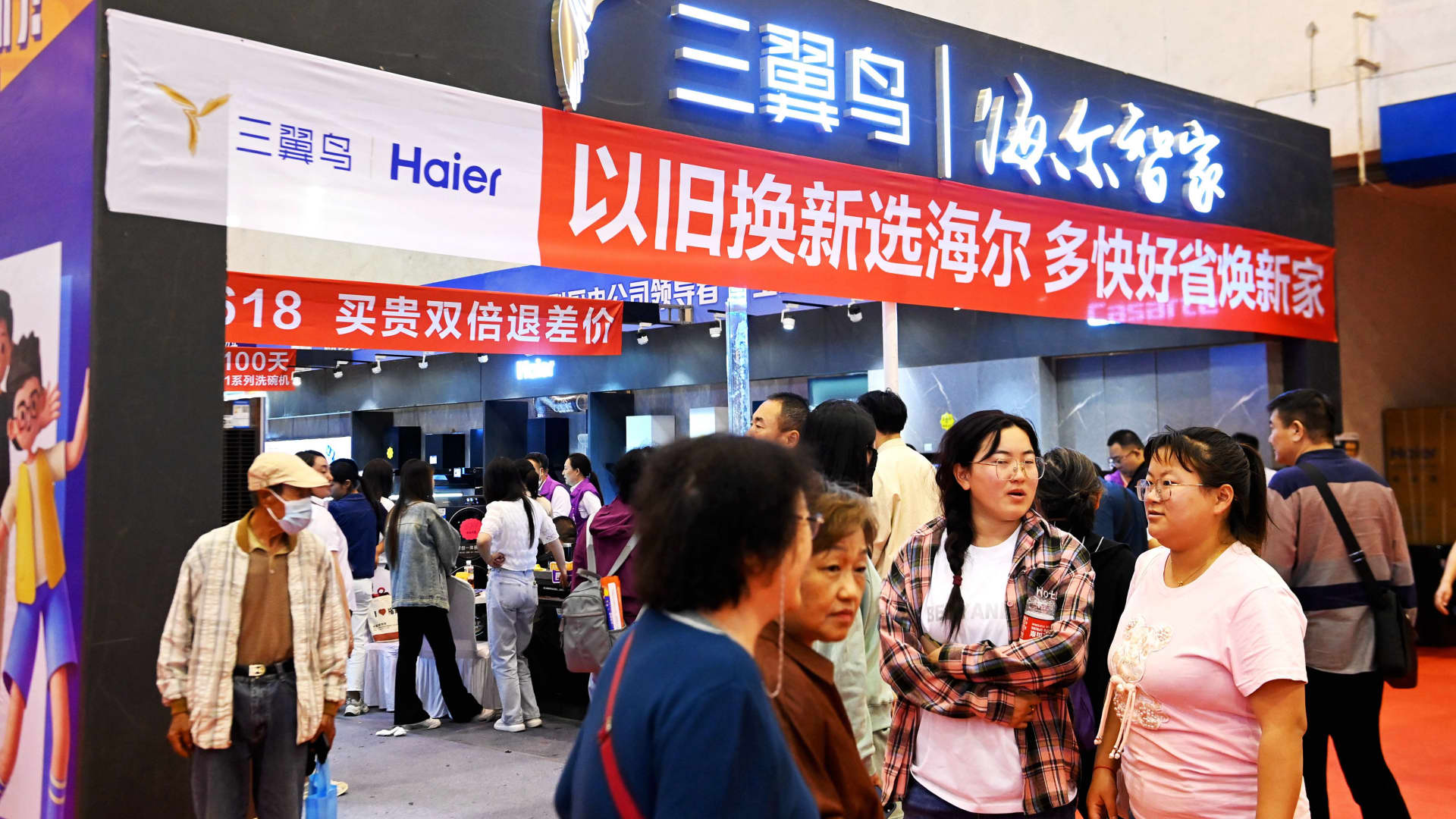
A banner plays up China’s trade-in policy at a home goods expo in Qingdao, Shandong province, China, on June 1, 2024.
Nurphoto | Nurphoto | Getty Images
BEIJING — China’s plan to boost consumption by encouraging trade-ins has yet to show significant results, several businesses told CNBC.
China in July announced allocation of 300 billion yuan ($41.5 billion) in ultra-long special government bonds to expand its existing trade-in and equipment upgrade policy, in its bid to boost consumption.
Half that amount is aimed at subsidizing trade-ins of cars, home appliances and other bigger-ticket consumer goods, while the rest is for supporting upgrades of large equipment such as elevators. Local governments can use the ultra-long government bonds to subsidize certain purchases by consumers and businesses.
While the targeted move to boost consumption surprised analysts, the measures still require China’s cautious consumer to spend some money up front and have a used product to trade in.
“We are not aware of companies that have seen this translate, since the promulgation of the measures, into concrete incentives on the ground in China,” Jens Eskelund, president of the EU Chamber of Commerce in China, told reporters earlier this week.
“Our encouragement would be that now we focus on execution [for] visible, measurable results,” he said.

The chamber’s analysis found that the central government policy’s total budgeted amount is about 210 yuan ($29.50) per capita. Given that “only a portion of [it] will reach household consumers, it is unlikely that this scheme alone will significantly increase domestic consumption,” organization said in a report published Wednesday.
Analysts are not overly optimistic about the extent to which the trade-in program could support retail sales.
UBS Investment Bank Chief China Economist Tao Wang said in July that the new trade-in program could support the equivalent of about 0.3% of retail sales in 2023.
China’s retail sales for August are due Saturday morning. Retail sales in June rose by 2%, the slowest since the Covid-19 pandemic, while July sales growth saw a modest improvement at 2.7%.
New energy vehicle sales, however, surged by nearly 37% in July despite a drop in overall passenger car sales, according to industry data.
The trade-in policy more than doubled existing subsidies for new energy and traditional fuel-powered vehicle purchases to 20,000 yuan and 15,000 yuan per car, respectively.
Waiting for elevator modernization
In March and April, China had already started to roll out policy broadly supporting equipment upgrades and consumer product trade-ins. Around the measures announced in late July, officials noted 800,000 elevators in China had been used for more than 15 years, and 170,000 of those had been in service for more than 20 years.
Two major foreign elevator companies told CNBC in August they had yet to see specific new orders under the new program for equipment upgrades.
“We are still at the very early stage on this whole program right now,” said Sally Loh, president of China operations for U.S. elevator company Otis. Businesses know about the overall monetary amount, she said, but “as to how much is being allocated to elevators, this hasn’t really been clarified.”
“We do see that definitely there is a lot of interest by the local government to make sure this kind of funding from the central government is being effectively deployed to the residential buildings that most need this replacement,” she said, noting the announced funding “really helps to resolve some of the financing issues that we saw were a big concern for our customers.”
Otis’ new equipment sales fell by double digits in China during the second quarter, according to an earnings release. It did not break out revenue by region.
Finnish elevator Kone said its Greater China revenue fell by more than 15% in the first six months of 2024 year on year to 1.28 billion euros ($1.41 billion), dragged down by the property slump. That was still more than 20% of Kone’s total revenue in the first half.
“Definitely we’re excited about the opportunity. We’ve been excited about it for a long time,” said Ilkka Hara, CFO of Kone. “This is more of a catalyst that will enable many to make the choice.”
“I definitely see opportunity in the future,” he said. “How quickly it materializes, that’s hard to say.”
Hara pointed out that new elevators can save more energy versus older models, and said Kone plans to grow its elevator service business in addition to unit sales.
Secondhand market outlook
Central government policies can take time to get implemented locally. Several major cities and provinces have only in the last few weeks announced details on how the trade-in program would work for residents.
For ATRenew, which operates stores for processing secondhand goods, the ultra-long government bonds program to support trade-ins does not have a short-term impact, said Rex Chen, the company’s CFO.
But he told CNBC the policy supports the longer-term development of the secondhand goods market, and he hopes there will be more government support for building trade-in kiosks in neighborhood communities.
ATRenew focuses on pricing and resale of selected secondhand products — the company claims it became Apple’s global trade-in partner last year.
In specific categories and regions — such as mobile phones and laptops in parts of Guangdong province — trade-in volume did rise this summer, Chen said.
Trade-in orders coming from e-commerce platform JD.com have risen by more than 50% year on year since the new policy was released, according to ATRenew, which did not specify the time frame.
— CNBC’s Sonia Heng contributed to this report.




Treasury Bond Volatility Forces Bessent to Double Debt Buyback Size as Yields Swing

Nvidia Earnings Preview: What Wall Street Expects From the AI Bellwether’s Q2 Report

SEC’s Semiannual Reporting Proposal Faces Investor Pushback: What CFOs Need to Know

Armanino adds Strategic Accounting Outsourced Solutions

New 2023 K-1 instructions stir the CAMT pot for partnerships and corporations

Tax Strategy: Employee Retention Credit update
-

 Economics1 week ago
U.S. Retail Sales Fall for the First Time in Nine Months as Consumer Spending Slows
-

 Economics1 week ago
Nvidia’s Potential $3 Billion SB Energy Investment Could Reshape AI Infrastructure
-

 Economics4 days ago
Top 10 Largest Economies by 2030: IMF & World Bank GDP Projections for Global Powerhouses
-

 Stock News4 days ago
How to understand Intel $15B Stock Offering
-

 Technology1 week ago
U.S.-China AI Competition Intensifies as Washington Pushes Allies to Choose Sides
-

 Economics4 days ago
Economic Profile of the United States of America (2026–2030 Horizon)
-

 Leaders3 days ago
Jackson Hole 2026: What the First Symposium Under Fed Chair Kevin Warsh Means for Markets
-
 Economics3 days ago
U.S. National Debt Surpasses $40 Trillion for the First Time: What It Means for the Economy