
Finance
China’s property market edges toward an inflection point

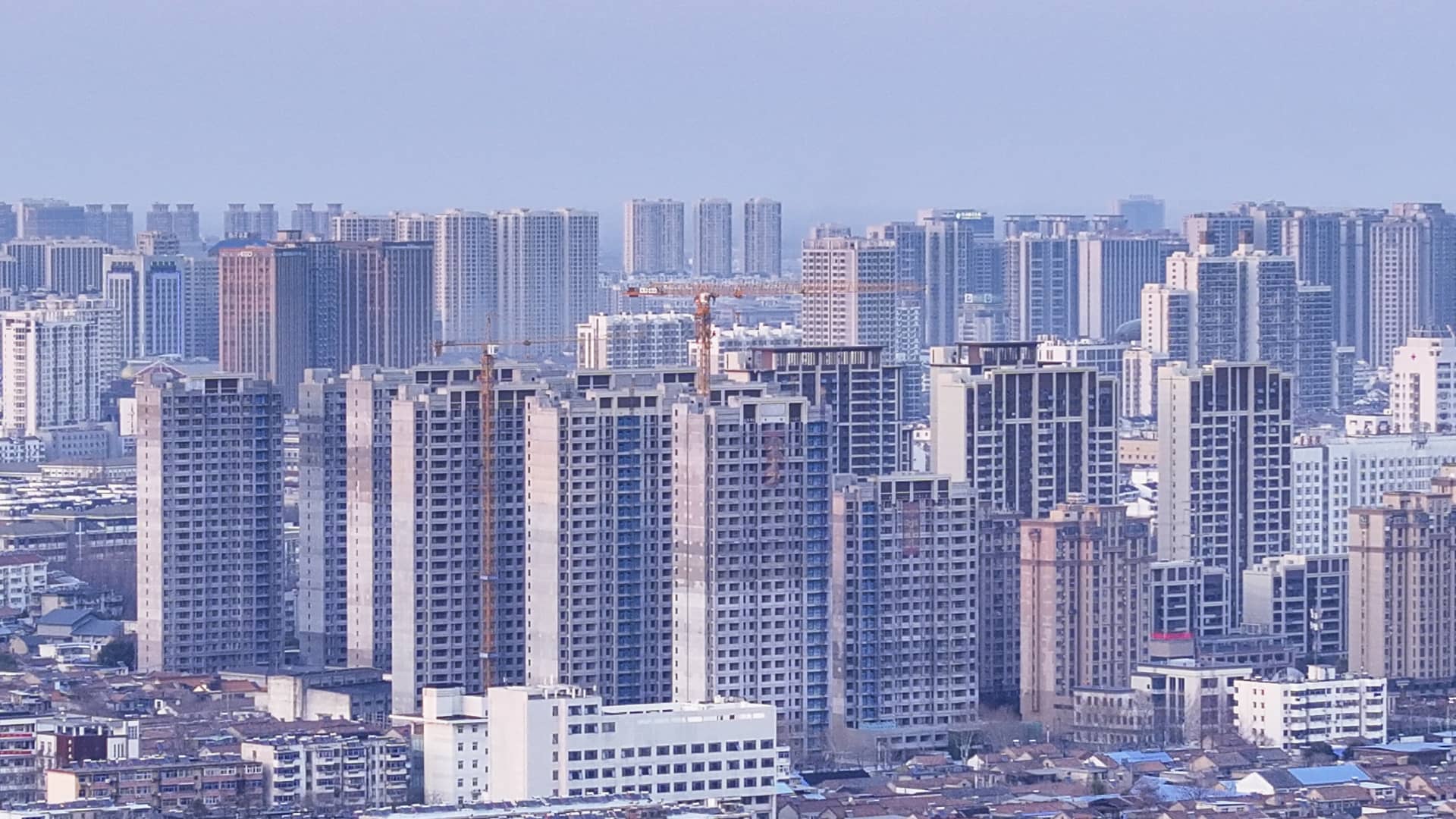
Urban buildings in Huai’an city, Jiangsu province, China, on March 18, 2025.
Cfoto | Future Publishing | Getty Images
BEIJING — UBS analysts on Wednesday became the latest to raise expectations that China’s struggling real estate market is close to stabilizing.
“After four or five years of a downward cycle, we have begun to see some relatively positive signals,” John Lam, head of Asia-Pacific property and Greater China property research at UBS Investment Bank, told reporters Wednesday. That’s according to a CNBC translation of his Mandarin-language remarks.
“Of course these signals aren’t nationwide, and may be local,” Lam said. “But compared to the past, it should be more positive.”
One indicator is improving sales in China’s largest cities.
Existing home sales in five major Chinese cities have climbed by more than 30% from a year ago on a weekly basis as of Wednesday, according to CNBC analysis of data accessed via Wind Information. The category is typically called “secondary home sales” in China, in contrast to the primary market, which has typically consisted of newly built apartment homes.
UBS now predicts China’s home prices can stabilize in early 2026, earlier than the mid-2026 timeframe previously forecast. They expect secondary transactions could reach half of the total by 2026.

UBS looked at four factors — low inventory, a rising premium on land prices, rising secondary sales and increasing rental prices — that had indicated a property market inflection point between 2014 and 2015. As of February 2025, only rental prices had yet to see an improvement, the firm said.
Chinese policymakers in September called for a “halt” in the decline of the property sector, which accounts for the majority of household wealth and just a few years earlier contributed to more than a quarter of the economy. Major developers such as Evergrande have defaulted on their debt, while property sales have nearly halved since 2021 to around 9.7 trillion yuan ($1.34 trillion) last year, according to S&P Global Ratings.
China’s property market began its recent decline in late 2020 after Beijing started cracking down on developers’ high reliance on debt for growth. Despite a flurry of central and local government measures in the last year and a half, the real estate slump has persisted.
But after more forceful stimulus was announced late last year, analysts started to predict a bottom could come as soon as later this year.
Back in January, S&P Global Ratings reiterated its view that China’s real estate market would stabilize toward the second half of 2025. The analysts expected “surging secondary sales” were a leading indicator on primary sales.
Then, in late February, Macquarie’s Chief China Economist Larry Hu pointed to three “positive” signals that could support a bottom in home prices this year. He noted that in addition to the policy push, unsold housing inventory levels have fallen to the lowest since 2011 and a narrowing gap between mortgage rates and rental yields could encourage homebuyers to buy rather than rent.
But he said in an email this week that what China’s housing market still needs is financial support channeled through the central bank.
HSBC’s Head of Asia Real Estate Michelle Kwok in February said there are “10 signs” the Chinese real estate market has bottomed. The list included recovery in new home sales, home prices and foreign investment participation.
In addition to state-owned enterprises, “foreign capital has started to invest in the property market,” the report said, noting “two Singaporean developers/investment funds acquired land sites in Shanghai on 20 February.”
Foreign investors are also looking for alternative ways to enter China’s property market after Beijing announced a push for affordable rental housing.
Invesco in late February announced its real estate investment arm formed a joint venture with Ziroom, a Chinese company known locally for its standardized, modern-style apartment rentals.
The joint venture, called Izara Holdings, plans to initially invest 1.2 billion yuan (about $160 million) in a 1,500-room rental housing development near one of the sites for Beijing’s Winter Olympics, with a targeted opening of 2027.
The units will likely be available for rent around 5,000 yuan a month, Calvin Chou, head of Asia-Pacific, Invesco Real Estate, said in an interview. He said developers’ financial difficulties have created a market gap, and he expects the joint venture to invest in at least one or two more projects in China this year.
Ziroom’s database allows the company to quickly assess regional factors for choosing new developments, Ziroom Asset Management CEO Meng Yue said in a statement, adding the venture plans to eventually expand overseas.
Not out of the woods
However, data still reflects a struggling property market. Real estate investment still fell by nearly 10% in the first two months of the year, according to a raft of official economic figures released Monday.
“The property sector is especially concerning as key data are in the negative territory across the board, with new home starts growth worsening to -29.6% in January-February from -25.5% in Q4 2024,” Nomura’s Chief China Economist Ting Lu said in a report Monday.
“It’s long been our view that without a real stabilization of the property sector there will be no real recovery of the Chinese economy,” he said.
Improved secondary sales also don’t directly benefit developers, whose revenue previously came from primary sales. S&P Global Ratings this month put Vanke on credit watch, and downgraded its rating on Longfor. Both developers were among the largest in the market.
“Generally China’s [recent] policy efforts have been quite extensive,” Sky Kwah, head of investment advisory at Raffles Family Office, said in an interview earlier this month.
“The key at this point in time is execution. The sector recovery relies on consumer confidence,” he said, adding that “you do not reverse confidence overnight. Confidence has to be earned.”





Nvidia Q2 FY2027 Earnings beats Wall Street Expectation with Record $96.2 Billion Revenue

Treasury Bond Volatility Forces Bessent to Double Debt Buyback Size as Yields Swing

Nvidia Earnings Preview: What Wall Street Expects From the AI Bellwether’s Q2 Report

Armanino adds Strategic Accounting Outsourced Solutions

New 2023 K-1 instructions stir the CAMT pot for partnerships and corporations

Tax Strategy: Employee Retention Credit update
-

 Economics1 week ago
Nvidia’s Potential $3 Billion SB Energy Investment Could Reshape AI Infrastructure
-

 Economics4 days ago
Top 10 Largest Economies by 2030: IMF & World Bank GDP Projections for Global Powerhouses
-

 Stock News4 days ago
How to understand Intel $15B Stock Offering
-

 Technology1 week ago
U.S.-China AI Competition Intensifies as Washington Pushes Allies to Choose Sides
-
 Stock News1 day ago
Nvidia Earnings Preview: What Wall Street Expects From the AI Bellwether’s Q2 Report
-

 Economics4 days ago
Economic Profile of the United States of America (2026–2030 Horizon)
-

 Leaders3 days ago
Jackson Hole 2026: What the First Symposium Under Fed Chair Kevin Warsh Means for Markets
-

 Economics3 days ago
U.S. National Debt Surpasses $40 Trillion for the First Time: What It Means for the Economy