
Finance
China’s property slump is far from bottoming. But Beijing is prioritizing tech growth

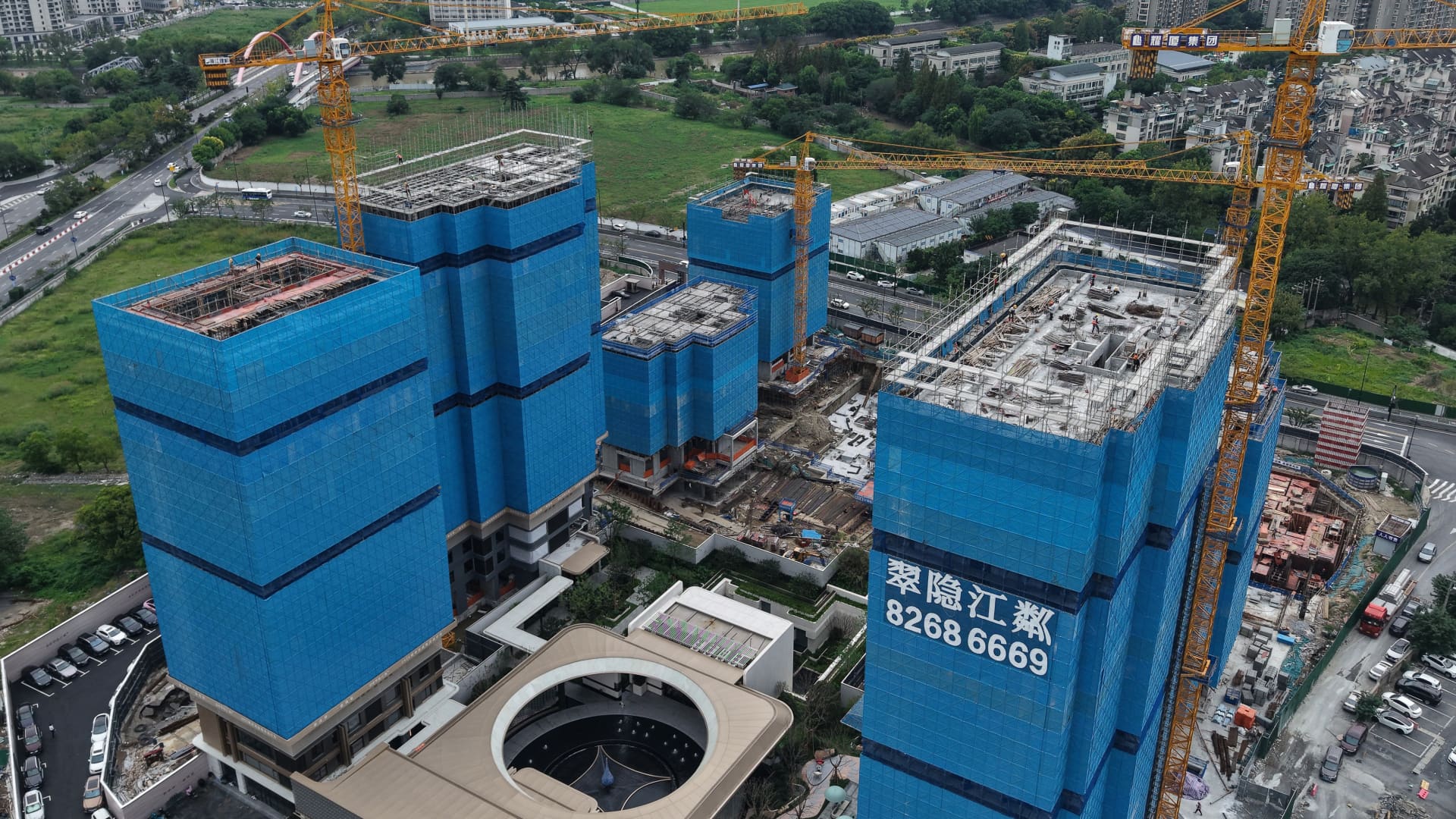
A new residential complex under construction in Hangzhou, Zhejiang Province, China on October 20, 2025.
Cfoto | Future Publishing | Getty Images
BEIJING — Chinese policymakers are unlikely to shore up the country’s struggling real estate sector, analysts told CNBC, even as the housing slump drags on economic growth.
The assessment comes as China’s top leaders, called the Central Committee, are due to wrap up a four-day meeting Thursday, which will outline priorities for the next five years.
In Beijing’s view, the property sector’s drag on growth has eased, while technological development is a more urgent priority in the current geopolitical landscape, said Ning Zhu, author of “China’s Guaranteed Bubble.” To him, that means Beijing is unlikely to enact significantly stronger real estate support.
After years of concern over property developers’ debt that led to Beijing’s crackdown, Chinese state media said earlier this month that “risks in key areas have been effectively prevented and mitigated,” according to a CNBC translation. The piece was part of a series of articles highlighting achievements over the past five years while highlighting Beijing’s push to promote opportunities in tech.
That underscores further divergence between Beijing’s view and that of most analysts.
“The government believes the property market is bottoming,” Zhu said. “I believe it is a gradual process and may take more time before reaching the bottom.”

Recent data underscores the divide between Beijing’s optimism and market reality. China’s Statistics Bureau on Monday said high-tech manufacturing grew by 9.6% in the first three quarters of the year compared to the same period in 2024, outpacing the 6.2% growth in overall industrial production.
However, real estate investment fell 13.9% in the first three quarters from a year earlier, extending the sector’s decline through September. The decline pushed fixed-asset investment into negative territory — the only such decline on record, excluding the Covid-19 pandemic.
That means that just over a year since Beijing called for a “halt” in the property sector’s decline, there are still few signs of a turnaround.
It’s “hard to say when” real estate will bottom, said Lulu Shi, a director at Fitch Ratings. “The overall population, demographics and the employment situation and housing market inventory, they are all worsening.”
China’s falling birth rate points to weaker housing demand in the future, while uncertainty about jobs and income growth weighs on homebuyer sentiment in the near term.
Falling home prices
The slide in property prices over roughly the last two years is also weighing on homebuyer sentiment, reversing decades of gains that once fueled heavy speculation in the property market.
The weighted average for new home prices in September fell 2.7% from the prior month on an annualized basis, according to a Goldman Sachs analysis of official data from China’s 70 largest cities published Monday. That was steeper than the 2.1% drop seen in August.
Prices of “secondary” homes, which have already been sold once, have plunged by a far steeper 5% to 20% over the past year, Goldman said, citing a mix of official and third-party figures.
Looking ahead, Beijing is unlikely to put much emphasis on property policy, whether in additional support or discouraging real estate speculation, said Bruce Pang, adjunct associate professor at CUHK Business School.
He noted that China’s multi-year plans, such as those for the next five years, tend to focus on new approaches for growth.

Subscribe now
Easing measures introduced in August, such as looser restrictions on multiple property purchases in major cities, have done little to lift sentiment. The policy changes mostly applied to the city outskirts rather than the most attractive downtown areas.
Citing that weaker-than-expected policy support, S&P Global Ratings earlier this month forecast property sales to fall 8% this year, worse than earlier estimates. They expect another drop of at least 6% next year as a market bottom remains elusive.
Moody’s Ratings also predicts China home sales to decline by single digits over the next 12 to 18 months.
This forecast is based on fading demand from buyers who had anticipated policy easing, said Daniel Zhou, an assistant vice president and analyst at Moody’s Ratings. He said the property market should gradually stabilize over the longer term under existing policy measures.
Broader economic impact
The real estate slump continues to weigh heavily on China’s economy, even as the sector’s role has shrunk from more than a quarter of output. As property sales have roughly halved in just a few years, manufacturing and exports have helped offset the decline.
“China’s economy has remained under the 2-speed mode, with consumption/property as the weak track and exports/manufacturing as the strong track,” Larry Hu, chief China economist at Macquarie, said in a note. “The pattern will continue until policymakers could no longer rely on external demand to drive growth.”
Chinese exports have remained unexpectedly strong so far this year, with 8.3% growth in September from a year ago, despite a 27% plunge in shipments of goods to the U.S.
For real estate, “it is very hard to see a trend of growth,” Shi said. “We believe there will be more policies, but it’s not likely that one policy can change the entire situation.”
Eventually, once the decline in home prices eases, she expects more buyers to gradually return to the housing market.





U.S.- Canada Trade Talks Collapse; Carney Says Retaliatory Tariffs Begin September 8

Flock Cameras and the Future of Public Security

AI Infrastructure Boom Hits Physical Limits: Power, Financing, and Supply Chain Strain

Armanino adds Strategic Accounting Outsourced Solutions

New 2023 K-1 instructions stir the CAMT pot for partnerships and corporations

Tax Strategy: Employee Retention Credit update
-

 Stock News1 week ago
Nvidia Earnings Preview: What Wall Street Expects From the AI Bellwether’s Q2 Report
-

 Accounting1 week ago
SEC’s Semiannual Reporting Proposal Faces Investor Pushback: What CFOs Need to Know
-

 Stock News1 week ago
Nvidia Q2 FY2027 Earnings beats Wall Street Expectation with Record $96.2 Billion Revenue
-

 Finance1 week ago
Treasury Bond Volatility Forces Bessent to Double Debt Buyback Size as Yields Swing
-
 Technology5 days ago
AI Infrastructure Boom Hits Physical Limits: Power, Financing, and Supply Chain Strain
-
 Technology3 days ago
Flock Cameras and the Future of Public Security
-
 Economics3 days ago
U.S.- Canada Trade Talks Collapse; Carney Says Retaliatory Tariffs Begin September 8