
Finance
Chinese AI applications are looking to move beyond chatbots

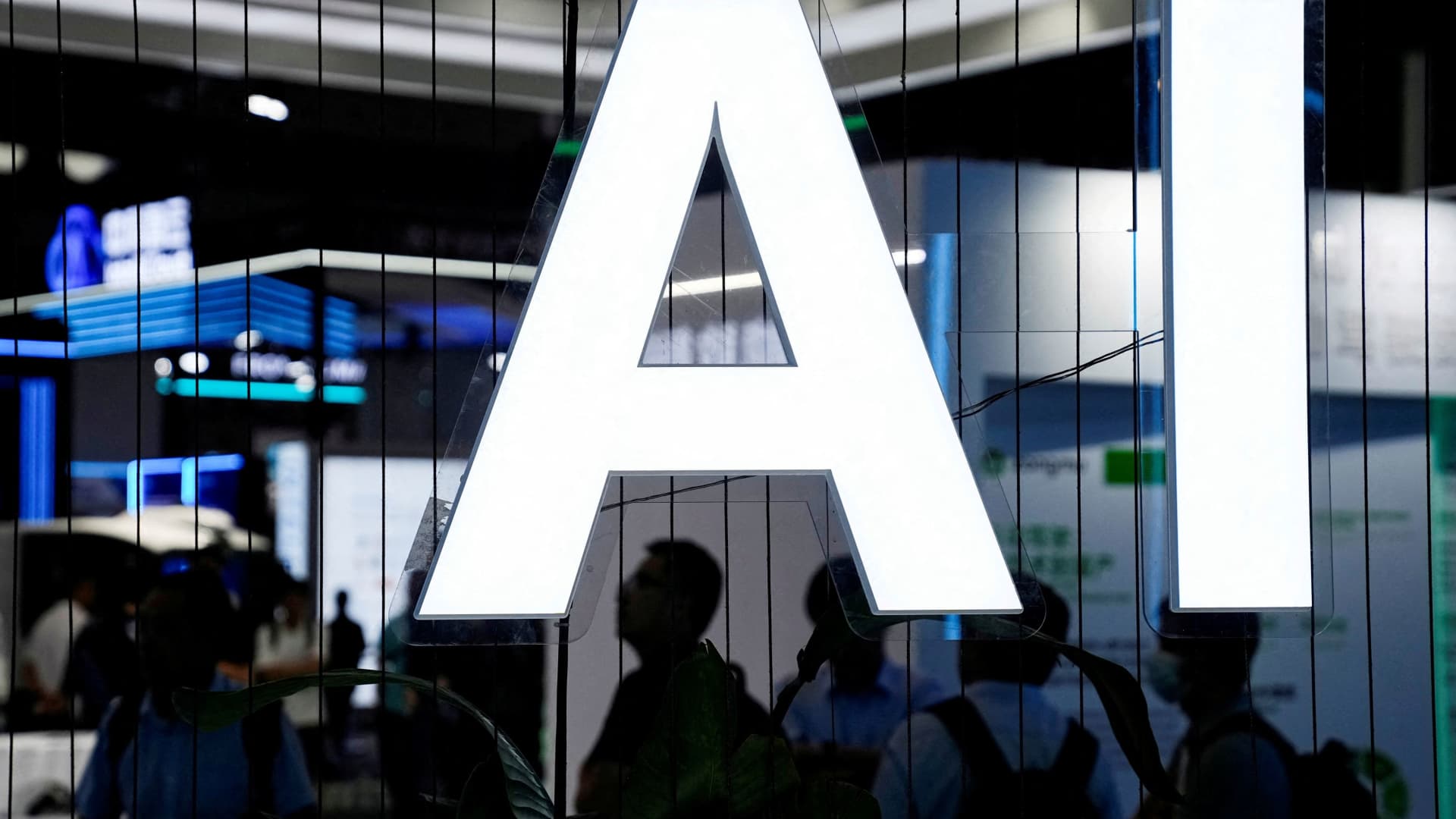
The World Artificial Intelligence Conference in Shanghai on July 6, 2023.
Aly Song | Reuters
BEIJING — A slew of releases last week demonstrate how Chinese companies such as DeepSeek and ByteDance have moved quickly with artificial intelligence models that compete with OpenAI’s ChatGPT.
Now, many companies in China are increasingly building on that foundation to develop products that look to go beyond a chatbot.
Baidu, best known for its search engine and Ernie chatbot, said Tuesday its generative AI-integrated Wenku platform for quickly creating powerpoints and other documents had reached 40 million paying users, with revenue up 60% from a year ago as of the end of last year. Updated features, such as using AI to generate a presentation based on a company’s financial filing, started being rolled out to users in the last week.
On the corporate side, Gartner data and analytics director analyst Ben Yan estimates more than 10% of businesses in China are using AI, up from 8% about six months ago. That would be a pickup in pace — the last 2 percentage point increase in adoption took more than a year, he said Wednesday.
“With our clients, we hear more and more success stories,” he said in Mandarin translated by CNBC. Yan noted that so-called AI agents will help speed up corporate implementation of the new tech.

AI models focus on specific functions such as search and generating summaries, whereas AI agents are more advanced — they can automate entire processes from searching to booking. One example is OpenAI’s new “Operator” function that claims to be able to make restaurant reservations on behalf of a ChatGPT user.
AI agents are also on the verge of coming to the Chinese market at scale.
Tencent plans to soon integrate AI agents with its messaging and social media app WeChat, CEO Pony Ma told staff in a Jan. 13 speech, according to a copy of the annual address seen by CNBC.
“We believe that China’s AI sector is advancing at a pace comparable to that of the United States,” Jo Huang, head of private equity at Raffles Family Office, said in an email. She said the firm is considering investing in a leading China AI deep tech fund in order to capture the local opportunity.
The development of Chinese AI applications creates features that are being integrated with domestic smartphones. Apple’s AI intelligence functions have yet to come to iPhone users in China.
“There is also a shift towards a growing user preference for local brands that can offer advanced AI features tailored to regional consumer preferences,” Wei Sun, principal artificial intelligence analyst at Counterpoint Research, said in an email Thursday.
She pointed out that Chinese smartphone companies such as Honor, Xiaomi and Vivo have been able to improve user experience of AI features, thanks to efforts to improve the efficiency of AI models that can run on the device without relying heavily on an internet-connected cloud service.
Compliance hurdles
The latest developments also reflect a difference in regulatory scrutiny with the U.S., and with the kind of technology being created.
Baidu’s ChatGPT-like Ernie bot didn’t get Beijing’s green light for a public rollout until August 2023, nearly one year after ChatGPT took the world by storm.
While AI models must get official certification for use in China, using them in applications is much easier, said Alex Lu, founder of Shanghai-based LSY consulting. On the side, he is working with a small team on an AI-powered tool for giving companies targeted daily insights on industry trends and global regulations, similar to the work of a human consultant.
Half a year after development began in June 2023, Lu said the team began testing a product for free with potential customers, including a manufacturer of car batteries. That has provided the feedback for a product the team hopes to charge 70,000 yuan to 100,000 yuan ($9,660 to $13,790) in annual license fees, Lu said.
But a bigger challenge can be getting companies to give AI access to proprietary data, or using AI-generated content commercially.
“I think [multinational corporations are] much more cautious than Chinese brands because of copyrights and legal issues,” Chris Reitermann, CEO of Ogilvy Asia-Pacific and Greater China, told CNBC late last year. He is also president of WPP China.
He said clients attempted to use AI for campaigns, only to run into compliance issues that prevented the projects from being launched. “Local brands, they may be a little less worried about these issues, more trial and error,” he said.
AI for global users
Some China-created AI applications are also being used overseas. Alibaba‘s international arm announced earlier this month that Accio, its AI-powered search engine for product sourcing, had reached 500,000 small business users.
Launched in November, Accio lets businesses use a few text or image prompts to find wholesale products — and provides them with analysis on their popularity with consumers and projected profit.
Accio cut the research time down from weeks to a day or so, said Mike McClary, who got early access to Accio and has sold camping lanterns and other products online for more than 10 years. McClary, CEO of amazing.com, claims e-commerce sales of more than $1 million a year and is based outside of St. Louis, Missouri.
He said Alibaba.com and Amazon, which he previously used, involved going through hundreds or thousands of results, and then individually negotiating with five to 10 suppliers before settling on one. The “next gamechanger,” McClary said, would be to use AI to put an image of a product into any scenario to create an advertisement.





Nvidia Q2 FY2027 Earnings beats Wall Street Expectation with Record $96.2 Billion Revenue

Treasury Bond Volatility Forces Bessent to Double Debt Buyback Size as Yields Swing

Nvidia Earnings Preview: What Wall Street Expects From the AI Bellwether’s Q2 Report

Armanino adds Strategic Accounting Outsourced Solutions

New 2023 K-1 instructions stir the CAMT pot for partnerships and corporations

Tax Strategy: Employee Retention Credit update
-
 Economics1 week ago
Nvidia’s Potential $3 Billion SB Energy Investment Could Reshape AI Infrastructure
-

 Economics4 days ago
Top 10 Largest Economies by 2030: IMF & World Bank GDP Projections for Global Powerhouses
-
 Stock News4 days ago
How to understand Intel $15B Stock Offering
-
 Technology1 week ago
U.S.-China AI Competition Intensifies as Washington Pushes Allies to Choose Sides
-
 Stock News1 day ago
Nvidia Earnings Preview: What Wall Street Expects From the AI Bellwether’s Q2 Report
-

 Economics4 days ago
Economic Profile of the United States of America (2026–2030 Horizon)
-

 Leaders3 days ago
Jackson Hole 2026: What the First Symposium Under Fed Chair Kevin Warsh Means for Markets
-
 Economics3 days ago
U.S. National Debt Surpasses $40 Trillion for the First Time: What It Means for the Economy