
Finance
Chinese smartphone maker Oppo in weekly AI talks with Google, Microsoft

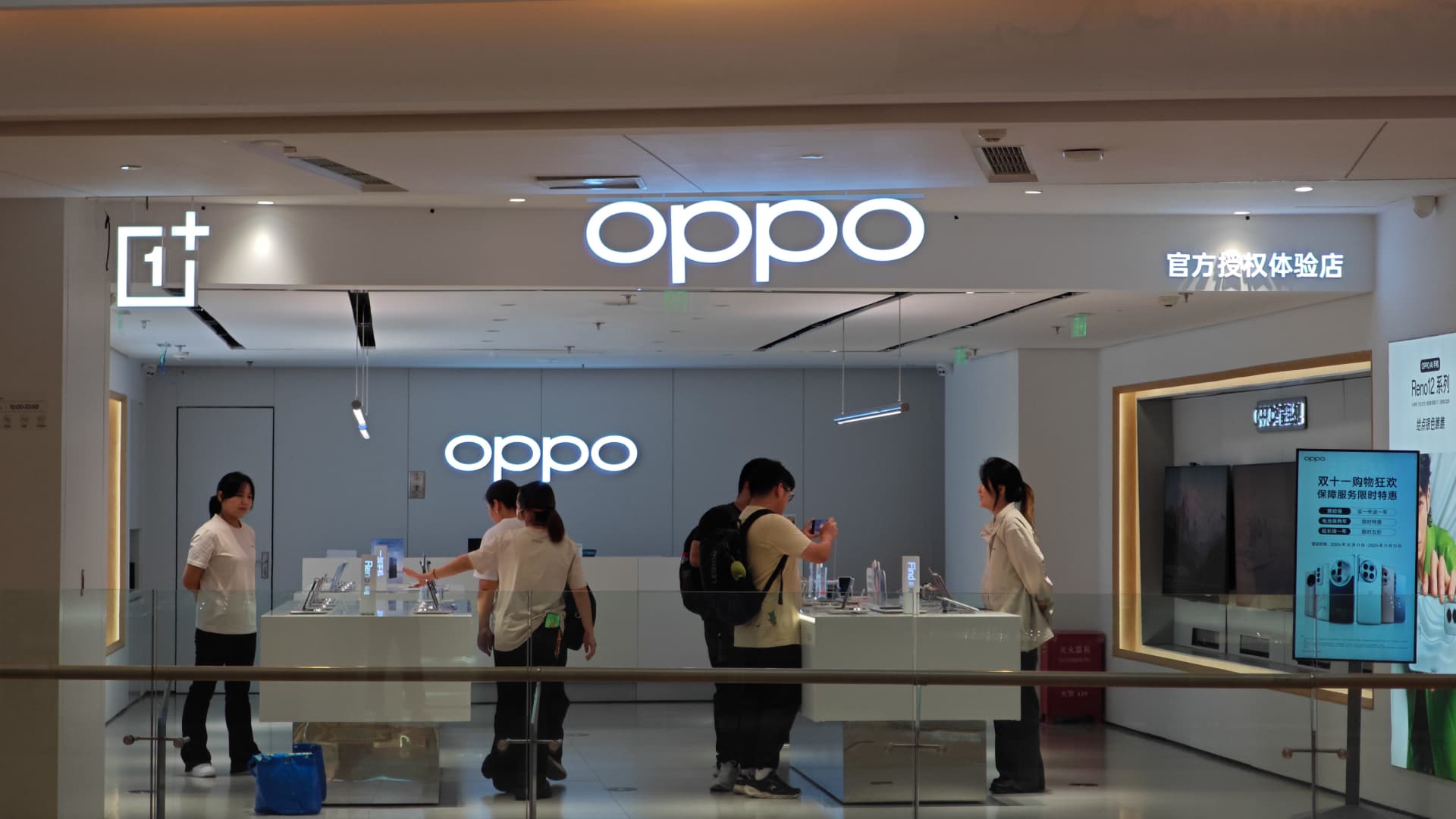
Chinese smartphone company Oppo ranks second in mainland China, and fourth worldwide, according to Canalys.
Nurphoto | Nurphoto | Getty Images
BEIJING — Chinese smartphone company Oppo is doubling down on artificial intelligence as it holds weekly talks about AI with senior management at Google and Microsoft in the run-up to the launch of its flagship phone overseas.
The collaborations are part of the race to find the next artificial intelligence application. The rise of generative AI — tech that can produce human-like responses when prompted — has companies from Apple to Honeywell rushing to tap its capabilities.
“Google will also come to China to ask us, what needs and pain points do you have with your products? Let’s solve them together,” Billy Zhang, president of Oppo’s overseas market, sales and services, told reporters last week at the company’s office in the southern Chinese city of Shenzhen. That’s according to a CNBC translation of his Mandarin-language remarks.
“We know consumers’ needs, and we will use AI to satisfy [them],” Zhang said. The company is expanding further in Europe, but does not have immediate plans for the U.S., he said.
Oppo, which owns the OnePlus brand too, said it derives around 60% of its revenue from Southeast Asia, Europe and other overseas markets. The company ranked fourth globally in terms of smartphone shipments in the third quarter, making up 9% of all units shipped, according to Canalys. Samsung and Apple were tied for the first spot, followed by Xiaomi.

While the U.S. leads in terms of AI capabilities, experts suggest Chinese companies will have an edge when it comes to consumer applications of the tech. That’s despite U.S. restrictions on exports of high-end chips to China.
Oppo has said its forthcoming flagship smartphone will be equipped with AI writing and recording summary tools from Google’s Gemini, and content generation features from Microsoft. Microsoft employs OpenAI products such as ChatGPT.
It was not immediately clear to what extent existing Oppo models use AI tools from the two tech companies. Oppo has yet to announce when its flagship phone will be available globally.
AI smartphones set for growth
Oppo in June announced it plans to integrate generative AI in 50 million of its devices this year. Its existing AI tools allow touching up photos — such as removing window reflections. Oppo also has a ChatGPT-like bot.
In addition to partnerships, Oppo said it has developed its own AI models since 2020 and opened an AI center in February.
“We are very optimistic about AI and have invested with great determination,” Zhang said. “AI is the most important area for tech in the future. All industries can be transformed by AI.”
Counterpoint Research predicts shipments of generative AI smartphones will skyrocket to 732 million in 2028 from 46 million last year, according to a whitepaper published Wednesday. The report did not specify how complex those generative AI features would be.
Apple next week is due to publicly release its first software update with AI tools. A subsequent update will allow removing unwanted elements in photos, and integration with ChatGPT, the iPhone maker said Wednesday.
Chinese smartphone company Honor on Wednesday revealed the next version of its operating system that can use AI to mimic actions on a touchscreen, such as opening an app to order coffee delivery.
Tech for production efficiency
Oppo plans to integrate AI into its factories, which are increasingly automated, Zhang said. “Today, automation improves quality and stability, lowers production costs and increases unit yield.”
At a production line for an entry-level smartphone in Dongguan, near Shenzhen, Oppo has this year replaced about 8% of the workers with machines, and moved those employees to work on more complex, higher-end phones.
Other companies have announced plans to integrate generative AI with the industrial sector. Honeywell this week announced a deal with Google’s Gemini to create AI assistants for factory workers and systems.
Oppo is rolling out its digital management system to its factories in seven other countries, starting with India and Indonesia. The company also produces phones in Turkey, Pakistan, Bangladesh, Brazil and Egypt.
“Since our manufacturing process is largely digitalized and standardized, growing and expanding to global markets is much easier,” Danny Du, director of manufacturing management at Oppo told CNBC.
Oppo has cut its manufacturing costs by nearly 40% over three years, Du said, adding that technological integration with factory machines and systems has cut production time to six days, from 16. He said that allows Oppo to respond more quickly to market orders, instead of relying on longer-term forecasts that come with the risk of unsold inventory.
— CNBC’s Kif Leswing and Eric Rosenbaum contributed to this report.





Treasury Bond Volatility Forces Bessent to Double Debt Buyback Size as Yields Swing

Nvidia Earnings Preview: What Wall Street Expects From the AI Bellwether’s Q2 Report

SEC’s Semiannual Reporting Proposal Faces Investor Pushback: What CFOs Need to Know

Armanino adds Strategic Accounting Outsourced Solutions

New 2023 K-1 instructions stir the CAMT pot for partnerships and corporations

Tax Strategy: Employee Retention Credit update
-

 Economics1 week ago
U.S. Retail Sales Fall for the First Time in Nine Months as Consumer Spending Slows
-
 Economics1 week ago
Nvidia’s Potential $3 Billion SB Energy Investment Could Reshape AI Infrastructure
-

 Economics4 days ago
Top 10 Largest Economies by 2030: IMF & World Bank GDP Projections for Global Powerhouses
-
 Stock News4 days ago
How to understand Intel $15B Stock Offering
-
 Technology1 week ago
U.S.-China AI Competition Intensifies as Washington Pushes Allies to Choose Sides
-

 Economics4 days ago
Economic Profile of the United States of America (2026–2030 Horizon)
-

 Leaders3 days ago
Jackson Hole 2026: What the First Symposium Under Fed Chair Kevin Warsh Means for Markets
-
 Economics3 days ago
U.S. National Debt Surpasses $40 Trillion for the First Time: What It Means for the Economy