Connect with us

Personal Finance

Climate change may cost Americans born in 2024 nearly $500,000 in lifetime

Published

on

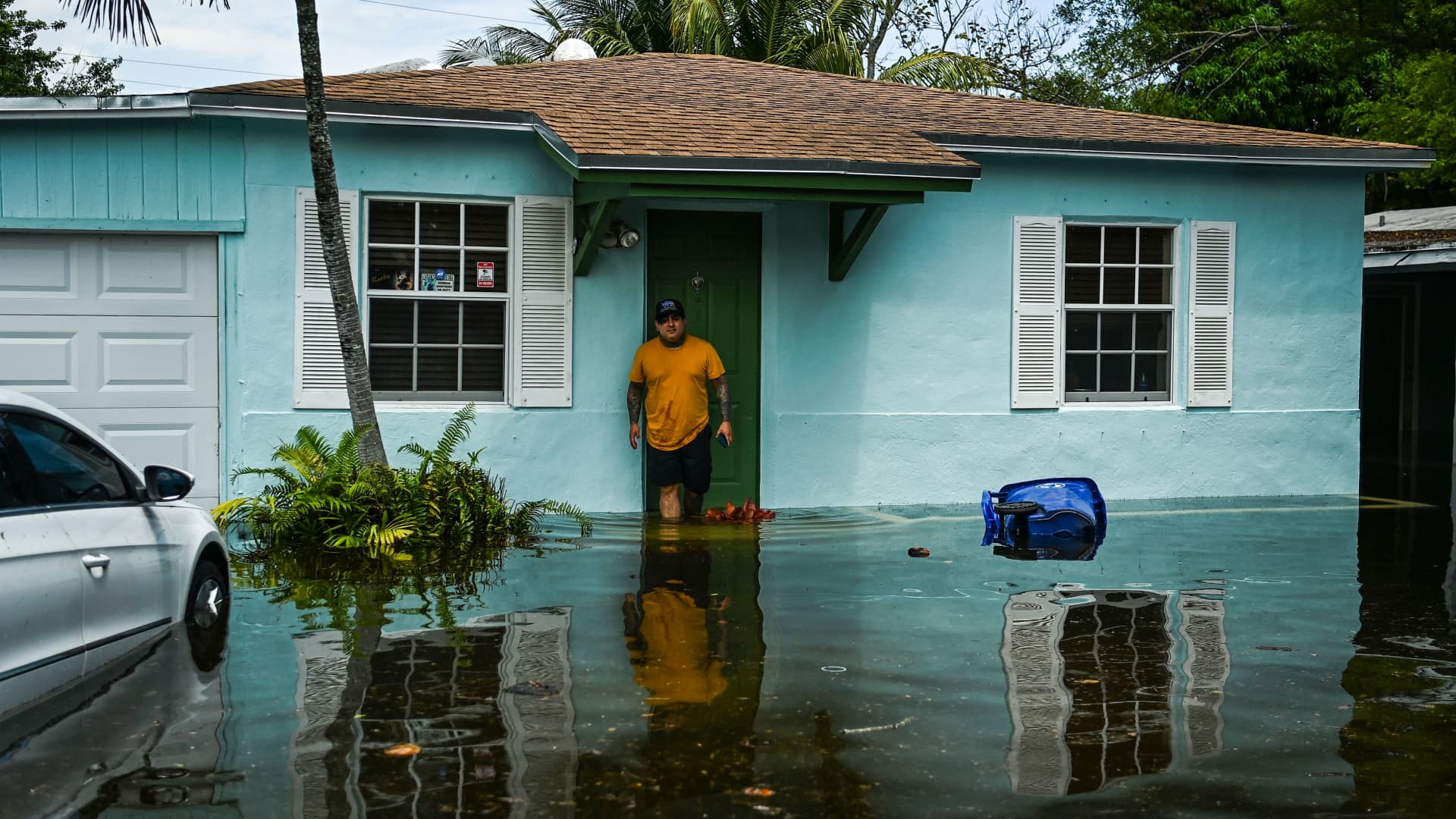
A man stands outside his flooded home after heavy rain in Fort Lauderdale, Florida, on April 13, 2023.

Chandan Khanna | AFP | Getty Images

The warming planet is already proving expensive.

U.S. weather and climate disasters cost more than $617 billion between 2018 and 2022 — a record figure, according to the U.S. Department of the Treasury. The October report found that around 13% of Americans reported economic hardship over the prior year due to climate change.

More people are likely to experience financial pain as temperatures climb and extreme weather events become more common, experts say.

With each additional degree of warming, the U.S. is expected to take a bigger economic hit, the Fifth National Climate Assessment warns. For example, an increase in global temperatures by 2°F is anticipated to double the financial impact induced by 1°F of warming.

Climate change could cost Americans born in 2024 nearly $500,000, due to higher taxes and pricier housing and food, among many other factors, ICF, a consulting firm, recently found in a report commissioned by Consumer Reports.

“The basic building blocks of our financial lives — housing, insurance, social welfare programs, taxes — will become more expensive or less valuable due to climate change, with lots of consequences for people’s wallets,” said Andrew Rumbach, a senior fellow at the Urban Institute.

‘Climateflation’ is already affecting prices

‘Household wealth is tied to housing’ — and that’s risky

A destroyed house following Hurricane Ian in Fort Myers Beach, Florida, US, on Tuesday, Oct. 4, 2022. 

Eva Marie Uzcategui | Bloomberg | Getty Images

Some of the biggest financial risks of climate change come into play with housing, Wagner said.

“Most household wealth is tied to housing, which [is] directly affected by everything from floods to droughts to wildfires,” he said.

At least 3 million Americans already report being displaced by a disaster, one survey by the U.S. Census Bureau found.

“That is tremendously costly for people and businesses,” Urban Institute’s Rumbach said.

Insurance companies are raising their monthly premiums on homeowner policies and rolling back coverage in areas prone to certain disasters to “adjust to climate risk,” he said.

“Florida, Louisiana and California are all facing severe challenges, and I expect these issues will spread to other states in the years ahead,” Rumbach said.

Globally, natural catastrophes cost insurers $108 billion in 2023, which is well above the annual average over the past 10 years of $89 billion, according to Swiss Re Institute. The institute estimates these losses could double within the next decade, as temperatures rise and storms intensify.

These costs are likely to be passed on to consumers, Rumbach said.

Currently, only around 40% of the expenses from natural catastrophes are covered by insurers, meaning the rest falls on governments and individuals, Swiss Re Institute found.

‘Clear interactions’ between climate and health

The warming planet could result in larger medical bills for many Americans.

Health-care costs due to fossil fuel pollution and climate change already exceed $800 billion a year in the U.S., a report by the Natural Resources Defense Council found.

Some of these expenses are a direct result of individual, dangerous disasters.

For example, Hurricane Sandy, which pounded the mid-Atlantic region in 2012, led to more than 12,000 hospital admissions, emergency room visits and outpatient encounters.

Damage is seen in the Breezy Point area of Queens in New York on October 30, 2012 after fire destroyed about 80 homes as a result of Hurricane Sandy which hit the area on October 29.

Stan Honda | AFP | Getty Images

Other health effects of climate change reflect more widespread shifts in global conditions.

“There are clear interactions between heat waves and health conditions,” said Charles Driscoll, a professor at Syracuse University who studies climate change. “For example, heat waves exacerbate cardiovascular events.”

Air pollution, for its part, is associated with respiratory diseases, cancer and nervous system disorders, Driscoll added.

Knock-on effects for taxes, wages, retirement savings

Federal, local and state governments will likely raise taxes as they deal with the higher costs of a hotter planet and more demand for their services.

At the same time, workers may see their wages shrink as businesses and communities are disrupted by storms and heat waves. Within seven years, up to 3.8% of total working hours around the world could be lost due to higher temperatures, according to the International Labour Organization. That amounts to roughly 136 million full-time jobs.

More than 65 million adult workers in the U.S. are in occupations endangered by climate-related health risks, KFF, formerly the Kaiser Family Foundation, estimated in a July 2023 analysis. These include fields with increased exposure to heat and decreased air quality, including construction and agricultural jobs.

ICF, the consulting firm, warns that global warming could put people’s retirement savings in jeopardy, too.

“Climate change is expected to decrease retirement income by impacting the value of corporate stocks held in retirement portfolios through higher costs to companies, declines in corporate productivity, damages to physical assets and supply chains, reduced resource availability and new costs associated with transitioning to low-carbon solutions,” it wrote.

A new economy in a hotter planet

The Woolsy fire burns a home near Malibu Lake in Malibu, Calif., Friday, Nov. 9, 2018. 

Ringo H.W. Chiu | AP

The workforce and education system are changing in anticipation of a hotter planet.

People are switching careers to leave fields threatened by global warming, such as gas and coal, while a small number of colleges are offering a new major: climate change studies.

Schools that offer such majors “are reporting a big increase” in demand, said higher education expert Mark Kantrowitz.

Meanwhile, the number of jobs in climate science is expected to grow by 6% between 2022 and 2032, compared to an average 3% for all occupations, the Bureau of Labor Statistics found.

“Slowing down and stopping climate change is a challenge, but also an opportunity for tremendous innovation and economic growth,” Urban Institute’s Rumbach said.

Climate change leads to droughts, which lead to crop failures, which cause food price spikes.

Gernot Wagner

a climate economist at Columbia Business School

In this new series, CNBC will examine what climate change means for your money, from retirement savings to insurance costs to career outlook.

We start with a story by reporter Greg Iacurci on how people continue to build in and move to Miami, despite the city being, in the words of one expert, “ground zero” for global warming. This dynamic is playing out across the country, and could worsen the financial pain ahead.

Has climate change left you with bigger or new bills? Tell us about your experience by emailing me at [email protected].

Continue Reading

Personal Finance

Maximizing Returns in High Rate Climate and market uncertainty

Published

on

Maximizing Returns in High-Rate Climate

In the macroeconomic environment of late July 2026, personal cash management requires an active, structured approach to wealth preservation. With central bank benchmark rates remaining elevated to ensure long-term disinflation, conservative yield-bearing vehicles—such as short-term U.S. Treasury bills, money market funds, and high-yield savings accounts (HYSAs)—continue to offer reliable nominal returns between 4% and 5%. For individual investors, maximizing net returns requires moving beyond passive checking accounts and executing a disciplined cash laddering strategy.

Leaving substantial liquid capital in traditional bank deposits creates an invisible drag on personal net worth due to ongoing inflation. By implementing a tiered liquidity framework, individuals can split emergency cash reserves and short-term capital allocations across rolling maturities. Allocating cash into 4-week, 8-week, and 13-week Treasury bills creates a continuous cycle of maturing liquidity, allowing investors to continuously reinvest capital at prevailing market yields while maintaining immediate access to emergency funds.

Tax efficiency represents a critical dimension of high-yield cash optimization. For high-earning individuals residing in states with substantial local income taxes, direct holdings in short-term U.S. Treasury instruments often deliver superior net post-tax yields compared to standard commercial bank HYSAs. Because interest earned on federal Treasury bills is strictly exempt from state and local taxation, investors can retain a larger portion of their compounding interest gains without taking on additional credit or market risk.

Ultimately, personal wealth accumulation in mid-2026 relies on intentional capital deployment. Cash should be managed as a productive asset class that generates consistent, risk-free returns. Regularly auditing account yield terms, automating recurring transfers, and leveraging tax-advantaged fixed-income instruments ensures that personal liquidity remains fully optimized against macroeconomic fluctuations.

Continue Reading

Personal Finance

Algorithmic Wealth Management: Balancing Automated Financial Planning with Human Oversight

Published

on

Balancing Automated Financial Planning with Human Oversight

The personal finance industry in July 2026 is experiencing a technological evolution, driven by the wide deployment of next-generation algorithmic wealth management tools. Modern digital financial platforms have expanded far beyond basic automated index investing; today’s robo-advisors utilize real-time tax-loss harvesting, dynamic portfolio rebalancing, and hyper-personalized spending analysis to optimize retail investor outcomes. However, as these digital solutions become ubiquitous, investors face the crucial challenge of balancing automated execution with human strategic judgment.

The core advantage of automated financial planning platforms lies in their ability to remove emotional bias from investment execution. During periods of market volatility or localized sector realignments, automated algorithms systematically rebalance portfolios back to target asset allocations without falling victim to panic selling or speculative enthusiasm. Furthermore, integrated cash-flow monitoring algorithms analyze individual spending patterns in real time, automatically sweeping surplus income into designated retirement or debt-liquidation accounts to accelerate net worth accumulation.

Despite these operational advantages, algorithmic tools have inherent structural limitations when addressing complex, highly personalized financial life events. Decisions involving multi-generational estate planning, highly complex tax strategies, small business exits, or nuanced real estate transactions require contextual human judgment that software models cannot replicate. Relying solely on automated models without periodic human professional review can result in misaligned risk profiles or overlooked tax liabilities during major life transitions.

The optimal approach for personal financial planning in late 2026 is a hybrid advisory model. Individuals should utilize automated platforms for routine asset allocation, continuous tax optimization, and low-cost passive index tracking, while engaging qualified human financial advisors for periodic strategic planning, estate structuring, and qualitative risk evaluations. This dual approach ensures maximum cost efficiency and disciplined execution while retaining essential strategic guidance.

Continue Reading

Personal Finance

High-Yield Optimization: Structuring Personal Cash Reserves in a Sustained Rate Environment

Published

on

Structuring Personal Cash Reserves in a Sustained Rate Environment

In the financial environment of mid-2026, personal cash management has re-emerged as a vital component of holistic wealth building. With central bank policy rates holding firm to maintain long-term price stability, yield-bearing instruments such as money market funds, high-yield savings accounts (HYSAs), and short-term Treasury bills continue to offer compounding returns around 4% to 5%. For individual investors, effectively structuring cash reserves requires shifting away from passive bank deposits toward active yield optimization.

A frequent pitfall in personal asset management is leaving substantial liquid capital in traditional checking or low-yield savings accounts, where real returns are continuously eroded by baseline inflation. By implementing a disciplined ‘cash ladder’ strategy—allocating liquid funds across tiered maturities using ultra-short Treasury instruments and FDIC-insured high-yield accounts—individuals can secure maximal yields while retaining immediate liquidity for emergency expenses or tactical investment opportunities.

Simultaneously, investors must evaluate the tax efficiency of their cash holdings based on their tax bracket and geographic location. For high earners situated in states with high local income taxes, direct holdings in short-term U.S. Treasury bills often yield a higher net post-tax return than standard high-yield savings accounts, as Treasury interest is strictly exempt from state and local taxation. Understanding these nuanced tax distinctions allows individuals to capture significant incremental gains without taking on additional market risk.

Ultimately, personal financial health in late 2026 hinges on intentional liquidity management. Cash reserves should not be viewed merely as static emergency funds, but as a dynamic asset class that contributes positively to net worth growth. Regularly auditing yield terms, automating cash transfers, and optimizing for post-tax efficiency ensures that personal capital remains fully productive across all economic conditions.

Continue Reading

Trending