
Personal Finance
College closures could jump amid financial challenges: Fed research

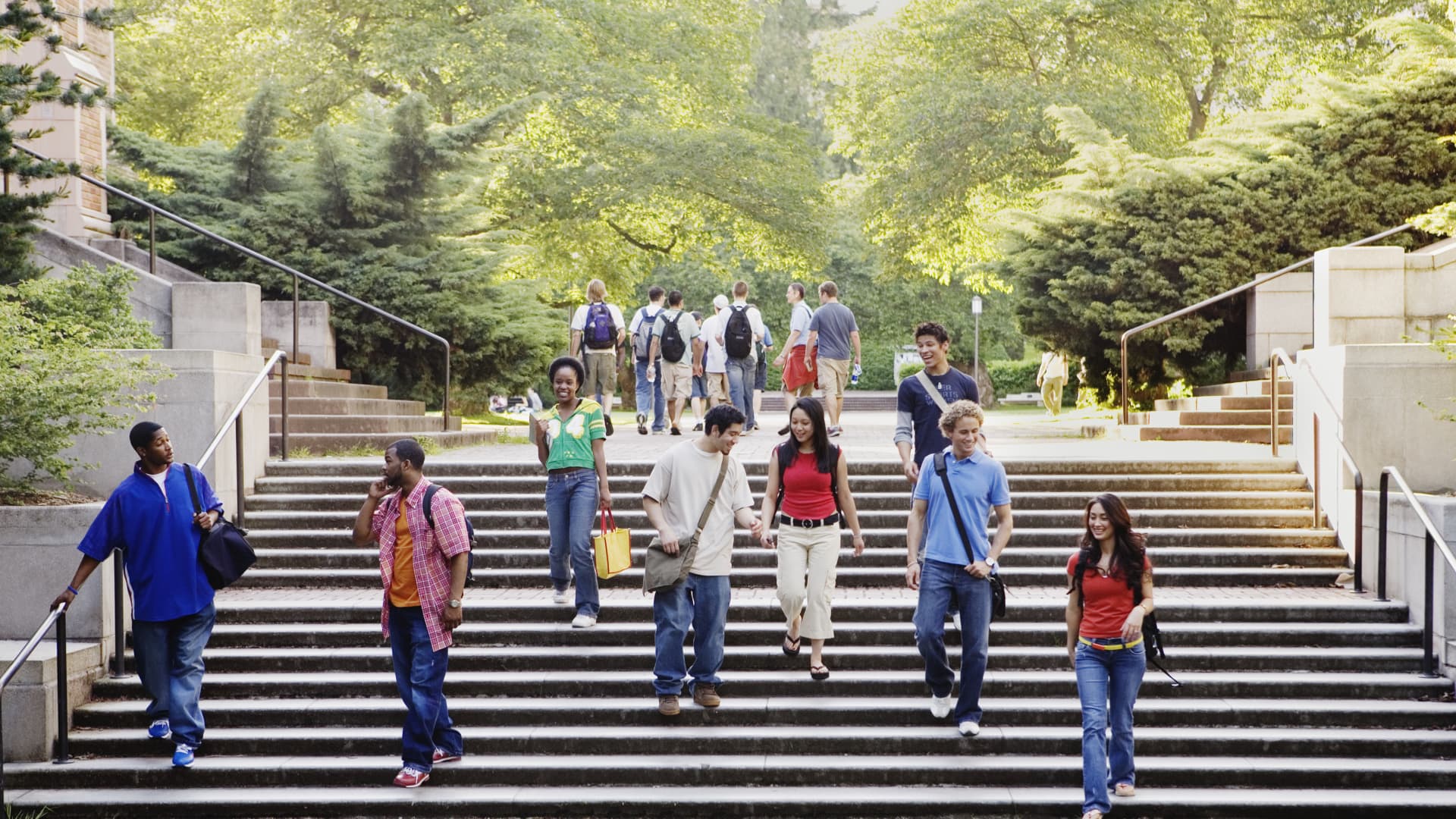
Andersen Ross Photography Inc | Digitalvision | Getty Images
Most people believe in the value of college and, for the most part, institutions of higher education have been able to weather significant financial challenges throughout history.
But now, the number of colleges set to close in the next five years is expected to spike, a new study found.
Higher education, as a whole, is “facing serious financial headwinds, both due to long-term trends and to the post-pandemic recovery,” according to a working paper by the Federal Reserve Bank of Philadelphia.
“Colleges and universities are facing unprecedented fiscal challenges in today’s economic climate,” the Fed researchers wrote.
More from Personal Finance:
The 2025-26 FAFSA is open ahead of schedule
These are the top 10 highest-paying college majors
More of the nation’s top colleges roll out no-loan policies
At least 20 colleges closed in 2024, and another nine schools announced they will close in 2025, according to the latest tally by Implan, an economic software and analysis company.
In the worst-case scenario, as many as 80 additional colleges would shut from 2025 to 2029, the Fed analysis found.
College enrollment is down
Not only are fewer high schoolers enrolling in college immediately after graduation but the overall population of college-age students is also shrinking, a trend experts refer to as the “enrollment cliff.”
“One key challenge is declines in enrollment, as the number of students enrolled in degree-granting colleges and universities fell by 15% from 2010 to 2021,” the Fed researchers said.
These days, only about 62% of high school seniors in the U.S. immediately go on to college, down from 68% in 2010, government data shows. Those that opt out are often low-income students, who increasingly feel priced out of a postsecondary education.
As the sticker price at some private colleges nears six figures a year, students have increasingly sought alternatives to a four-year degree, such as joining the workforce or completing certificate programs or apprenticeships.
Ballooning costs have played a large role in a changing mindset, according to Candi Clouse, a vice president at Implan.
“They don’t want to have the student loan debt,” she said.
Experts had also warned that problems with the rollout of last year’s Free Application for Federal Student Aid form would result in fewer students applying for financial aid, which could contribute to declining enrollment.
A wave of colleges in financial crisis
Growing competition for fewer students, higher operating costs and state-imposed restrictions on tuition increases for public colleges have limited institutions’ ability to increase tuition revenue, the Fed report found.
That has left some colleges and universities in a severe financial distress, according Implan’s Clouse.
“We see the decline in national birthrates, rising cost of education and rising cost of operations,” she said. “We see colleges being right-sized.”
At a local level, these closures can be devastating, Clouse added.
“When a school closes, many people are left scrambling,” she said.
On average, each college or university that shuts down affects 265 jobs and $14 million in labor income, according to Implan’s calculations.
“It can be huge for these small cities when they are reliant on an institution that has likely been there for generations,” Clouse said.
During the pandemic, federal funding provided a temporary stopgap for cash-strapped colleges. In the years since, there has been a wave of schools declaring “financial exigency,” according to the Fed.
To stay afloat, some colleges have cut faculty and slashed areas of academic study, including programs in sociology, creative writing, music and religion.
Not all schools are struggling, however. In fact, the country’s most elite institutions are faring better than ever.
College applications are up
Overall, total application volume through Nov. 1 rose 10% for the 2024-25 application season, compared to a year earlier, according to the latest data from the Common Application, although a growing share of applicants only applied to public schools.
Private college is becoming a path for only those with the means to pay for it, other reports show.
Children from families in the top 1% are more than twice as likely to attend highly selective private colleges, according to the National Bureau of Economic Research, which continues to “amplify the persistence of privilege across generations,” the report found.
Meanwhile costs are still rising, tuition and fees plus room and board for a four-year private college averaged $58,600 in the 2024-25 school year, up from $56,390 a year earlier. At four-year, in-state public colleges, it was $24,920, up from $24,080, according to the College Board, which tracks trends in college pricing and student aid.


Personal Finance
Next-Generation Retirement Planning: Managing Longevity Risk and Variable Income Streams


U.S.- Canada Trade Talks Collapse; Carney Says Retaliatory Tariffs Begin September 8

Flock Cameras and the Future of Public Security

AI Infrastructure Boom Hits Physical Limits: Power, Financing, and Supply Chain Strain

Armanino adds Strategic Accounting Outsourced Solutions

New 2023 K-1 instructions stir the CAMT pot for partnerships and corporations

Tax Strategy: Employee Retention Credit update
-

 Stock News1 week ago
Nvidia Q2 FY2027 Earnings beats Wall Street Expectation with Record $96.2 Billion Revenue
-
 Technology5 days ago
AI Infrastructure Boom Hits Physical Limits: Power, Financing, and Supply Chain Strain
-
 Technology3 days ago
Flock Cameras and the Future of Public Security
-
 Economics3 days ago
U.S.- Canada Trade Talks Collapse; Carney Says Retaliatory Tariffs Begin September 8