
Finance
Deeproute claims ‘deep cooperation’ with Nvidia on driver assist

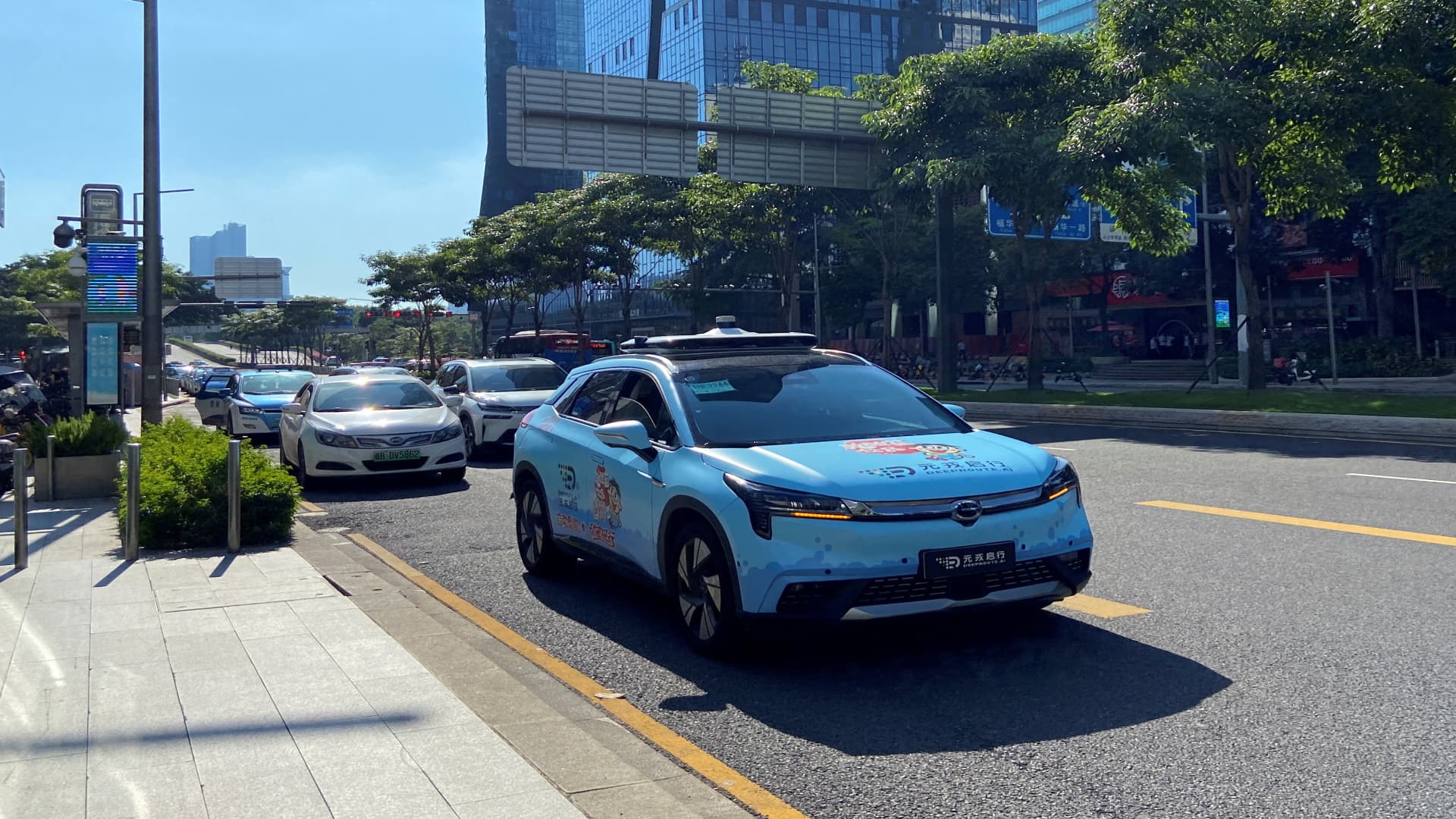
A car with autonomous driving system by Alibaba-backed DeepRoute.ai, drives on a street in Shenzhen, Guangdong province, China July 27, 2022.
David Kirton | Reuters
BEIJING — Deeproute.ai, a Chinese startup developing autonomous driving systems, announced a $100 million funding round Tuesday from an undisclosed automaker, while emphasizing close ties with chipmaker Nvidia.
Pitchbook data showed Chinese company Great Wall Motor led the investment.
It’s been difficult to obtain financing, especially from a non-government source, Maxwell Zhou, CEO of DeepRoute.ai, told reporters Tuesday in Mandarin, translated by CNBC.
The startup is also in “deep cooperation” with Nvidia, Zhou said, noting “in-depth discussions” with the chipmaker’s CEO Jensen Huang.
Zhou spoke on “Commercializing mass-produced autonomous driving solutions” at Nvidia’s closely watched GTC AI conference in March.

Shenzhen-based Deeproute said it uses Nvidia’s Orin chip for its current driver-assist system.
The startup added it is part of the first batch of companies in China to obtain Nvidia’s newer Thor chip for cars and will release a new system using it next year that can use more visual cues to manage more complex driving scenarios.
“Lots of companies in China are competing on autonomous driving. It is actually a competition over AI,” Zhou said.
In terms of AI computing power, Deeproute said it has its own capacity, and can tap Alibaba‘s if needed. The e-commerce and cloud computing company led a $300 million investment round in Deeproute in 2021, giving it a valuation of more than $1 billion just two years after it was founded in 2019, according to the startup.
The U.S. in October 2022 imposed sweeping restrictions on China’s ability to access the most advanced semiconductors from Nvidia and other American companies. Automotive chips don’t currently fall in that category.
Nvidia is scheduled to release earnings for the quarter ended Oct. 27 on Nov. 20. For the quarter ended July 28, the chipmaker said its automotive segment saw revenue rise by 37% year-on-year to $345 million.
Eyes on Japan
Deeproute currently works with Chinese automakers selling in China. The company expects at least three car models using its driver-assist system will hit the road this year.
Already, Deeproute’s systems are running in more than 20,000 cars on the road, Zhou said. He expects that number to increase, potentially by ten-fold, next year.
The startup, which has an office in California, said it is looking to work with foreign automakers and plans to participate in Japan’s auto show next year.
Tesla competition
Deeproute has focused on using artificial intelligence to automatically drive cars, without relying on “high-definition maps.” That allows a vehicle to use driver assist tech on roads where those technical parameters haven’t been created.
It’s a trend car tech companies such as Xpeng and Huawei are pursuing — and Tesla‘s strategy for developing autonomous driving. Elon Musk’s car company has focused on using cameras and artificial intelligence to steer the vehicle, without heavy reliance on HD maps.
Those maps, used by autonomous driving companies such as Alphabet‘s Waymo, give a car a detailed picture of city streets. But they need to be created before a car runs on the road, a process that can drive up costs.
Zhou said the company is very eager for Tesla’s driver-assist product — called “Full Self-Driving” — to enter China. His reasoning is that Tesla’s product will encourage more consumers to become more interested in driver-assist features — and boost Deeproute’s prominence in the sector.
When asked about IPO plans, Zhou said the startup would keep to its own development pace, but it welcomed the latest public offerings of other industry players.
Chinese autonomous driving software developer WeRide went public on the Nasdaq last month, while robotaxi operator Pony.ai has filed for a U.S. IPO.
Industry focus on driver-assist
Companies in China’s autos industry are increasingly looking at driver-assist tech as a way to stay competitive in the market.
Pony.ai announced Saturday an agreement to cooperate on mass-development of fully autonomous robotaxis with state-owned Beijing Automotive Group’s new energy vehicle subsidiary.
Tencent on Monday announced it extended its strategic cooperation with German autos supplier Bosch to work on autonomous driving and tech-enabled cockpits. The two companies first agreed to strategic cooperation in 2020.
Clarification: This story has been updated to reflect that Deeproute was part of the first batch of companies in China to obtain Nvidia’s new Thor chip for cars.





Treasury Bond Volatility Forces Bessent to Double Debt Buyback Size as Yields Swing

Nvidia Earnings Preview: What Wall Street Expects From the AI Bellwether’s Q2 Report

SEC’s Semiannual Reporting Proposal Faces Investor Pushback: What CFOs Need to Know

Armanino adds Strategic Accounting Outsourced Solutions

New 2023 K-1 instructions stir the CAMT pot for partnerships and corporations

Tax Strategy: Employee Retention Credit update
-

 Economics1 week ago
U.S. Retail Sales Fall for the First Time in Nine Months as Consumer Spending Slows
-
 Economics1 week ago
Nvidia’s Potential $3 Billion SB Energy Investment Could Reshape AI Infrastructure
-

 Economics4 days ago
Top 10 Largest Economies by 2030: IMF & World Bank GDP Projections for Global Powerhouses
-
 Stock News4 days ago
How to understand Intel $15B Stock Offering
-
 Technology1 week ago
U.S.-China AI Competition Intensifies as Washington Pushes Allies to Choose Sides
-

 Economics4 days ago
Economic Profile of the United States of America (2026–2030 Horizon)
-

 Leaders3 days ago
Jackson Hole 2026: What the First Symposium Under Fed Chair Kevin Warsh Means for Markets
-
 Stock News20 hours ago
Nvidia Earnings Preview: What Wall Street Expects From the AI Bellwether’s Q2 Report