Connect with us

Finance

Democrat senators question what Elon Musk plans to do with CFPB data

Published

on

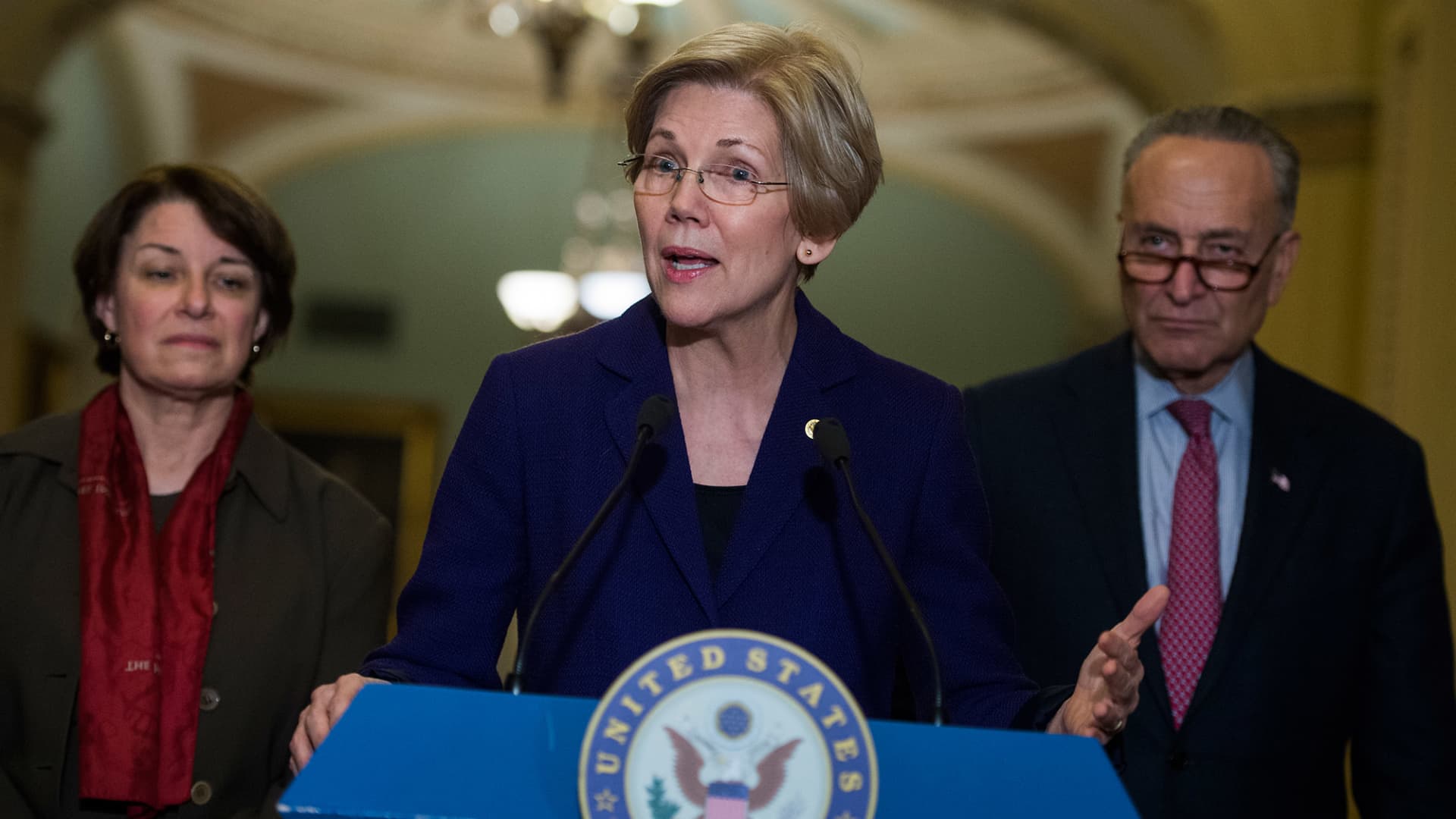
Sens. Elizabeth Warren, D-Mass., center, Amy Klobuchar, D-Minn., and Senate Minority Leader Charles Schumer, D-N.Y., conduct a news conference after the Senate Policy luncheons in the Capitol, March 14, 2017.

Tom Williams | CQ Roll Call | Getty Images

Democrat lawmakers led by Massachusetts Sen. Elizabeth Warren on Tuesday held a forum pushing back against the moves that the Trump administration and Elon Musk have taken to neutralize the Consumer Financial Protection Bureau.

Guests at the event included a retired military veteran helped by the agency, a mortgage broker who said the CFPB has helped curb industry abuses, and the bureau’s former head for supervision.

But the focus of the senators’ attention was Elon Musk, the driving force behind the so-called Department of Government Efficiency. While Musk was invited to the Washington, D.C, event, according to Warren, he didn’t make an appearance.

The lawmakers questioned whether Musk was conflicted in his efforts to dismantle the CFPB, highlighting his recent plan to launch a digital payments service within X, the social media network he owns.

“By seizing control of the agency, Musk can now root through all of the CFPB’s confidential data that DOGE has accessed on these potential competitors,” Warren said. “As Musk launches his new app, he faces oversight from the CFPB. His plan seems to be to eliminate the watchdog.”

A representative for Musk and X didn’t immediately respond to request for comment.

Earlier this month, operatives from DOGE gained access to CFPB systems, shortly before the bureau’s new leadership shuttered the agency’s headquarters, froze nearly all activities and laid off roughly 200 employees. A CFPB union has alleged in a lawsuit that acting CFPB Director Russell Vought intends to fire more than 95% of the agency’s staff.

“Elon, how do you justify shutting down the agency that’s going to be looking at your peer-to-peer payment plan?” Sen. Amy Klobuchar, D.-Minn., asked rhetorically during the hearing Tuesday. “How do you justify shutting down the agency that has jurisdiction and oversight over many of the other financial issues that you are going to make money from doing?”

‘Secret sauce’

Responding to a question from Sen. Chris Van Hollen, D.-Md., about what Musk could do with CFPB data, Lorelei Salas, the former CFPB supervision director, said the regulator kept “very sensitive trade secret information,” including from payments services PayPal, CashApp and Zelle, as well as online lenders.

“We’ve been looking at a number of digital wallet companies, payments companies, and we have information… on the technologies that they’re using,” Salas said. “We have information on the secret sauce of the credit models that people used with artificial intelligence to make decisions about whether you get a loan or not.”

Late last year, the CFPB took steps to supervise tech giants and payments firms that dominate the market, including Apple and PayPal, and sued the operator of the Zelle payments network and the three biggest U.S. banks using it for allegedly failing to properly investigate fraud complaints.

Besides confidential data on companies examined by the CFPB, the agency has “very sensitive data” from consumers filing complaints, Salas added. Consumers often leave account numbers and other personal data in their complaints, agency sources have said.

Now, with the CFPB and its employees in a state of limbo, the question is how far Musk and Vought can take their campaign to minimize the watchdog. A federal judge has halted their efforts, saying that they cannot fire employees or purge bureau data for the time being.

“The CFPB has been sidelined, but it is not dead,” Warren said, asserting that only Congress can shut down the bureau. “Advocates are in court right now asking judges to enforce the law, and I am confident they are going to win.”

Continue Reading

Finance

Treasury Yields Rise as Fed Cut Expectations Shift

Published

on

Treasury Yields Rise as Fed Cut Expectations Shift

Fixed-income markets recorded significant re-pricing during the week ending July 25, 2026, as a convergence of strong labor market metrics and surging energy costs drove U.S. Treasury yields higher across all maturities. The benchmark 10-year Treasury yield climbed toward 4.70%, reaching its highest point in several months. Institutional bond investors rapidly adjusted portfolio durations as expectations for near-term interest rate cuts by the Federal Reserve faded in response to inflation concerns.

The upward shift in sovereign yields reflects a broader fundamental reassessment of global monetary policy. Earlier in the quarter, money markets had priced in a series of rate reductions designed to support economic activity. However, with initial jobless claims falling to 187,000 and crude oil breaching $100 per barrel, fixed-income traders are pricing in a ‘higher-for-longer’ interest rate environment. The inversion between short-term Treasury bills and long-term bonds narrowed, indicating a shift toward term premium expansion.

Rising Treasury yields present both challenges and opportunities for institutional wealth managers. While commercial lenders and mortgage origination volumes face headwinds from elevated borrowing costs, fixed-income investors are locking in attractive real yields on high-quality sovereign and investment-grade corporate bonds. Institutional debt issuers, conversely, are recalibrating their capital structures, opting for shorter-term refinancing instruments or private credit facilities to avoid committing to elevated long-term coupon rates.

Navigating the current bond market landscape demands strict duration management and credit selection. Wealth advisors recommend maintaining flexible fixed-income allocations, combining short-duration Treasuries with inflation-protected securities (TIPS) to shield capital against potential energy-driven inflation spikes while earning dependable nominal income.

Continue Reading

Finance

Private Credit Expansion Transforms Corporate Loans

Published

on

Private Credit Expansion Transforms Corporate Loans

Private credit markets reached a pivotal milestone during the week ending July 25, 2026, as non-bank direct lending consortiums captured a record share of middle-market corporate debt originations. With commercial banks maintaining conservative credit standards and public bond yields remaining elevated, corporate borrowers are increasingly turning to private fund managers for customized capital solutions. This expansion marks a permanent structural shift in enterprise finance, establishing private credit as a primary pillar of institutional corporate liquidity.

The acceleration of private credit deals is driven by speed, deal certainty, and flexible terms. Unlike traditional syndicated bank loans that require lengthy underwriting, credit rating approvals, and public roadshows, private direct lenders can structure tailored financing packages within days. Middle-market firms facing upcoming debt maturities are utilizing private debt facilities to execute recapitalizations, strategic acquisitions, and growth capital deployments without risking execution delay in public markets.

However, financial regulators and central bank supervisors are scrutinizing the sector’s rapid growth. Supervisory agencies are evaluating potential systemic risks associated with non-bank leverage, valuation transparency, and liquidity mismatches during economic downturns. Despite regulatory interest, major pension funds, insurance firms, and sovereign wealth entities continue to expand capital allocations to private credit funds, attracted by reliable floating-rate yields that outperform public fixed-income benchmarks.

As private credit matures into a dominant asset class, corporate chief financial officers must evaluate non-bank lenders alongside traditional banking relationships. Direct lending partnerships provide valuable balance sheet resilience, enabling companies to secure flexible financing terms even during periods of public market turbulence.

Continue Reading

Finance

Tokenized Debt Shifts How Corporate Manage Short Term Liquidity

Published

on

Tokenized Debt Shifts Corporate Liquidity

The landscape of institutional debt markets is undergoing a profound structural shift on July 21, 2026, as major corporate issuers and commercial banks rapidly accelerate the deployment of tokenized debt instruments. Data published by leading capital market consortiums indicates that primary issuances of digital commercial paper and tokenized corporate bonds have reached record volumes this month. By moving legacy debt origination, underwriting, and secondary distribution onto permissioned distributed ledgers, corporate treasurers are unlocking unprecedented operational flexibility and instantaneous cross-border liquidity.

The adoption of tokenized debt is fundamentally altering how enterprise balance sheets manage short-term liquidity needs. Traditional corporate bond settlement cycles historically required multi-day clearing processes involving numerous intermediaries, custodial entities, and clearinghouses. Through programmable smart contracts on distributed ledgers, issuers can now execute atomic settlement—enabling continuous, 24/7 access to institutional capital pools. This instantaneous clearing mechanism drastically reduces counterparty risk, eliminates costly settlement friction, and allows treasury teams to dynamically optimize working capital in real time.

A major catalyst driving this institutional migration is the establishment of comprehensive digital asset regulatory frameworks across major financial hubs. Clear legal guidelines regarding ledger-based securities ownership have provided institutional compliance officers with the regulatory confidence necessary to transition multi-billion-dollar liquidity facilities onto digital platforms. Furthermore, the integration of automated regulatory reporting directly into token smart contracts simplifies ongoing compliance audits, ensuring that secondary market trades automatically enforce investor accreditation limits and tax withholding requirements.

For chief financial officers and institutional portfolio managers, tokenized debt represents a fundamental evolution in fixed-income strategy. Companies that embrace ledger-based debt structures gain direct access to a broader, global base of digital-native institutional investors while substantially reducing borrowing overhead. As ledger interoperability continues to improve across global exchanges, tokenized debt is poised to become the standard infrastructure for global corporate finance.

Continue Reading

Trending