
Personal Finance
Do tariffs protect U.S. jobs and industry? Economists say no

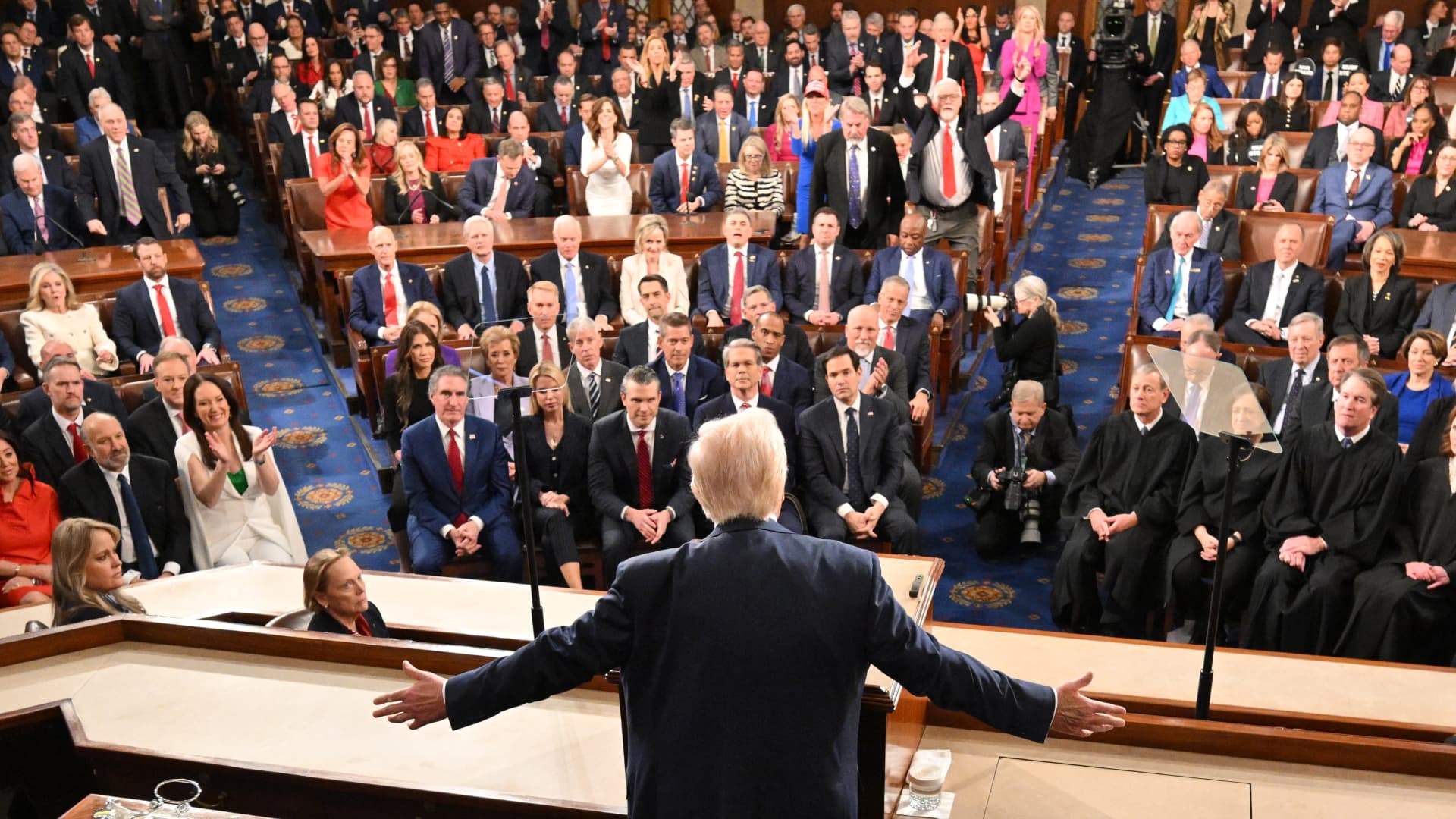
President Donald Trump addresses a joint session of Congress at the U.S. Capitol on March 4, 2025.
Mandel Ngan-Pool/Getty Images
President Donald Trump has spoken of tariffs as a job-creating behemoth.
Tariffs will “create jobs like we have never seen before,” Trump said Tuesday during a joint session of Congress.
Economists disagree.
In fact, the tariff policies Trump has pursued since taking office would likely have the opposite effect, they said.
“It costs American jobs,” said Mark Zandi, chief economist of Moody’s.
He categorized tariffs imposed broadly as a “lose-lose.”
“There are no winners here in the trade war we’re seemingly being engulfed in,” Zandi said.
A barrage of tariffs
The Trump administration has announced a barrage of tariffs since Inauguration Day.
Trump has imposed an additional duty of 20% on all imports from China. He put 25% tariffs on imports from Canada and Mexico, the U.S.’ two biggest trade partners. (Just days after those took effect, the president delayed levies on some products for a month.)
Tariffs of 25% on steel and aluminum are set to take effect Wednesday, while duties on copper and lumber and reciprocal tariffs on all U.S. trade partners could be coming in the not-too-distant future.
There’s a deceptively simple logic to the protective power of such economic policy.
Tariffs generally aim to help U.S. companies compete more effectively with foreign competitors, by making it more expensive for companies to source products from overseas. U.S. products look more favorable, thereby lending support to domestic industry and jobs.
Workers pour molten steel at a machinery manufacturing company which produces for export in Hangzhou, in China’s eastern Zhejiang province on March 5, 2025.
AFP via Getty Images
There’s some evidence of such benefits for targeted industries.
For example, steel tariffs during Trump’s first term reduced imports of steel from other nations by 24%, on average, over 2018 to 2021, according to a 2023 report by the U.S. International Trade Commission. They also raised U.S. steel prices and domestic production by about 2% each, the report said.
New steel tariffs set to take effect March 12 would also “likely boost” steel prices, Shannon O’Neil and Julia Huesa, researchers at the Council on Foreign Relations, wrote in February.
Higher prices would likely benefit U.S. producers and add jobs to the steel industry’s current headcount, around 140,000, they said.
Tariffs have ‘collateral damage’
While tariffs’ protection may “relieve” struggling U.S. industries, it comes with a cost, Lydia Cox, an assistant economics professor at the University of Wisconsin-Madison and international trade expert, wrote in a 2022 paper.
Tariffs create higher input costs for other industries, making them “vulnerable” to foreign competition, Cox wrote.
These spillover effects hurt other sectors of the economy, ultimately costing jobs, economists said.
Take steel, for example.
Steel tariffs raise production costs for the manufacturing sector and other steel-intensive U.S. industries, like automobiles, farming machinery, household appliances, construction and oil drilling, O’Neil and Huesa wrote.

Cox studied the effects of steel tariffs imposed by former president George W. Bush in 2002-03, and found they were responsible for 168,000 fewer jobs per year in steel-using industries, on average — more jobs than there are in the entire steel sector.
Tariffs are a “pretty blunt instrument,” said Cox during a recent webinar for the Harvard Kennedy School.
They create “a lot of collateral damage,” she added.
Why tariffs are a ‘tax on exports’
Trucks head to the Ambassador Bridge between Windsor, Canada and Detroit, Michigan on March 4, 2025.
Bill Pugliano | Getty Images
Such damage includes retaliatory tariffs imposed by other nations, which make it pricier for U.S.-based exporters to sell their goods abroad, economists said.
Tariffs imposed during Trump’s first-term — on products like washing machines, steel and aluminum — hit $290 billion of U.S. imports with an average 24% tariff by August 2019, according to a 2020 paper published by the U.S. Federal Reserve. Those levies ultimately translated to a 2% tariff on all U.S. exports after accounting for foreign retaliation, it found.
“A tax on imports is effectively a tax on exports,” Erica York, senior economist at the Tax Foundation, wrote last year for the Cato Institute, a libertarian think tank.
More from Personal Finance:
Medicaid cuts may include work requirements
DOGE layoffs may ‘overwhelm’ unemployment system
Who benefits from Trump tax cuts?
Damage to the U.S. economy from those first-term Trump tariffs “clearly” amounted to “many times” more than the wages of newly created jobs, economists Larry Summers, former Treasury secretary during the Clinton administration, and Phil Gramm, a former U.S. senator (R-Texas), wrote in a recent Wall Street Journal op-ed.
(President Joe Biden kept most of Trump’s tariffs in place.)
U.S. trade partners have already begun fighting back against Trump’s recent tranche of tariffs.
China put tariffs of up to 15% on many U.S. agricultural goods — which are the largest U.S. exports to China — starting Monday. Canada also put $21 billion of retaliatory tariffs on U.S. goods like orange juice, peanut butter, coffee, appliances, footwear, cosmetics, motorcycles and paper products.
President Trump alluded to the potential economic pain of his tariff policies during his address to Congress.
“There will be a little disturbance, but we are okay with that,” he said. “It won’t be much.”

While many economists don’t yet forecast a U.S. recession, Trump in a Fox News interview on Sunday didn’t rule out the possibility of a downturn as tariffs take effect — though he said the economy would benefit in the long term. If a recession were to happen, it would weigh on protected sectors, too, economists said.
Voters elected President Trump with a mandate to institute an economic agenda that includes tariffs, Kush Desai, a spokesperson for the White House, said in an e-mailed statement.
“Tariffs played a key role in the industrial ascent of the United States stretching back to the 1800s through William McKinley’s presidency,” Desai said.
‘Disappointing results’ of Trump-era tariff policies
There is a historical precedent for the trade war that’s breaking out: The Smoot-Hawley Tariff of 1930, which triggered a reduction in exports and failed to boost agricultural prices for the farmers it sought to protect, Michael Strain, director of economic policy studies at the American Enterprise Institute, a conservative think tank, wrote in a 2024 paper.
Economists also believe the Smoot-Hawley tariff exacerbated the Great Depression.
While a nearly century-old economic policy doesn’t necessarily point to what will happen in the modern era, protectionist policies from the post-2017 years have — like Smoot-Hawley — “had disappointing results,” Strain wrote.
Evidence from recent years suggests protectionism may actually hurt the workers it seeks to help, Strain said.
For example, Trump’s first-term tariffs reduced total manufacturing employment by a net 2.7%, Aaron Flaaen and Justin Pierce, economists at the Federal Reserve Board, wrote in 2024. That’s after accounting for a 0.4% boost to employment in manufacturing jobs protected by tariffs, they found.
The 2018-19 trade war “failed to revive domestic manufacturing” and actually reduced jobs in the broad manufacturing sector, Strain wrote.
The share of U.S. employment coming from manufacturing jobs has been falling since the end of World War II, largely because technological advances have increased workers’ productivity, Strain said. It would be more helpful to direct economic policy toward connecting workers to jobs of the future, he said.
“Trade — like technological advances — is disruptive, but attempts to entomb the U.S. economy in amber are not a helpful response,” he wrote.


Personal Finance
Next-Generation Retirement Planning: Managing Longevity Risk and Variable Income Streams


U.S.- Canada Trade Talks Collapse; Carney Says Retaliatory Tariffs Begin September 8

Flock Cameras and the Future of Public Security

AI Infrastructure Boom Hits Physical Limits: Power, Financing, and Supply Chain Strain

Armanino adds Strategic Accounting Outsourced Solutions

New 2023 K-1 instructions stir the CAMT pot for partnerships and corporations

Tax Strategy: Employee Retention Credit update
-

 Stock News1 week ago
Nvidia Q2 FY2027 Earnings beats Wall Street Expectation with Record $96.2 Billion Revenue
-
 Technology5 days ago
AI Infrastructure Boom Hits Physical Limits: Power, Financing, and Supply Chain Strain
-
 Technology3 days ago
Flock Cameras and the Future of Public Security
-
 Economics3 days ago
U.S.- Canada Trade Talks Collapse; Carney Says Retaliatory Tariffs Begin September 8