
Personal Finance
DOGE actions may cause Social Security benefit ‘interruption’: ex-agency head

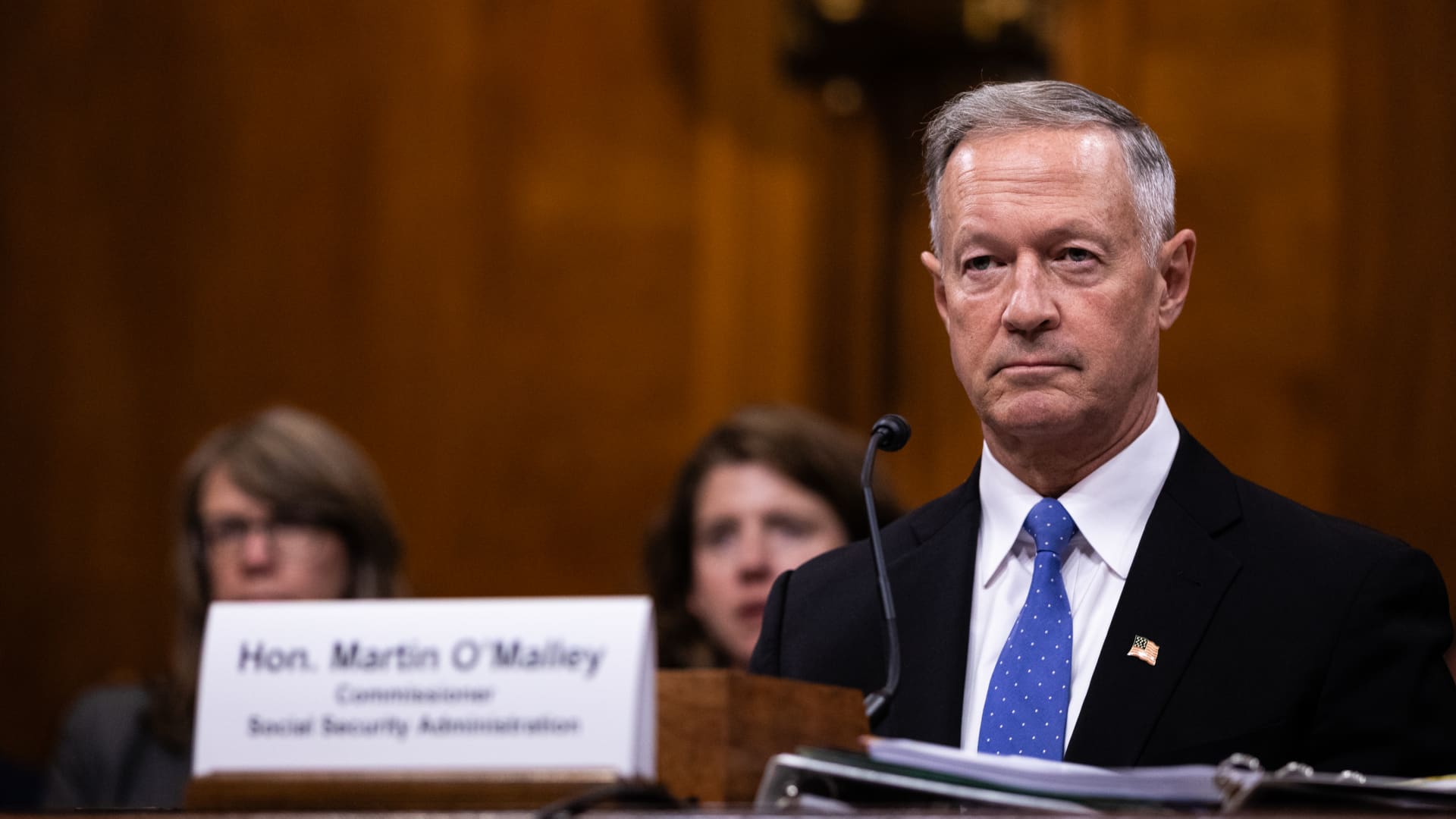
Then Social Security Commissioner Martin O’Malley testifies before the Senate Committee on the Budget on Sept. 11, 2024.
Anna Rose Layden | Getty Images News | Getty Images
Social Security has never missed a benefit payment since the program first began sending individuals monthly benefits more than eight decades ago.
But the recent actions at the U.S. Social Security Administration by Elon Musk‘s so-called Department of Government Efficiency are putting monthly benefit checks for more than 72.5 million Americans at risk, former commissioner and former Maryland governor Martin O’Malley told CNBC.com.
“Ultimately, you’re going to see the system collapse and an interruption of benefits,” O’Malley said. “I believe you will see that within the next 30 to 90 days.”
Ahead of any interruption in benefits, “people should start saving now,” O’Malley said.
More from Personal Finance:
Americans are suffering from ‘sticker shock’ — how to adjust
You can still lower your 2024 tax bill or boost your refund
1 in 5 Americans are ‘doom spending’ — how that can backfire
The Social Security Administration uses multiple systems and technologies that Elon Musk has criticized for leading to errors. As commissioner, O’Malley told Congress the agency needed more funding for IT modernization.
O’Malley said DOGE leaders are now making changes at the agency, and significant staff cuts have already led to system outages. Those intermittent IT outages may happen more frequently and for more extended periods of time until there is a “system collapse and an interruption of benefits,” he said.
Neither the Social Security Administration nor the White House responded to requests for comment by press time.
Social Security Administration leadership upheaval
The Department of Government Efficiency, also known as DOGE, is not a federal department. And Musk, whom President Donald Trump brought on board to implement DOGE, is not an elected official.
Since its establishment, DOGE has looked to slash spending at federal government agencies.

The cuts have led to leadership upheaval, with the recent resignation of acting commissioner Michelle King following a reported disagreement over DOGE’s access to sensitive data. O’Malley resigned from the Social Security Administration in November to run for chairman of the Democratic National Committee, a race which he lost to Minnesota Democrat Ken Martin.
Trump has nominated Frank Bisignano, CEO of financial-technology company Fiserv, to serve as the new commissioner of the Social Security Administration. Bisignano has yet to sit for Senate confirmation hearings.
In the interim, Lee Dudek, who first joined the agency in 2009, has been appointed acting commissioner.
Earlier this month, Dudek posted on LinkedIn that he had been placed on administrative leave from the agency for helping DOGE representatives, The Wall Street Journal reported on Feb. 20.
“Our continuing priority is paying beneficiaries the right amount at the right time, and providing other critical services people rely on from us,” Dudek said in a Feb. 19 statement about his appointment.
Whose benefits may be most at risk
Yet experts say the benefits Americans rely on could be at risk based on the Trump administration’s overhaul of the agency.
“The American public needs to understand that one of their major social safety nets is in dire jeopardy,” said Jill Hornick, a union official at the American Federation of Government Employees Local 1395, which primarily represents Social Security offices in Illinois.
“It’ll take a while for the effects to be felt, but they’re coming,” Hornick said, predicting what will happen to Social Security is going to be “far worse” than the planned cuts to Medicaid.
For people who are already receiving Social Security benefits, most of that is automated and may not be affected, she said. However, processing new claims — whether it be for retirement or disability benefits — may take longer since those cannot be processed without Social Security employees, she said.
On Thursday, the Social Security Administration sent a notice to employees that gives them until March 14 to decide whether to take an early buyout. Unlike a previous January offer, this now includes service employees, and staffing reductions in that area may impact how quickly the agency processes benefit claims and provides other services, Hornick said.
For example, if a woman files for a survivor benefit after her husband passes away, she needs to provide a copy of her marriage license. A Social Security employee then needs to code the system to verify they have seen that document and the applicant is eligible for benefits, Hornick said.
“Not everybody can do things electronically,” particularly the older adults and disabled individuals who the Social Security Administration serves, said Maria Freese, senior legislative representative at the National Committee to Preserve Social Security and Medicare.
“If you don’t have people to run an agency that requires hands-on customer service, then of course there’s a risk that you could end up with benefits being either denied or interrupted,” Freese said.
Office closures may reduce access to services
The DOGE savings web page has a list of about 45 Social Security locations where leases will be terminated, according to Rich Couture, spokesperson for AFGE SSA General Committee, a union that represents 42,000 Social Security employees nationally.
The list provides little information on the uses for the locations that are being closed. Based on the square footage listed, they may be sites used to conduct in-person hearings for disability benefits, Couture said. In one case, the location seems to be a busy New York state field office that provides general services, he said.
“If they’re going to close these offices that are busy in highly populated areas, it would suggest to me that there’s no office in this country that would be safe from having a lease terminated, especially in rural areas,” Couture said.

In a recent statement, Rep. John Larson, D-Conn., said the moves are a “backdoor benefit cut.”
“Let me be clear — laying off half of the workforce at the Social Security Administration and shuttering field offices will mean the delay, disruption and denial of benefits,” Larson said.
In a statement to CNBC.com earlier this week, the Social Security Administration said it has not set any reduction targets, in response to reports it plans to cut 50% of its employees.
As a union, AFGE has been issuing bargaining demands in response to the agency’s recent decisions and plans to enforce employee rights through other methods as necessary, spokesperson Couture said.
While many lawsuits have been filed, it will take time to work through them, especially as the courts are now being flooded with cases tied to the Trump administration’s actions, said Nancy Altman, president of advocacy organization Social Security Works.
The biggest results may come from the pressure American voters could put on elected officials, former SSA commissioner O’Malley said.
“I think many people throughout the country are going to start bringing a lot of heat to members of Congress who have been facilitating, supporting, aiding and abetting the breaking of their Social Security and the interruption of benefits that they work their whole lives to earn,” he said. “These are earned benefits.”


Personal Finance
Next-Generation Retirement Planning: Managing Longevity Risk and Variable Income Streams


U.S.- Canada Trade Talks Collapse; Carney Says Retaliatory Tariffs Begin September 8

Flock Cameras and the Future of Public Security

AI Infrastructure Boom Hits Physical Limits: Power, Financing, and Supply Chain Strain

Armanino adds Strategic Accounting Outsourced Solutions

New 2023 K-1 instructions stir the CAMT pot for partnerships and corporations

Tax Strategy: Employee Retention Credit update
-

 Stock News1 week ago
Nvidia Q2 FY2027 Earnings beats Wall Street Expectation with Record $96.2 Billion Revenue
-
 Technology5 days ago
AI Infrastructure Boom Hits Physical Limits: Power, Financing, and Supply Chain Strain
-
 Technology3 days ago
Flock Cameras and the Future of Public Security
-
 Economics3 days ago
U.S.- Canada Trade Talks Collapse; Carney Says Retaliatory Tariffs Begin September 8