
Accounting
DOJ takes CTA beneficial ownership information fight to Supreme Court

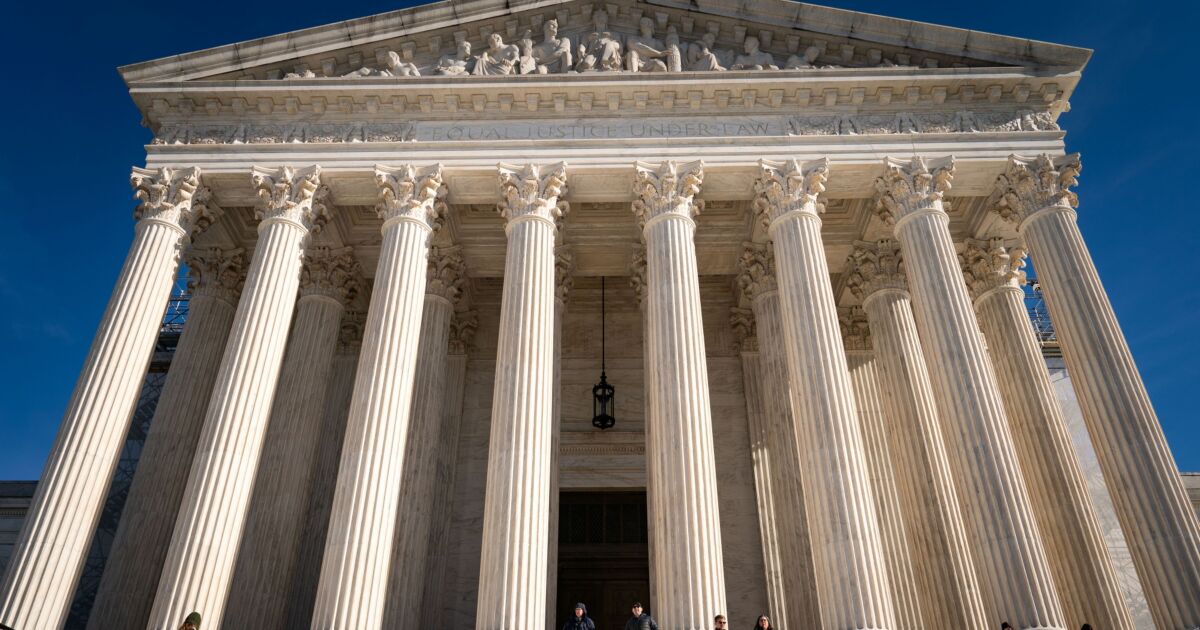

The Justice Department filed an emergency request with the U.S. Supreme Court, asking it to lift the injunction on the beneficial ownership information reporting requirement under the Corporate Transparency Act after a
The 2021 law requires businesses to report on their true ownership to the Treasury Department’s Financial Crimes Enforcement Network starting Jan. 1, 2025 as a way to deter illicit activity by shell companies, but given the legal back and forth, the requirement has been delayed by FinCEN. In the Justice Department’s
In the application, the DOJ explains the rationale for the beneficial ownership requirement. “Congress found that malign actors often conceal their ownership of corporations and other entities to facilitate illicit activities such as money laundering, tax fraud, human and drug trafficking, and the financing of terrorism,” said the filing. “Congress determined that requiring companies to report information about their owners would enable the government to detect and prosecute financial crimes, discourage the use of shell companies to conduct illicit activity, and facilitate the government’s national-security and intelligence efforts.”
The application comes from Attorney General Merrick Garland, Treasury Secretary Janet Yellen, the Financial Crimes Enforcement Network and FinCEN director Andrea Gacki.
The CTA requires organizations to report to the federal government information about their beneficial owners, that is, individuals who exercise substantial control over the entity or own or control 25% of its ownership interests. The covered entities have to report their beneficial owners’ names, dates of birth, addresses, and unique identifying numbers (e.g., driver’s license or passport numbers).
The DOJ pointed to several reasons why the Supreme Court should lift the injunction, noting that the injunction was too broad and went beyond the original plaintiffs who filed the lawsuit. “Respondents—four entities subject to the Act, an individual affiliated with one of those entities, and a membership organization—brought this suit to challenge the Act’s constitutionality,” said the DOJ. “The district court granted respondents a preliminary injunction, holding that they were likely to succeed on the merits of their claim that the Act, on its face, exceeds Congress’s enumerated powers. Although respondents had sought relief only on their own behalf, the court entered a universal injunction purporting to enjoin the Act itself and prohibiting the enforcement of the Act even against nonparties. A motions panel of the Fifth Circuit stayed that injunction, but days later a merits panel vacated the stay and reinstated the universal injunction without any analysis of the government’s likelihood of success on the merits or the relative harms to the parties. This Court should stay the district court’s injunction.”
The plaintiffs in the case are Texas Top Cop Shop, Inc.; Data Comm for Business, Inc.; Libertarian Party of Mississippi; Mustardseed Livestock, L.L.C.; National Federation of Independent Business, Inc.; and Russell Straayer.
The DOJ argued that the government is likely to succeed on the merits of the claim. “The Act’s reporting requirements are important to the government in preventing, detecting, and prosecuting crimes such as money laundering, tax fraud, and the financing of terrorism,” said the DOJ. “The requirements therefore fall comfortably within Congress’s authority under the Commerce Clause to regulate economic activities (here, the anonymous operation of business entities) that substantially affect interstate commerce. The requirements are also necessary and proper to effectuate several of Congress’s enumerated powers, including the power to regulate interstate and foreign commerce and to collect taxes, as well as Congress’s powers with respect to foreign affairs. Even if there might be outlier circumstances in which the Act could be thought to exceed Congress’s powers, the Act complies with the Constitution in most of its applications, which suffices to defeat respondents’ facial challenge.”
The DOJ argued that the district court issued its universal injunction after two other district courts held that the CTA is likely constitutional and had denied preliminary-injunction motions raising substantially similar constitutional claims. A third district court denied a preliminary-injunction motion because the plaintiffs had failed to show irreparable harm. The DOJ acknowledged that one district court held that the CTA violates the Constitution, but issued an injunction covering only the plaintiffs in that case, specifically the members of the National Small Business Association.
The DOJ provided further reasons why the Supreme Court should issue a stay on the district court’s universal injunction, saying it “irreparably harms the federal government in multiple ways.”
“It prevents the government from executing a duly enacted Act of Congress, impedes efforts to prevent financial crime and protect national security, undermines the United States’ ability to press other countries to improve their own anti-money laundering 4 regimes, and severely disrupts the ongoing implementation of the Act,” said the DOJ. “By contrast, the Act imposes only minimal burdens on respondents. At a minimum, this Court should narrow the district court’s vastly overbroad injunction. A court of equity may grant relief only to the parties before it. The district court violated that principle by issuing a universal injunction purporting to enjoin the Act itself and forbidding the enforcement of the Act even against non-parties.”
The DOJ believes the case will need to be decided by the Supreme Court eventually and said the application for a stay could be treated as a petition for a writ of certiorari. “”Several Members of this Court have recognized that such universal relief contradicts Article III and established equitable principles and have urged clarification of these principles in an appropriate case—but the Court’s antecedent determination on a threshold procedural issue or the merits in prior cases has obviated the need to resolve the remedial question,” said the DOJ. “Because the lower courts need guidance on the propriety of universal injunctions, this Court may additionally wish to treat this application as a petition for a writ of certiorari before judgment presenting the question whether the district court erred in entering preliminary relief on a universal basis.”
“The DOJ argues that this case would provide an ideal vehicle for addressing the lawfulness of universal relief,” wrote Ed Zollars, owner of Thomas, Zollars & Lynch, in Kaplan Financial Education’s





U.S. Inflation Outlook for 2027

S&P 500 September Outlook: Tech Rally Holds Index at 7,600

India Unveils ‘Saptadhara’ Reform Agenda Targeting Technology, Youth Skilling, and Growth

Armanino adds Strategic Accounting Outsourced Solutions

New 2023 K-1 instructions stir the CAMT pot for partnerships and corporations

Tax Strategy: Employee Retention Credit update
-

 Technology1 week ago
AI Infrastructure Boom Hits Physical Limits: Power, Financing, and Supply Chain Strain
-
 Stock News4 days ago
S&P 500 September Outlook: Tech Rally Holds Index at 7,600
-

 Economics1 week ago
U.S.- Canada Trade Talks Collapse; Carney Says Retaliatory Tariffs Begin September 8
-

 Finance4 days ago
S&P 500 Outperforms Amid Strong Corporate Earnings as Treasury Yields Cap Equity Multiples
-

 Technology1 week ago
Flock Cameras and the Future of Public Security
-

 Insights4 days ago
Climate Resilience and Offshore Wind and Land Restoration Milestones
-

 Accounting4 days ago
Mandatory ESG Reporting Standards Demand Standardized Non-Financial Audit Trails
-
 Leaders4 days ago
India Unveils ‘Saptadhara’ Reform Agenda Targeting Technology, Youth Skilling, and Growth