
Economics
EU economy survived ‘terrible prophecies’, now faces trade with China: EU’s Gentiloni



The European Union has successfully avoided the “terrible prophecies” that threatened its economy in recent years, but must still contend with Russia’s war in Ukraine and a tenuous trade relationship with China, outgoing European Commissioner for Economy Paolo Gentiloni said Saturday.
The bloc’s economy underwent “overall a weak growth, but nothing of the terrible prophecies that we heard in the last two or three years: recessions, blackouts, divergence, divisions in Europe in front of Russia’s invasion,” Gentiloni said in an interview with CNBC’s Steve Sedgwick at the Ambrosetti Forum at Cernobbio, on the shores of Italy’s Lake Como.
A former prime minister of Italy, Gentiloni has served as the European Commissioner for Economy under EC President Ursula von der Leyen since December 2019. The European Commission is responsible for the 20-nation euro zone’s economic strategy and legislation — such as tariffs — while the European Central Bank oversees the region’s monetary policy and interest rate decisions.
Gentiloni will not be returning for a second term as commissioner following Von der Leyen’s tumultuous re-election as president — but he has laid out the economic picture that awaits his imminent successor.
“The economy is growing, slowly, but growing. And the risks of differences among the European Union, that was very high when the pandemic happened, are very limited,” he noted. “The bad part of the story is that if we don’t raise out capacity in terms of competitiveness, if we don’t make enormous progress in what we call the capital markets union, and if we don’t address the challenge of defense … if we don’t do that, well, the new situation of the world will appear very difficult for Europeans.”
Resurging from the Covid-19 pandemic, Europe has been battling a cost-of-living crisis and high-inflation environment exacerbated by Russia’s February 2022 invasion of Ukraine and energy supply tightness following sanctions against Moscow. The euro zone’s economy has expanded in the first half of this year, with flash figures showing better-than-expected gross domestic product growth of 0.3% in the three months to the end of June, compared with the previous quarter.
In its spring forecasts, the European Commission projected the EU’s GDP will swell by 1% in 2024 and by 0.8% in the euro area, with respective growth of 1.6% and 1.4% in the two regions in 2024. At the time, the Commission flagged growth on the back of accelerated private consumption, declining inflation and a strong labor market, but also broader geopolitical risks amid ongoing conflicts in Ukraine and the Middle East.
Amid a drop in inflation, the ECB in June took the first step to ease monetary policy since 2019, trimming the central bank’s key rate to 3.75%, down from a record 4% where it has been since September 2023. As of Friday, markets had fully priced in another ECB rate cut in its forthcoming meeting of Sept. 12.
The Chinese relationship
Looking ahead, Europe must now weather the dual storm of close-call elections in key trade partner the U.S. in November, and frictions in its trade relationship China. The EU has come into Beijing’s crosshairs following the bloc’s June decision to impose higher tariffs on Chinese electric vehicle imports that were found benefit “heavily from unfair subsidies” and pose a “threat of economic injury” to EV producers in Europe.
Gentiloni on Saturday stressed that trade diplomacy with China and the war in Ukraine must top the agenda of challenges facing a new Commission — and that they are more pressing concerns than the advent of a potential second U.S. administration under former President Donald Trump.
The European Union must “support Ukraine, keep the doors of international trade open” but also “abandon our ingenuity in the trade relation with China. But this does not mean that we can accept the idea that international trade and international trade rules [are] over,” Gentiloni noted.
He downplayed the economic impact of a Trump victory in November, adding, “I think that a change in the U.S. administration, meaning Trump winning the election, of course it will not be welcome in Brussels, but I don’t think that the change would be enormous in terms of economic relations.”
Winds of change
Gentiloni has yet to announce his next steps after departing from the Commission, at a time when Europe and its legislative body face a rising wave of far-right support.
“You should never organize your next role when you are having a role. But of course I will give my contribution to European affairs and maybe also to Italian politics and Italian affairs,” he said Saturday.
The leftist politician was unlikely to garner the support of Italian Prime Minister Giorgia Meloni, who has nominated Minister for European Affairs Raffaele Fitto from the ranks of her right-wing Brothers of Italy party to join the new EU executive.
Far-right factions gained substantive ground in the latest European election, leading the right-wing prime minister of Hungary — which currently holds the presidency of the EU Council — Viktor Orbán to question whether a van der Leyen Commission is appropriate, given the political sentiment.
“The core of the difficulty is the following: the previous Commission proved to be very much unsuccessful, in terms of competitiveness, of European economy, migration, stopping the war. So generally speaking, it was an unsuccessful Commission,” the Hungarian leader told CNBC’s Sedgwick on Friday, noting that a decision was taken to “create the same Commission, basically.”
He added: “So I have [a] great belief that [people] can change and be able to deliver better performances than they have done previously. But [is is] difficult to think so. So I try to support the Commission as much as we can, but being a rational man, I think we neglected the desire of the voters for change, and the same establishment [is] still in position in Brussels, and it’s not good.”

— CNBC’s Katrina Bishop contributed to this report.










Economics
U.S. National Debt Surpasses $40 Trillion for the First Time: What It Means for the Economy



Executive Summary & Core Macro Outlook
The United States enters the 2026–2030 macroeconomic window as the unquestioned heavyweight of nominal economic output, retaining its status as the primary engine of global financial liquidity, private enterprise innovation, and high-margin technological deployment. According to multi-year projections from the International Monetary Fund (IMF) World Economic Outlook and complementary datasets from the World Bank, the US nominal Gross Domestic Product (GDP) is projected to reach $32.38 trillion by 2026, accounting for approximately 25% of global nominal output and roughly 14.5% of world GDP measured at Purchasing Power Parity (PPP).
Unlike many of its advanced-economy peers across Western Europe and East Asia—which are grappling with acute demographic contraction and structural energy shocks—the United States demonstrates remarkable macroeconomic resilience. The IMF projects a real GDP Compound Annual Growth Rate (CAGR) of 2.1% to 2.3% through 2030. This expansion is sustained by three structural anchors: unmatched capital depth driving massive private-sector investment in Artificial Intelligence (AI) infrastructure, complete energy independence as a net exporter of hydrocarbons and liquefied natural gas (LNG), and high labor productivity gains that cushion the economy against rising debt-servicing costs.
Macroeconomic Data Matrix (2026–2030 Projections)
| Economic Metric | IMF / World Bank Baseline (2026–2030) | Global Benchmark & Context |
| Nominal GDP (2026 Projection) | ~$32.38 Trillion | Rank #1 Globally |
| GDP at Purchasing Power Parity (PPP) | ~$32.40 Trillion | Rank #2 Globally (Behind China’s ~$38.5T PPP) |
| Projected Real GDP CAGR (2026–2030) | 2.1% – 2.3% | Top decile among G7 advanced economies |
| Gross Public Debt (% of GDP) | ~122.5% – 128.0% | Structural fiscal deficit trajectory |
| Core Inflation Rate (PCE Target) | Stabilizing at 2.0% – 2.2% | Federal Reserve inflation target alignment |
| Current Account Balance (% of GDP) | -2.8% to -3.2% | Persistent capital import & reserve currency demand |
Deep Structural Growth Drivers
1. The AI Infrastructure Hyper-Cycle & TFP Expansion
The defining growth catalyst for the US economy over the 2026–2030 horizon is the unprecedented scale of private capital expenditure (Capex) poured into artificial intelligence infrastructure, enterprise software integration, and advanced computing hardware.
Major technology mega-caps and private equity funds are directing hundreds of billions of dollars annually into hyper-scale data centers, domestic semiconductor fabrication, high-voltage electrical grid upgrades, and AI-driven workflow platforms. According to World Bank economic research, technological adoption across American service and manufacturing sectors is driving a notable uptick in Total Factor Productivity (TFP). This productivity surge allows US companies to expand profit margins and output even in an environment characterized by higher structural real interest rates and tight skilled-labor markets.
2. Deep Capital Markets and Private Sector Liquidity
The structural backbone of US economic outperformance remains its financial system. US capital markets represent over 40% of global equity market capitalization and a vast majority of global venture capital and private credit assets.
This liquidity creates an efficient mechanism for capital allocation: high-potential emerging industries (such as quantum computing, synthetic biology, and advanced defense technology) receive early-stage funding at a scale that no other national market can match. When global monetary conditions tighten, global capital flees toward safety and yield, reinforcing US capital depth and lowering the relative cost of equity capital for American corporations.
3. Net Energy Independence & Industrial Cost Advantages
Unlike industrial hubs in Germany, Japan, or South Korea—which remain highly vulnerable to volatile sea-lane logistics and imported fuel price spikes—the United States operates as a major net exporter of petroleum, natural gas, and refined chemical products.
Access to abundant, cheap domestic natural gas provides US heavy industry, advanced manufacturing, and electricity-hungry data centers with a persistent structural cost advantage. Furthermore, federal policy frameworks (including the CHIPS and Science Act and clean energy tax provisions) continue to catalyze domestic private manufacturing investment, re-shoring high-value supply chains from East Asia back to the American Sunbelt and Midwest.
Macroeconomic Vulnerabilities & Downside Risks
1. Structural Sovereign Debt Trajectory
The most significant medium-term threat to US macroeconomic stability is the path of federal public debt. With gross national debt exceeding 120% of GDP and annual federal deficits running between 5% and 7% of GDP, the US fiscal baseline faces increasing structural pressure.
As older legacy low-yield Treasury bonds mature, they are refinanced at higher prevailing interest rates. According to IMF fiscal monitor assessments, federal net interest payments are absorbing an expanding share of total fiscal revenue, crowding out discretionary spending and narrowing the government’s capacity to deploy counter-cyclical fiscal stimulus during future downturns.
2. Commercial Real Estate (CRE) & Banking Sector Realignment
The structural transformation toward hybrid work models has permanently altered office space utilization across major US metropolitan areas. Regional and community banks, which hold a disproportionate share of commercial real estate debt, face ongoing balance-sheet pressure as legacy office loans mature and require refinancing at lower property valuations and higher interest rates. While systemic money-center banks remain well-capitalized, localized credit tightening from regional lenders presents a headwind for small-and-medium enterprise (SME) borrowing.
High-Outperformance Sector Matrix (2026–2030)
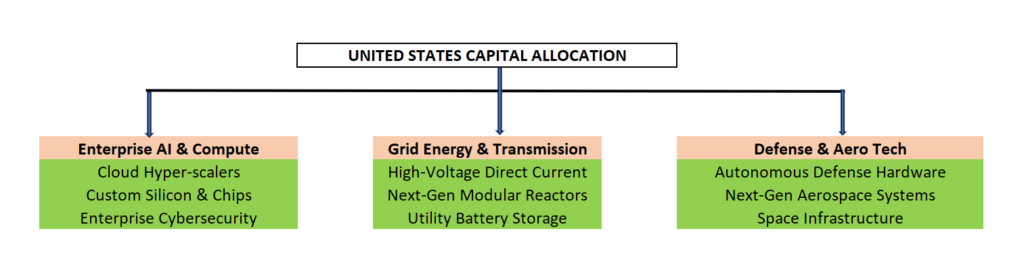
- Enterprise AI, Cloud Compute, & Cybersecurity: Companies building enterprise-grade software, AI agents, cloud architectures, and specialized hardware protection layers.
- Next-Generation Energy & Grid Modernization: Power generation utilities, high-voltage electrical equipment makers, small modular nuclear reactor (SMR) developers, and energy storage systems catering to exponential data center energy demands.
- Advanced Defense Technology & Aerospace: Autonomous systems, satellite networks, hypersonic defense, and advanced materials supplying both domestic security needs and global allied demand.
Strategic Summary for Global Investors & Executives
The United States through 2030 remains the ultimate high-volume, high-yield destination for institutional capital. While fiscal debt risks require long-term monitoring, the immediate 5-year outlook is defined by strong technology-driven productivity, resilient private consumption, and unmatched market liquidity. For global corporations and institutional allocators, exposure to the US economy remains an indispensable pillar of long-term growth strategy.
Top 65 Largest Economies in the World for 2027
Top 10 Largest Economies by 2030: IMF & World Bank GDP Projections for Global Powerhouses

U.S.- Canada Trade Talks Collapse; Carney Says Retaliatory Tariffs Begin September 8

Flock Cameras and the Future of Public Security

AI Infrastructure Boom Hits Physical Limits: Power, Financing, and Supply Chain Strain

Armanino adds Strategic Accounting Outsourced Solutions

New 2023 K-1 instructions stir the CAMT pot for partnerships and corporations

Tax Strategy: Employee Retention Credit update
-

 Stock News1 week ago
Nvidia Earnings Preview: What Wall Street Expects From the AI Bellwether’s Q2 Report
-

 Accounting1 week ago
SEC’s Semiannual Reporting Proposal Faces Investor Pushback: What CFOs Need to Know
-

 Finance1 week ago
Treasury Bond Volatility Forces Bessent to Double Debt Buyback Size as Yields Swing
-

 Stock News1 week ago
Nvidia Q2 FY2027 Earnings beats Wall Street Expectation with Record $96.2 Billion Revenue
-
 Technology4 days ago
AI Infrastructure Boom Hits Physical Limits: Power, Financing, and Supply Chain Strain
-
 Economics2 days ago
U.S.- Canada Trade Talks Collapse; Carney Says Retaliatory Tariffs Begin September 8
-
 Technology2 days ago
Flock Cameras and the Future of Public Security