Economics
European Central Bank interest rate decision, September 2025
Published
11 months agoon
Christine Lagarde, president of the European Central Bank (ECB), addresses the annual European Systemic Risk Board conference in Frankfurt, Germany, on Wednesday, Sept. 3, 2025.
Alex Kraus/Bloomberg via Getty Images
The European Central Bank held interest rates steady on Thursday as economic uncertainty persists in the wake of U.S. Donald Trump’s aggressive tariff agenda.
Ahead of the decision, markets had been pricing in an around 99% chance of the ECB’s key deposit facility rate being left at 2% for the second consecutive time. The central bank last cut rates in June, bringing rates further down from last year’s record high of 4%.
“Inflation is currently at around the 2% medium-term target and the Governing Council’s assessment of the inflation outlook is broadly unchanged,” the ECB said in a statement.
The central bank added that it would follow a meeting-by-meeting, data-dependent approach and was not pre-committing to a specific path for interest rates.
The ECB is grappling with global economic uncertainty, despite inflation in the euro zone hovering around the central bank’s 2% target in recent months, and the EU striking a trade agreement with the U.S.
The transatlantic partners agreed to 15% blanket tariffs on EU exports to the U.S. in July, with further details about the framework emerging last month. It addressed some questions for key European sectors like pharmaceuticals.
However, questions remain as some issues — such as provisions for the wine and spirits sector — were left open. Concerns over further tariffs have also grown following Trump’s threat of retaliations against the EU after it hit Alphabet‘s Google with a $3.45 billion antitrust fine.
Fears about the impact tariffs could have on economic growth remain. Growth in the euro zone has remained sluggish even as rates have come down, with the latest figures showing just 0.1% growth in the second quarter after a 0.6% expansion in the previous period.
While the interest rate decision itself was widely anticipated, Deutsche Bank economists last week noted that “the focus will be on the signals for the path that lies ahead for monetary policy.”
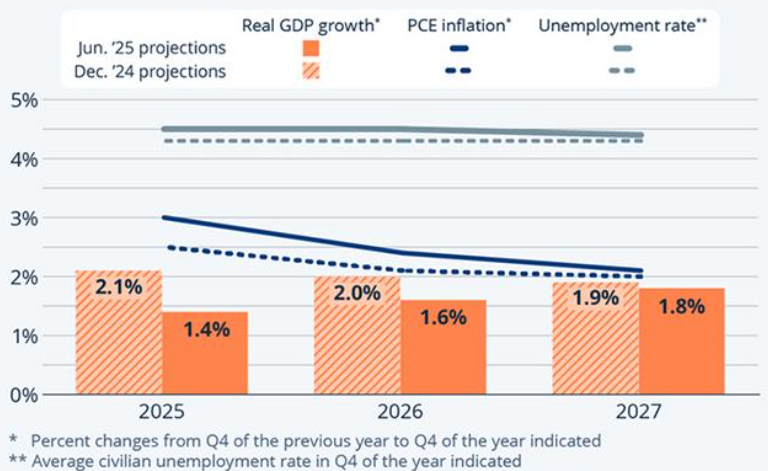
Markets on Thursday are therefore expected to focus on ECB President Christine Lagarde’s press conference and the latest projections for inflation and economic growth. The central bank last updated its economic forecasts in June.
This is a breaking news story, please check back for updates.
You may like
-
IMF Upgrades Global Growth Forecast as World Economy Shows Unexpected Resilience in 2026
-
U.S. Consumer Spending Defies High Interest Rates as Retail Sales Surprise Economists
-
US Jobless Claims Fall to Historic Lows
-
Tech Sell-off, Soaring Crude Oil, and Tariffs Shake Wall Street
-
U.S. Imposes New 50% Tariffs on Canadian Imports Under Rare Legal Provision
-
The Warsh Shift: How the New Fed Chair Is Balancing War Drags and Tech Winds
Economics
IMF Upgrades Global Growth Forecast as World Economy Shows Unexpected Resilience in 2026
Published
6 hours agoon
July 28, 2026
The global economy has entered the second half of 2026 with stronger momentum than many economists predicted just a year ago. After navigating a challenging period marked by elevated inflation, aggressive interest rate increases, geopolitical uncertainty, and slowing international trade, several major economies have demonstrated remarkable resilience. Reflecting this improved outlook, the International Monetary Fund (IMF) recently upgraded its global growth forecast, reinforcing expectations that the world economy may achieve a soft landing rather than fall into a widespread recession.
The revised forecast reflects improving economic conditions across both advanced and emerging economies. While growth remains uneven across regions, stronger consumer spending, recovering business investment, easing inflationary pressures, and resilient labor markets have collectively supported higher-than-expected economic activity. The IMF’s latest assessment provides investors, businesses, and policymakers with renewed confidence that global growth can remain sustainable despite ongoing structural challenges.
Gross Domestic Product (GDP) remains the primary measure used to evaluate economic performance. It captures the total value of goods and services produced within an economy over a given period and serves as one of the most important indicators of national prosperity.
Understanding how GDP is measured helps explain why stronger production, consumer spending, business investment, and exports all contribute to higher economic growth without counting the same economic activity multiple times.
One of the most encouraging developments has been the continued strength of consumer demand. Households in several major economies have continued spending despite higher borrowing costs. Strong employment markets and moderate wage growth have helped offset some of the financial pressure created by elevated interest rates. As inflation has gradually eased in many countries, consumers have regained purchasing power, supporting retail sales, travel, entertainment, and service industries.
Business investment has also remained surprisingly resilient. Companies continue investing in artificial intelligence, cloud computing, advanced manufacturing, clean energy, and digital infrastructure. The rapid expansion of AI technologies has encouraged many firms to modernize operations, improve productivity, and expand long-term capital investment despite relatively expensive financing conditions.
Emerging markets have also contributed positively to the improved outlook. Many developing economies have benefited from recovering commodity demand, stronger exports, improved tourism, and expanding domestic consumption. Although some regions continue facing debt challenges and currency volatility, overall growth across emerging markets has exceeded earlier expectations.
International trade has begun showing signs of stabilization after several years of disruption. Global supply chains have become more efficient as transportation costs normalize and manufacturing capacity expands in multiple regions. Businesses have diversified suppliers and invested heavily in logistics, reducing some of the vulnerabilities exposed during previous supply chain disruptions.

Inflation remains one of the most closely monitored economic variables. Although price pressures have moderated considerably from their post-pandemic peaks, inflation has not disappeared entirely. Housing costs, healthcare expenses, insurance premiums, and labor shortages continue contributing to elevated prices in several sectors. Nevertheless, slower inflation has reduced pressure on central banks to maintain extremely restrictive monetary policies.
For central banks, the improved economic outlook creates both opportunities and challenges. Stronger growth supports employment and corporate profitability, but policymakers must ensure inflation continues moving toward long-term targets before easing monetary policy too aggressively. Premature interest rate cuts could risk reigniting inflation, while maintaining restrictive policies for too long could unnecessarily slow future economic expansion.
Financial markets have responded positively to the IMF’s upgraded forecast. Equity investors generally view stronger global growth as supportive for corporate earnings, international trade, industrial production, and commodity demand. Companies with significant international operations may benefit from expanding consumer markets and increased business investment across multiple regions.
The improved outlook also carries positive implications for developing economies seeking foreign investment. Stronger global growth often encourages multinational corporations to expand internationally, increasing capital flows, infrastructure investment, and employment opportunities. This can help accelerate long-term economic development while strengthening global trade relationships.
However, important risks remain. Geopolitical tensions continue creating uncertainty in several regions, while trade disputes, cybersecurity threats, and climate-related disruptions could affect future economic performance. Public debt levels also remain elevated in many countries, limiting governments’ ability to provide additional fiscal support should growth weaken unexpectedly.
Another area requiring close attention is productivity growth. While artificial intelligence and digital transformation offer enormous opportunities, realizing their full economic benefits will require continued investment in education, workforce development, and technological infrastructure. Countries that successfully integrate new technologies into their economies may experience faster productivity gains and stronger long-term growth.
Looking ahead, economists expect moderate but steady expansion to continue if inflation remains under control and labor markets stay relatively healthy. Continued investment in technology, energy infrastructure, healthcare, and advanced manufacturing could provide additional support for global economic activity over the next several years.
Why This Matters
The IMF’s upgraded global growth forecast suggests that the world economy has proven more resilient than many experts anticipated. Strong consumer demand, improving business investment, moderating inflation, and recovering international trade have all contributed to a more optimistic outlook. Although risks remain, the latest projections indicate that businesses, investors, and policymakers may be entering a period of more stable and sustainable economic expansion, making future GDP, inflation, and employment reports especially important indicators to watch throughout the remainder of 2026.
Economics
U.S. Consumer Spending Defies High Interest Rates as Retail Sales Surprise Economists
Published
6 hours agoon
July 28, 2026
The U.S. economy continues to demonstrate remarkable resilience as consumer spending remains stronger than many economists anticipated. Recent retail sales data showed that American consumers maintained healthy spending levels despite borrowing costs remaining near their highest levels in years. The stronger-than-expected figures have sparked renewed optimism about the nation’s economic outlook while raising important questions about the future path of interest rates and inflation.
Retail sales are one of the most closely watched indicators of economic health because consumer spending accounts for roughly two-thirds of U.S. economic activity. When households continue purchasing goods and services, businesses experience stronger revenues, employment remains stable, and overall economic growth receives additional support. The latest figures suggest that American consumers are still willing to spend despite higher financing costs for homes, automobiles, and credit card debt.
Several factors are helping support household spending. Wage growth has remained relatively healthy across many industries, while unemployment continues to stay near historically low levels. Many households also accumulated savings during previous years, providing an additional financial cushion against rising prices and higher interest expenses. Although inflation has moderated from its peak, consumers remain cautious about everyday expenses, carefully balancing discretionary purchases with essential household needs.
One notable aspect of the latest retail report is the broad-based nature of consumer demand. Spending increased across multiple sectors, including online retailers, restaurants, home improvement stores, and general merchandise retailers. This diversified spending pattern indicates that consumer confidence remains relatively stable even as economic uncertainty persists.
From a macroeconomic perspective, strong retail sales contribute directly to gross domestic product by supporting consumption, one of the largest components of economic output. Continued consumer demand also encourages businesses to maintain hiring plans, invest in inventory, and expand operations. These activities reinforce broader economic momentum and reduce the immediate risk of a significant economic slowdown.
However, stronger consumer spending presents both opportunities and challenges for policymakers. While healthy demand supports business activity, it may also keep inflation above the Federal Reserve’s long-term target if demand continues to outpace available supply.

stronger consumer spending presents both opportunities and challenges for policymakers.
As consumer demand shifts higher while supply adjusts more gradually, prices can remain elevated until production catches up or demand moderates. This relationship helps explain why central banks closely monitor retail sales when evaluating future monetary policy decisions.
For the Federal Reserve, resilient consumer spending complicates the outlook for interest rates. Officials have consistently stated that monetary policy decisions will remain data dependent. If household demand continues expanding at a faster pace than expected, policymakers may delay future interest rate reductions to ensure inflation continues moving toward its long-term objective. Conversely, if consumer spending begins slowing during the second half of the year, the central bank could gain greater confidence that inflationary pressures are easing.
Financial markets have responded with cautious optimism. Equity investors generally view strong retail sales as supportive for corporate earnings, particularly for consumer discretionary companies, retailers, payment processors, and logistics firms. Stronger revenues often translate into improved profitability, benefiting companies that depend heavily on consumer purchases.
Bond investors, however, may interpret the same data differently. Persistent consumer strength can increase expectations that interest rates will remain elevated for longer, placing upward pressure on Treasury yields. Higher yields can influence borrowing costs across the broader economy, affecting mortgages, business investment, and consumer credit.
Businesses are also adapting their strategies in response to evolving consumer behavior. Many retailers continue investing in digital commerce, supply chain efficiency, and inventory management to meet shifting customer preferences while controlling operating costs. Companies that effectively balance pricing strategies with customer demand are likely to outperform competitors if economic conditions remain stable.
Despite encouraging economic indicators, risks remain. Household savings accumulated during previous years have gradually declined, while credit card balances and delinquency rates have increased in some segments of the population. Rising housing costs, insurance premiums, and healthcare expenses continue to pressure many family budgets. If these financial burdens intensify, consumer spending could moderate later in the year.
Global developments also deserve close attention. Geopolitical tensions, fluctuations in energy prices, and international trade disruptions could influence inflation and consumer confidence. Because the United States operates within a highly interconnected global economy, external events can quickly affect domestic spending patterns and business investment decisions.
Looking ahead, economists will closely monitor upcoming employment reports, inflation data, consumer confidence surveys, and retail sales releases to determine whether current spending momentum can be sustained. If employment remains strong and wage growth continues outpacing inflation, household consumption may provide ongoing support for economic expansion throughout the remainder of 2026.
Why This Matters
The latest retail sales figures highlight the underlying strength of the U.S. economy despite elevated interest rates. Strong consumer spending supports economic growth, corporate earnings, and labor market stability, but it also reinforces the Federal Reserve’s cautious approach toward monetary policy. For investors, businesses, and consumers alike, future retail sales reports will remain one of the most important indicators for assessing the direction of the U.S. economy during the second half of 2026.
Economics
The Domino Effect of Japan’s Rate Hikes On US Stocks and Treasuries Market Marks A New Era
Published
1 day agoon
July 27, 2026
The Era of Permanent Cheap Capital and Global Liquidity
For nearly three decades, the global financial system operated on a foundational premise that Japanese capital would remain permanently cheap, abundant, and virtually costless to borrow. Following the catastrophic collapse of Japan’s asset price bubble in the early 1990s, the Bank of Japan embarked on an unprecedented monetary experiment designed to combat entrenched deflation and economic stagnation. Through ultra-loose policies, including zero and negative interest rates alongside rigid yield curve control, Japanese policymakers created an environment where domestic yields were suppressed to near-zero levels. This persistent liquidity flood transformed Japan into the ultimate funding source for global financial markets. Investors around the world, ranging from international hedge funds and private equity firms to corporate treasuries and institutional asset managers, systematically borrowed trillions of low-yielding Japanese Yen. They converted these funds into foreign currencies to purchase higher-yielding risk assets across the globe, particularly within the United States. This cross-border strategy, known universally as the Yen carry trade, functioned as a continuous engine of global liquidity, inflating asset valuations, compressing volatility, and fueling continuous bull markets in US growth equities, corporate debt, and sovereign Treasuries.
The Monetary Pivot: Japan’s Historic Rate Hikes
However, when the Bank of Japan initiated a landmark shift toward monetary policy normalization, it effectively dismantled the structural mechanics of global financial leverage. Driven by rising domestic inflation, historic wage gains from corporate labor negotiations, and severe currency depreciation that threatened household purchasing power, Japanese central bankers brought an end to negative interest rates and yield curve control. They proceeded to raise benchmark policy rates to levels unseen in decades while signaling further monetary tightening. This policy turn occurred precisely as major Western central banks, including the Federal Reserve, were preparing to ease monetary conditions. The resulting convergence in interest rate differentials triggered a rapid and violent appreciation of the Japanese Yen against the United States dollar. As the funding currency surged in value, the foundational economics of the Yen carry trade collapsed almost overnight. Global market participants were confronted with skyrocketing debt servicing costs on their Yen liabilities, igniting a forced deleveraging cascade that rippled across international capital markets. The immediate aftermath was marked by severe selloffs in liquid US growth equities, massive spikes in global market volatility, and a profound structural realignment within the multi-trillion-dollar US Treasury market.

Us Dollar Bills
Historical Foundations: The Lost Decades and Unconventional Policy
To fully grasp the magnitude of this policy pivot, one must examine the long economic history that forced the Bank of Japan into uncharted monetary territory. Following the bursting of Japan’s real estate and equity market bubble, the domestic economy entered a prolonged period commonly referred to as the Lost Decades. Consumer demand plummeted, corporate balance sheets underwent severe debt-clearing processes, and price levels trended persistently downward. In response, Japanese monetary authorities pioneered unconventional policy tools long before Western central banks adopted them during the global financial crisis. By the late 1990s, the Bank of Japan had lowered its short-term interest rate target to absolute zero. When zero interest rates proved insufficient to reignite economic expansion and inflation, the central bank pushed benchmark borrowing costs into negative territory in early 2016. Under this negative interest rate framework, commercial banks were effectively charged for holding excess reserves with the central bank, a measure designed to compel financial institutions to extend credit into the real economy.
Yield Curve Control and the Search for Foreign Returns
To complement negative short-term interest rates, Japanese policymakers introduced an aggressive framework known as Yield Curve Control later in 2016. Under this regime, the Bank of Japan set explicit targets for ten-year Japanese Government Bond yields, maintaining a strict ceiling through continuous, open-ended bond purchasing operations. If market yields threatened to rise above the central bank’s target threshold, monetary authorities stood ready to buy unlimited quantities of domestic sovereign debt. This policy successfully capped domestic borrowing costs and suppressed yield volatility across the Japanese fixed-income landscape. However, the collateral consequence of artificially capping yields was a total distortion of capital pricing. With domestic savings yielding virtually zero return after accounting for inflation, Japanese institutional investors, pension funds, and life insurance companies were forced to look beyond their domestic borders in a desperate search for positive yield. Millions of private retail investors in Japan similarly migrated their savings into foreign currency deposits, high-dividend overseas equities, and international bond markets.
The Mechanics of the Yen Carry Trade Strategy
The mechanics of the Yen carry trade relied on a straightforward yet powerful economic premise. Market participants could borrow capital in Japanese Yen at essentially zero cost, execute foreign exchange transactions to convert those Yen into United States dollars, and deploy the proceeds into dollar-denominated assets offering significantly higher returns. As long as two conditions remained intact—a wide interest rate spread between the United States and Japan, and a stable or depreciating Japanese Yen—the carry trade operated as a self-reinforcing profit generator. When investors converted their borrowed Yen into dollars on the spot foreign exchange market, they generated continuous selling pressure on the Yen and buying pressure on the dollar. This persistent currency transaction caused the Yen to depreciate further, which in turn increased the unhedged profitability of the trade. The borrowing costs were minimal, the asset appreciation in American markets was substantial, and the foreign currency movement continually reduced the cost of paying back the original Yen loan when measured in dollars. Over several decades, this structural loop allowed global leverage to accumulate to unprecedented levels, with JPY-denominated liabilities serving as the foundational bedrock for global risk-taking.

Yen Note
Structural Vulnerabilities and Leverage Sensitivity
The structural fragility of the carry trade lies in its extreme exposure to currency fluctuations and interest rate shifts. When an investor executes an unhedged carry trade, their ultimate return depends not only on the yield differential between the two countries, but also on the percentage change in the exchange rate between the funding currency and the target currency. If the funding currency appreciates rapidly, the cost of servicing and repaying the debt increases in dollar terms, quickly eroding any yield spread previously earned. Because institutional fund managers and quantitative trading funds often deployed immense leverage to amplify the modest yield spreads inherent in fixed-income carry strategies, even minor movements in foreign exchange rates could threaten catastrophic capital losses. What appeared to be a low-risk, steady-income strategy during quiet market conditions concealed deep structural vulnerability, functioning as a financial mechanism that accumulated hidden risk until a macroeconomic catalyst forced an abrupt liquidation.
Domestic Inflation and the Wage-Price Catalyst
That macroeconomic catalyst materialized when Japan’s internal economic conditions underwent a dramatic transformation following global post-pandemic supply disruptions and commodity shocks. For the first time in thirty years, persistent inflation settled into the Japanese economy. Import prices surged, corporate profit margins expanded, and domestic businesses began passing elevated input costs on to end consumers. Crucially, inflation ceased to be purely imported and began taking root within the domestic labor market. During the annual spring labor negotiations, major Japanese corporations agreed to raise baseline employee wages by over five percent, marking the largest wage increase in more than three decades. Japanese policymakers had long maintained that sustainable, demand-driven inflation required a healthy wage-price spiral, where rising paychecks fuel consumer spending and support corporate pricing power. With wage growth accelerating and core consumer price inflation consistently exceeding the central bank’s two percent target, the Bank of Japan could no longer justify maintaining hyper-expansionary crisis policies.
Central Bank Convergence and Foreign Exchange Surges
In early 2024, the Bank of Japan commenced a deliberate shift away from its radical monetary experiments. The central bank formally abandoned its negative interest rate policy, lifting short-term interest rates back into positive territory for the first time in eight years, while simultaneously dismantling the Yield Curve Control framework. Rather than satisfying market expectations, this initial step was merely the beginning of a broader monetary tightening cycle. By mid-summer, monetary authorities raised the overnight call rate further to a range around a quarter of a percent and announced plans to systematically reduce their monthly purchases of Japanese Government Bonds. Subsequent policy statements confirmed that if economic activity and price trends aligned with projections, further rate hikes toward one percent and beyond would follow. This hawkish policy trajectory coincided with a period when the Federal Reserve was signaling an end to its own aggressive tightening cycle due to cooling American labor metrics, setting the stage for a dramatic narrowing of the interest rate differential between the two nations.
The Liquidation Spiral: Margin Calls and Forced Deleveraging
The convergence of central bank policies ignited a violent unwinding of the Yen carry trade across global capital markets. As international traders recognized that the interest rate gap was closing and that Japanese monetary authorities were actively intervening to support their domestic currency, the Japanese Yen appreciated at a rapid speed. In a matter of weeks, the exchange rate shifted dramatically, moving from historic lows near one hundred and sixty Yen per dollar toward much stronger levels. This sudden shift caught heavily leveraged market participants off guard. Global asset managers, hedge funds, and trend-following quantitative strategies suddenly faced massive unrealized losses on their currency positions. To cover their rapidly escalating Yen liabilities and meet stringent margin calls from prime brokers, investors were forced to sell off their most liquid overseas assets immediately.

New York Stock Exchange
Cross-Asset Volatility and Global Market Disruption
This forced deleveraging created a self-reinforcing liquidation loop that severely impacted global risk assets. To repay Yen-denominated loans, fund managers had to sell American stocks and Treasuries, convert the dollar sales back into Japanese Yen on the spot market, and transfer those Yen to domestic Japanese lenders. This surge in market demand for the Yen accelerated currency appreciation, which in turn triggered additional margin calls for remaining carry trade participants. The market impact was instantaneous and widespread. Stock exchanges in Tokyo suffered historic single-day crashes, while global volatility measures spiked to levels comparable only to the most severe financial crises in modern history. The cross-asset selloff demonstrated that what had originated as a domestic policy tweak in Tokyo had transformed into a systemic deleveraging event for the entire Western financial architecture.
US Equity Vulnerability: Technology Equities under Pressure
The impact of this deleveraging cycle on the United States stock market was immediate, concentrated, and structurally profound. For years, cheap JPY funding had been funneled into high-momentum American technology stocks. Because mega-cap technology corporations offered exceptional earnings growth and high liquidity, they served as the primary destination for leveraged global capital. When the margin call cascade hit, these high-performing technology equities became the first assets sold off to satisfy collateral requirements. The sheer liquidity of mega-cap tech stocks, which had made them so attractive during the market uptrend, turned into a vulnerability during the liquidation process. As systematic strategies, risk-parity funds, and commodity trading advisors rushed to reduce overall portfolio exposure, high-multiple growth stocks endured rapid price contractions, driving sharp declines across broad American equity benchmarks.
Permanent Capital Costs and Equity Multiple Squeezes
Beyond the immediate price drops, the ending of cheap Yen loans imposed a lasting structural constraint on American stock valuations. The availability of low-cost cross-border leverage had long served as a key liquidity buffer, allowing fund managers to apply higher multiples to future corporate earnings. With Japanese interest rates rising and currency volatility remaining elevated, the net cost of global capital permanently increased. Investors could no longer rely on endless streams of cheap credit to inflate asset prices, forcing a broader market rotation toward fundamental balance sheet strength. Equities with robust free cash flows, low debt obligations, and defensive market positions demonstrated relative resilience, while speculative, non-profitable growth companies faced severe valuation compression. The market was forced to re-price equity risk in an environment where global liquidity was no longer guaranteed by the Bank of Japan.

Bank of Japan Gov. Kazuo Ueda, left, and Japanese Prime Minister Sanae Takaichi
US Sovereign Debt Impact: The Largest Foreign Creditor Shifts
While equity markets experienced high-frequency volatility during the unwinding, the United States Government Bond market faced a far more enduring, structural realignment. Japan occupies a unique position within the American sovereign debt landscape, holding the title of the largest single foreign creditor to the United States government. Japanese institutional investors, life insurance companies, commercial banks, and public pension funds collectively hold well over one trillion dollars in United States Treasury securities. For decades, these institutional entities provided a reliable pool of capital for American sovereign debt auctions, absorbing substantial portions of newly issued bonds and helping keep long-term borrowing costs low for the United States government.
Currency Hedging Breakdown and Negative Net Yields
However, the economics governing Japanese institutional investment in United States Treasuries underwent a fundamental breakdown due to shifting interest rate differentials and currency hedging dynamics. When a Japanese life insurance company or pension fund purchases American sovereign bonds, it typically hedges the inherent foreign exchange risk using currency swaps or forward contracts to prevent currency fluctuations from wiping out fixed-income returns. The cost of this foreign exchange hedge is determined primarily by the short-term interest rate spread between the United States dollar and the Japanese Yen. When the Federal Reserve raised rates aggressively while the Bank of Japan maintained rates near zero, the short-term interest rate gap widened dramatically, driving foreign exchange hedging costs to extraordinary highs.
The Retreat of Japanese Institutional Capital
As currency hedging costs escalated, they completely consumed the nominal yield advantage offered by United States Treasuries over Japanese Government Bonds. Even when ten-year American Treasury yields hovered at attractive levels above four percent, the net yield earned by a Japanese institutional investor—after paying for the required currency hedge—dropped into negative territory. Japanese institutional funds were effectively paying a premium to hold hedged American debt compared to holding domestic sovereign bonds. Consequently, these major global buyers halted their expansion into American fixed income, reducing their participation in Treasury auctions and allowing existing holdings to mature without re-investing the capital. The absence of this major foreign buyer required the United States Treasury to depend more heavily on domestic price-sensitive buyers, introducing upward pressure and structural volatility into long-term sovereign bond yields.
Capital Repatriation and the Home-Bias Movement
The broader consequence of Japan’s monetary normalization is a long-term shift in cross-border capital flows, defined by a structural home-bias repatriation of Japanese wealth. For decades, Japanese capital fled domestic shores because domestic yields were inadequate to meet long-term pension liabilities and insurance payout obligations. As the Bank of Japan permits domestic yields on ten-year Japanese Government Bonds to rise toward multi-year highs, the domestic market is once again offering viable nominal returns without foreign exchange risk. Japanese institutional investors are discovering that they can achieve acceptable risk-adjusted yields at home, eliminating the complex legal, operational, and currency risks associated with maintaining massive overseas portfolios. This capital repatriation process creates a steady, structural drain of liquidity from Western capital markets back to Tokyo.
Elevated Term Premia and the High-Cost-of-Capital Era
This global capital realignment carries deep implications for the future path of global interest rates and national debt management. For the United States, the retreat of price-insensitive foreign central bank buyers comes at a time when federal budget deficits remain elevated, requiring massive continuous issuances of new sovereign debt. Without the stabilizing presence of Japanese institutional demand, the term premium—the extra yield demanded by investors to hold long-term debt—must structurally expand. This dynamic ensures that long-term interest rates in the United States may remain elevated even if the Federal Reserve chooses to reduce short-term benchmark rates. The global cost of capital has effectively established a higher floor, fundamentally altering the macroeconomic conditions for corporate borrowing, mortgage pricing, and sovereign debt servicing worldwide.

Risk Management Adaptation for Global Portfolios
In this transformed financial ecosystem, institutional and retail investors must completely re-evaluate their approaches to portfolio construction and risk management. The assumption that global liquidity will always remain abundant, or that cross-border currency carry trades offer a safe source of passive yield, has been thoroughly disproven. Modern risk management frameworks must account for the reality that central bank monetary policies are increasingly interconnected, and that policy shifts in Tokyo can trigger sudden deleveraging events in New York, London, and Frankfurt. Managing currency exposure, monitoring cross-border capital flows, and accounting for shifting term premia are no longer secondary considerations; they are essential requirements for navigating global markets.
Conclusion: The New Paradigm in Global Macroeconomics
Ultimately, the Bank of Japan’s exit from its extreme monetary policy represents a historic turning point for the global economy. By dismantling the mechanics that enabled decades of low-cost Yen borrowing, Japanese monetary authorities have forced financial markets to confront the true cost of global capital. While the initial phases of this transition produced sharp volatility spikes across equity markets and disruptions in fixed income, the long-term result is a return to fundamental capital pricing. As global investors adapt to this new paradigm, success will depend on identifying businesses with strong intrinsic cash flows, managing leverage prudently, and recognizing that the era of unlimited, zero-cost cross-border liquidity has come to an end.
IMF Upgrades Global Growth Forecast as World Economy Shows Unexpected Resilience in 2026
U.S. Consumer Spending Defies High Interest Rates as Retail Sales Surprise Economists
Leading Teams Through Energy and Macro Volatility
Armanino adds Strategic Accounting Outsourced Solutions
New 2023 K-1 instructions stir the CAMT pot for partnerships and corporations
Tax Strategy: Employee Retention Credit update
Trending
-
Economics1 week agoThe Warsh Shift: How the New Fed Chair Is Balancing War Drags and Tech Winds
-
Economics1 week agoGlobal Trade Realignment and Supply Chains in 2026
-
Economics1 week agoLabor Market Calibration: Analyzing the Shift Toward Skill-Based Allocation in 2026
-
Finance1 week agoTokenized Real-World Assets: Institutional Ledger Adoption Achieves Scale in July 2026
-
Economics1 week agoUK Has a New Prime Minister Without a General Election
-
Personal Finance1 week agoHigh-Yield Optimization: Structuring Personal Cash Reserves in a Sustained Rate Environment
-
Stock News4 days agoTech Sell-off, Soaring Crude Oil, and Tariffs Shake Wall Street
-
Personal Finance1 week agoAlgorithmic Wealth Management: Balancing Automated Financial Planning with Human Oversight