
Personal Finance
FAFSA rollout was ‘a stunning failure.’ How next year will compare


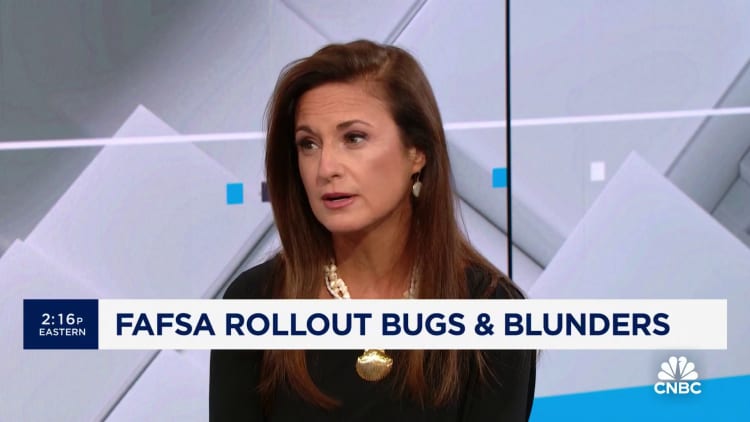
By most accounts, the rollout of the new Free Application for Federal Student Aid, better known as FAFSA, was disastrous from the start. Even now, some college students don’t know the status of their aid awards for the fall.
“The Department’s poor planning has led to a stunning failure: Some college students might not have financial aid dollars in their hands in time to start classes in the next few weeks,” said Beth Maglione, interim president and CEO of the National Association of Student Financial Aid Administrators.
To avoid the same issues going forward, the U.S. Department of Education recently announced that the launch of next year’s federal student aid application form will also be delayed.
A ‘new approach’ for the 2025-26 FAFSA
The 2025-26 FAFSA will be available to applicants on or before Dec. 1, following a phased rollout starting on Oct. 1 to “identify and resolve the kind of system errors that can derail millions of students,” the Education Department said. (Typically, students have access to the coming academic year’s form in October.)
“Following a challenging 2024-25 FAFSA cycle, the Department listened carefully to the input of students, families, and higher education institutions, made substantial changes to leadership and operations at Federal Student Aid, and is taking a new approach this year that will significantly improve the FAFSA experience,” U.S. Secretary of Education Miguel Cardona said in a statement.
More from Personal Finance:
The best private and public colleges for financial aid
Harvard is back on top as the ultimate ‘dream’ school
More of the nation’s top colleges roll out no-loan policies
Higher education expert Mark Kantrowitz said he is skeptical that the department will be able to address all of the challenges that have plagued this year’s federal student aid application in the months ahead, not to mention next year’s form.
“Given that there are still more than two dozen unresolved issues from the 2024-25 FAFSA, it remains to be seen whether the 2024-25 FAFSA will be fully implemented by October 1 — or December 1 — let alone the 2025-26 FAFSA,” Kantrowitz said.
“Just because the U.S. Department of Education says that it will get it done by December 1 doesn’t mean that they will get it done in time,” he added.
Families ‘are falling back on borrowing for college’
For many families, financial aid is crucial when it comes to covering college costs, which have now crept into the six figures.
The FAFSA serves as the gateway to all federal aid money, including federal student loans, work study and especially grants — which have become the most crucial kind of assistance because they typically do not need to be repaid.
In part because of issues with the new form, students are now relying on loans more, according to Sallie Mae’s recent How America Pays for College report. The share of parents taking out federal parent PLUS loans to help cover the costs of their children’s college education has also grown, other studies show.
“We’ve really seen that in times of economic hardship, [families] are falling back on borrowing for college,” said Jennifer Berg, vice president of public affairs for market research firm Ipsos, which partnered with Sallie Mae on the report.
“That’s when the FAFSA really plays a role,” Berg said.
To that end, it’s more important that the FAFSA is fully functional for next year, even if it means another delayed start, most experts say.
“The fact that we are still, to this day, dealing with the aftershocks of this year’s FAFSA rollout shows just how imperative it is that the process is thoroughly tested from end to end,” said the National Association of Student Financial Aid Administrators’ Maglione.
Although a reliable FAFSA trumps the postponement, “we acknowledge this is a difficult trade-off between functionality and the release date,” added Kim Cook, CEO of the National College Attainment Network — but it’s worth it as long as the FAFSA is fully operable by December 1.
“Our students need to know they can afford college and stay on track to enroll,” Cook said.


Personal Finance
Next-Generation Retirement Planning: Managing Longevity Risk and Variable Income Streams


S&P 500 September Outlook: Tech Rally Holds Index at 7,600

India Unveils ‘Saptadhara’ Reform Agenda Targeting Technology, Youth Skilling, and Growth

S&P 500 Outperforms Amid Strong Corporate Earnings as Treasury Yields Cap Equity Multiples

Armanino adds Strategic Accounting Outsourced Solutions

New 2023 K-1 instructions stir the CAMT pot for partnerships and corporations

Tax Strategy: Employee Retention Credit update
-

 Stock News1 week ago
Nvidia Q2 FY2027 Earnings beats Wall Street Expectation with Record $96.2 Billion Revenue
-

 Technology6 days ago
AI Infrastructure Boom Hits Physical Limits: Power, Financing, and Supply Chain Strain
-

 Economics4 days ago
U.S.- Canada Trade Talks Collapse; Carney Says Retaliatory Tariffs Begin September 8
-

 Technology4 days ago
Flock Cameras and the Future of Public Security
-

 Insights1 hour ago
Climate Resilience and Offshore Wind and Land Restoration Milestones
-
 Stock News1 minute ago
S&P 500 September Outlook: Tech Rally Holds Index at 7,600
-

 Accounting1 hour ago
Mandatory ESG Reporting Standards Demand Standardized Non-Financial Audit Trails
-
 Finance38 minutes ago
S&P 500 Outperforms Amid Strong Corporate Earnings as Treasury Yields Cap Equity Multiples