
Finance
Fed Chair Powell says central bank doesn’t ‘need to be in a hurry’ to lower interest rates further

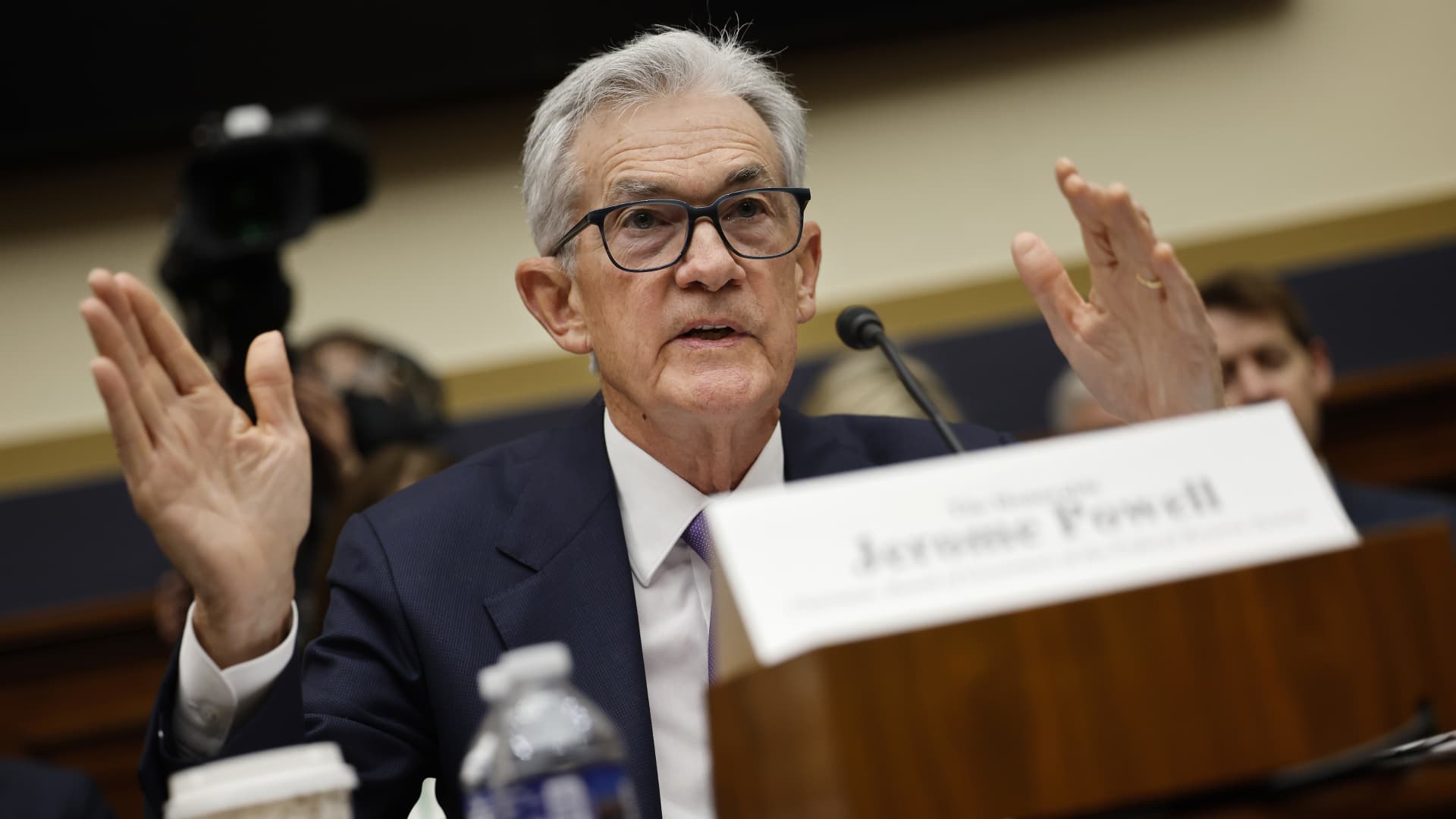
Federal Reserve Bank Chairman Jerome Powell testifies before the House Financial Services Committee in the Rayburn House Office Building on Capitol Hill on March 06, 2024 in Washington, DC.
Chip Somodevilla | Getty Images
Federal Reserve Chair Jerome Powell on Tuesday reiterated the central bank’s commitment to bringing inflation down and signaled that policymakers aren’t in a rush to push interest rates lower.
In remarks before the Senate Banking Committee, Powell called the economy “strong overall” with a “solid” labor market and inflation that is easing but still above the Fed’s 2% goal.
With those conditions prevailing, he said the Fed doesn’t need to move quickly to ease monetary policy.
“With our policy stance now significantly less restrictive than it had been and the economy remaining strong, we do not need to be in a hurry to adjust our policy stance,” Powell said. “We know that reducing policy restraint too fast or too much could hinder progress on inflation. At the same time, reducing policy restraint too slowly or too little could unduly weaken economic activity and employment.”
Powell’s comments came in the first of two appearances this week on Capitol Hill. He speaks to the Senate Banking Committee on Tuesday then the House Financial Services Committee on Wednesday.
Much of the proceeding focused on bank supervision rather than monetary policy.
Ranking Democratic Sen. Elizabeth Warren of Massachusetts charged that President Donald Trump’s move to halt the work of the Consumer Financial Protection Bureau left consumers without a watchdog of the nation’s largest banks.

Warren asked Powell who is administering consumer compliance outside of the CFPB, to which he responded, “I can say no other federal regulator.” Powell nonetheless said the broader banking system is safe.
On monetary policy, Powell’s remarks were largely in keeping with his recent statements and those of his colleagues, who are digesting a number of fiscal and monetary dynamics that make for an uncertain environment.
Most prominently, Trump has launched an aggressive campaign to institute tariffs against the largest U.S. trading partners, in one sense to level the economic playing field and in another to enforce foreign policy goals against illegal immigration and drug smuggling, specifically fentanyl.
Powell did not mention any of that in his prepared remarks but was expected to face questioning on tariffs and other issues from panel members.
In one exchange, he again noted that it is not the Fed’s policy or responsibility to get involved in fiscal policy.
“I think the standard case for for free trade and all that logically still makes sense. It didn’t work that well when we have one very large country that doesn’t really play by the rules,” Powell said. “In any case, it’s not the Fed’s job to make or comment on tariff policy … That’s for elected people and and it’s not for us to comment. Ours is to try to react to it in a thoughtful, sensible way and make monetary policy so that we can achieve our mandate.”
Markets have interpreted the recent messaging as indications that the Fed will be on hold with rates, probably into the summer, after cutting its benchmark borrowing level by a full percentage point in the latter part of 2024.
Powell said the current policy stance, with the benchmark fed funds rate in a range between 4.25%-4.5%, is providing flexibility. The Federal Open Market Committee held the rate in place at its late-January meeting.
“We are attentive to the risks to both sides of our dual mandate, and policy is well positioned to deal with the risks and uncertainties that we face,” he said.
Shortly after taking office, Trump said he would “demand” that interest rates come down “immediately.” However, in subsequent remarks he said he agreed with the decision to keep rates in place, while Treasury Secretary Scott Bessent said the administration is more focused on seeing the 10-year Treasury yield move lower than on the Fed’s actions, which more strongly influence shorter-term rates.
Mortgage rates have held high even as the Fed has cut, and Powell said that could change ahead.
“It’s true that mortgage rates have gone or remained high, but that’s not so directly related to the Fed’s rate,” Powell said. “It’s really related more to long-term bond rates, particularly the Treasury, the 10-year Treasury, 30-year Treasury, for example. And those are high for reasons not particularly closely related to Fed policy.”
Powell said mortgage rates could come down as the Fed keeps rates low, though he’s unsure when that could happen.




Nvidia Q2 FY2027 Earnings beats Wall Street Expectation with Record $96.2 Billion Revenue

Treasury Bond Volatility Forces Bessent to Double Debt Buyback Size as Yields Swing

Nvidia Earnings Preview: What Wall Street Expects From the AI Bellwether’s Q2 Report

Armanino adds Strategic Accounting Outsourced Solutions

New 2023 K-1 instructions stir the CAMT pot for partnerships and corporations

Tax Strategy: Employee Retention Credit update
-

 Economics1 week ago
Nvidia’s Potential $3 Billion SB Energy Investment Could Reshape AI Infrastructure
-

 Economics4 days ago
Top 10 Largest Economies by 2030: IMF & World Bank GDP Projections for Global Powerhouses
-

 Stock News4 days ago
How to understand Intel $15B Stock Offering
-

 Technology1 week ago
U.S.-China AI Competition Intensifies as Washington Pushes Allies to Choose Sides
-
 Stock News1 day ago
Nvidia Earnings Preview: What Wall Street Expects From the AI Bellwether’s Q2 Report
-
 Economics4 days ago
Economic Profile of the United States of America (2026–2030 Horizon)
-
 Leaders3 days ago
Jackson Hole 2026: What the First Symposium Under Fed Chair Kevin Warsh Means for Markets
-

 Economics3 days ago
U.S. National Debt Surpasses $40 Trillion for the First Time: What It Means for the Economy