Connect with us

Finance

Fed Governor Bowman says additional rate hike could be needed if inflation stays high

Published

on

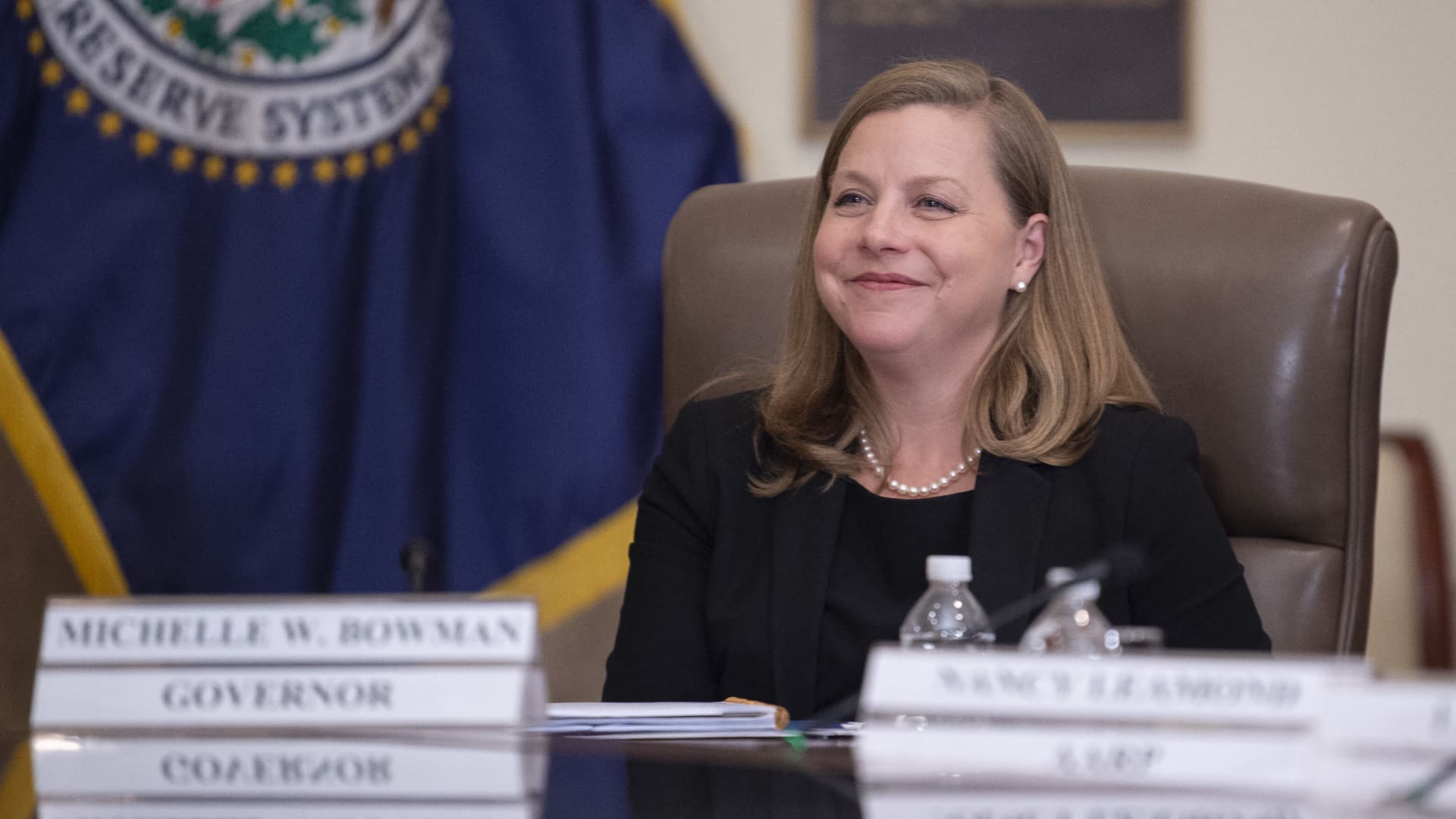
US Federal Reserve Governor Michelle Bowman attends a “Fed Listens” event at the Federal Reserve headquarters in Washington, DC, on October 4, 2019. 

Eric Baradat | AFP | Getty Images

Federal Reserve Governor Michelle Bowman said Friday that it’s possible interest rates may have to move higher to control inflation, rather than the cuts her fellow officials have indicated are likely and that the market is expecting.

Noting a number of potential upside risks to inflation, Bowman said policymakers need to be careful not to ease policy too quickly.

“While it is not my baseline outlook, I continue to see the risk that at a future meeting we may need to increase the policy rate further should progress on inflation stall or even reverse,” she said in prepared remarks for a speech to a group of Fed watchers in New York. “Reducing our policy rate too soon or too quickly could result in a rebound in inflation, requiring further future policy rate increases to return inflation to 2 percent over the longer run.”

As a member of the Board of Governors, Bowman is a permanent voting member of the rate-setting Federal Open Market Committee. Since taking office in late 2018, her public speeches have put her on the more hawkish side of the FOMC, meaning she favors a more aggressive posture toward containing inflation.

Bowman said her most likely outcome remains that “it will eventually become appropriate to lower” rates, though she noted that “we are still not yet at the point” of cutting as “I continue to see a number of upside risks to inflation.”

The speech, to the Shadow Open Market Committee, comes with markets on edge about the near-term future of Fed policy. Statements this week from multiple officials, including Chair Jerome Powell, have indicated a cautious approach to cutting rates. Atlanta Fed President Raphael Bostic, an FOMC voter, told CNBC he likely sees just one reduction this year, and Minneapolis Fed President Neel Kashkari indicated no cuts could happen if inflation does not decelerate further.

Futures traders are pricing in three cuts this year, though it has become a close call between June and July for when they start. FOMC members in March also penciled in three cuts this year, though one unidentified official in the “dot plot” indicated no decreases until 2026 and there was considerable dispersion otherwise about how aggressively the central bank would move.

“Given the risks and uncertainties regarding my economic outlook, I will continue to watch the data closely as I assess the appropriate path of monetary policy, and I will remain cautious in my approach to considering future changes in the stance of policy,” Bowman said.

Weighing inflation risks, she said that supply-side improvements that helped bring numbers down this year may not have the same impact going forward. Moreover, she cited geopolitical risks and fiscal stimulus as other upside risks, along with stubbornly higher housing prices and labor market tightness.

“Inflation readings over the past two months suggest progress may be uneven or slower going forward, especially for core services,” Bowman said.

Fed officials will get their next look at inflation data Wednesday, when the Labor Department releases the March consumer price index report.

Don’t miss these stories from CNBC PRO:

Continue Reading

Finance

Tokenized Debt Shifts How Corporate Manage Short Term Liquidity

Published

on

Tokenized Debt Shifts Corporate Liquidity

The landscape of institutional debt markets is undergoing a profound structural shift on July 21, 2026, as major corporate issuers and commercial banks rapidly accelerate the deployment of tokenized debt instruments. Data published by leading capital market consortiums indicates that primary issuances of digital commercial paper and tokenized corporate bonds have reached record volumes this month. By moving legacy debt origination, underwriting, and secondary distribution onto permissioned distributed ledgers, corporate treasurers are unlocking unprecedented operational flexibility and instantaneous cross-border liquidity.

The adoption of tokenized debt is fundamentally altering how enterprise balance sheets manage short-term liquidity needs. Traditional corporate bond settlement cycles historically required multi-day clearing processes involving numerous intermediaries, custodial entities, and clearinghouses. Through programmable smart contracts on distributed ledgers, issuers can now execute atomic settlement—enabling continuous, 24/7 access to institutional capital pools. This instantaneous clearing mechanism drastically reduces counterparty risk, eliminates costly settlement friction, and allows treasury teams to dynamically optimize working capital in real time.

A major catalyst driving this institutional migration is the establishment of comprehensive digital asset regulatory frameworks across major financial hubs. Clear legal guidelines regarding ledger-based securities ownership have provided institutional compliance officers with the regulatory confidence necessary to transition multi-billion-dollar liquidity facilities onto digital platforms. Furthermore, the integration of automated regulatory reporting directly into token smart contracts simplifies ongoing compliance audits, ensuring that secondary market trades automatically enforce investor accreditation limits and tax withholding requirements.

For chief financial officers and institutional portfolio managers, tokenized debt represents a fundamental evolution in fixed-income strategy. Companies that embrace ledger-based debt structures gain direct access to a broader, global base of digital-native institutional investors while substantially reducing borrowing overhead. As ledger interoperability continues to improve across global exchanges, tokenized debt is poised to become the standard infrastructure for global corporate finance.

Continue Reading

Finance

Private Credit Expansion: How Alternative Lending Platforms Are Reshaping Corporate Liquidity

Published

on

How Alternative Lending Platforms Are Reshaping Corporate Liquidity

Private credit has firmly established itself as a foundational pillar of global financial markets in 2026, transitioning from an alternative asset class into a dominant mechanism for middle-market corporate financing. Reports published in mid-July 2026 show that direct lending assets under management have expanded significantly, as corporate borrowers increasingly bypass traditional syndication desks in favor of customized private debt solutions. This structural migration has fundamentally altered corporate liquidity dynamics, providing middle-market enterprises with reliable access to tailored capital packages even during periods of regulatory bank tightening.

The primary driver of this continued growth is the structural flexibility inherent in private debt agreements. Unlike public bond markets or conservative commercial bank loans—which often carry rigid covenants and slow underwriting timelines—private credit funds offer speed of execution, flexible payment-in-kind structures, and customized debt-service frameworks. For companies undertaking strategic acquisitions, capital expenditures, or complex balance sheet recapitalizations, the ability to negotiate directly with a unified syndicate of private lenders provides significant certainty and confidentiality.

However, the expansion of private credit is attracting heightened regulatory attention and risk scrutiny. Financial regulatory bodies are closely evaluating the lack of secondary market price discovery and the potential concentration of illiquidity risks within non-bank financial institutions. Because private debt instruments are held to maturity and marked to model rather than marked to market, evaluating real-time enterprise valuations during economic shifts requires robust internal credit assessment standards. Analysts note that as loan portfolios mature, performance variations between disciplined lenders and aggressive underwriters will become increasingly apparent.

For corporate financial officers and institutional portfolio managers, private credit represents both a powerful strategic tool and a vital diversification strategy. Borrowers must weigh the higher nominal coupon rates of private debt against the tangible value of operational flexibility and execution certainty. Meanwhile, investors must maintain rigorous credit due diligence, prioritizing funds with proven restructuring capabilities and deep operational expertise in underwriting resilient middle-market businesses.

Continue Reading

Finance

Tokenized Real-World Assets: Institutional Ledger Adoption Achieves Scale in July 2026

Published

on

Institutional Ledger Adoption Achieves Scale in July 2026

The integration of blockchain technology with legacy financial markets has reached a decisive tipping point in July 2026, driven by the rapid scaling of Real-World Asset (RWA) tokenization. Major global investment banks, custodial entities, and asset managers are actively shifting sovereign debt, commercial paper, and private fund shares onto permissioned distributed ledgers. Recent industry data confirms that the aggregate market capitalization of tokenized treasury products and private credit funds has surged past major milestones, illustrating that ledger-based settlement is no longer experimental, but core financial infrastructure.

The fundamental value proposition of asset tokenization rests on operational efficiency, continuous liquidity, and automated compliance execution. By embedding regulatory checks, investor accreditation limits, and automated coupon distributions directly into smart contract code, financial institutions eliminate vast amounts of manual back-office reconciliation. Furthermore, fractionalized ownership structures allow high-value asset classes—such as prime commercial real estate and private equity funds—to be split into accessible units, significantly expanding liquidity pools and enabling real-time collateral optimization.

A key catalyst behind this institutional momentum is the establishment of comprehensive regulatory clarity across major financial jurisdictions. The implementation of standardized digital asset frameworks in the United States and Europe has provided institutional compliance officers with the legal certainty required to deploy capital on-chain. As a result, premier custodian banks are now offering unified digital asset custody, seamlessly bridging traditional securities depositories with programmable ledger ecosystems.

Looking forward, the maturation of tokenized assets will continue to transform secondary market trading and treasury management. Corporate treasurers can now yield-optimize idle cash in real time by moving into tokenized money market instruments that settle instantaneously on a 24/7 basis. To remain competitive, financial leaders must ensure their institutional architectures are interoperable with modern digital ledger protocols, positioning their organizations at the forefront of modern capital market efficiency.

Continue Reading

Trending