Connect with us

Finance

Fed Governor Miran says he did not tell Trump how he would vote on rates this week

Published

on

Federal Reserve Governor Stephen Miran: I don’t see any material inflation from tariffs

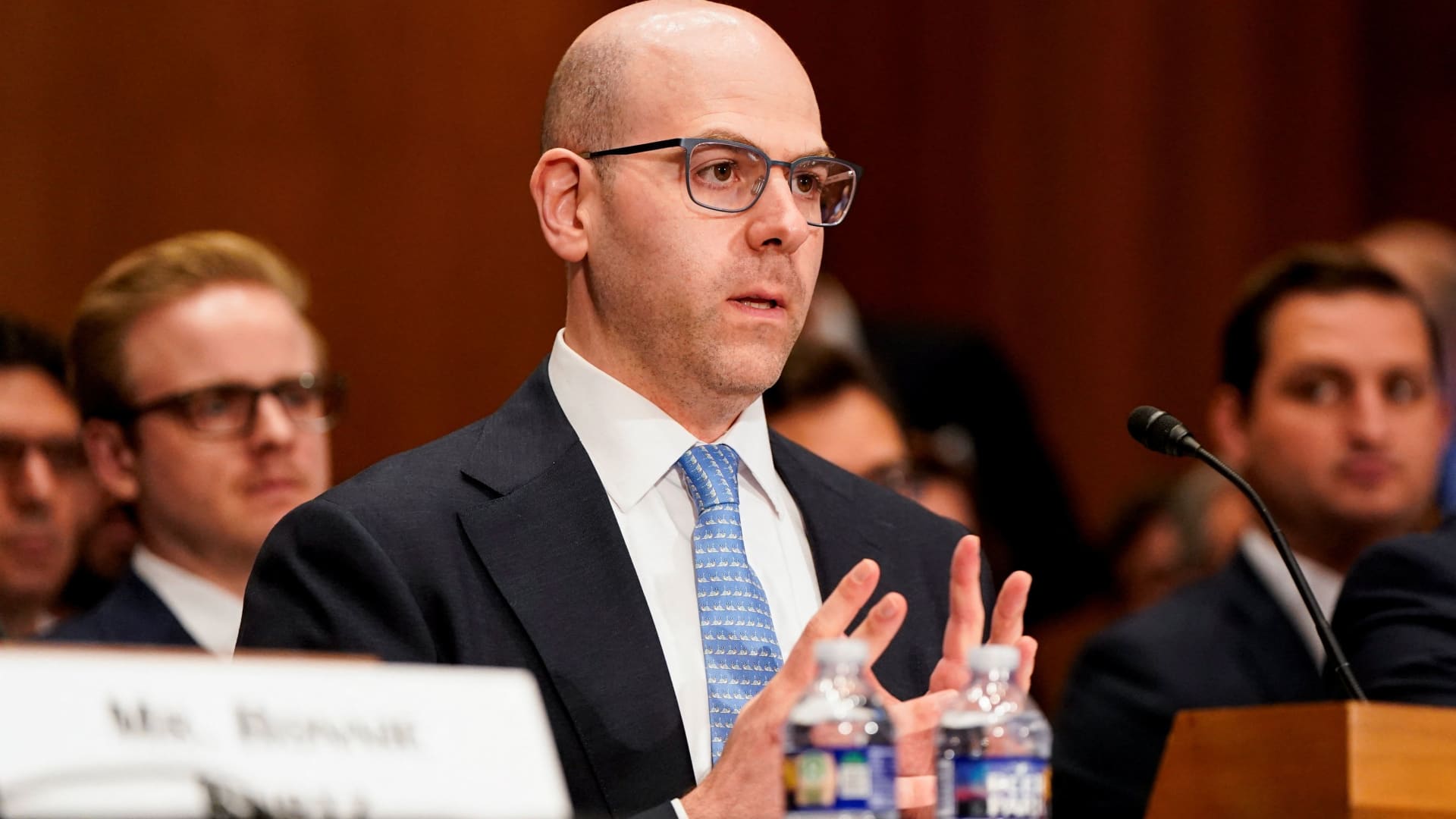
Federal Reserve Governor Stephen Miran told CNBC on Friday that he spoke only briefly to President Trump before this week’s interest rate decision and was not pressured on how to vote.

Miran, who voted against the quarter percentage point reduction in favor of a move twice that size, said he made his decision independently.

“He called me Tuesday morning to congratulate me, and that was it,” the central banker said during a “Squawk on the Street” interview. “I did not talk to him about how I vote. I did not talk to him about about my dots in the [Summary] of Economic Projections.”

Not only did Miran vote against the quarter-point move but also his “dot” for where he sees the fed funds rate at the end of this year was well below the rest of the 19 participants at the Federal Open Market Committee meeting. He also views rates being lower than most of the other officials.

Questions over Fed independence have intensified since Trump took office for his second term in January.

The president has been pushing hard for the Fed to lower interest rates aggressively, openly name-calling Chair Jerome Powell, whom he has nicknamed “Too Late.” In previous administrations, pressure on the Fed generally was done in a more discrete manner.

Also, Trump has sought to oust Governor Lisa Cook, and has said he would litmus-test Powell’s replacement next year for a willingness to ease monetary policy.

Along those lines, questions have arisen about potential conflicts for Miran taking a leave as head of the Council of Economic Advisers, rather than resigning. However, he called those concerns “a bit silly” as he only intends to stay at the Fed until the unexpired term he is filling ends in January 2026.

“If the President told me that I was going to stay in the seat past January, I would just resign immediately. You know, there’d be no there’d be no question about it,” he said. “The fact that people are saying this is, you know, that’s a motivator in terms of wanting to get my full views out there on Monday and walk through [them] in meticulous detail, because I do feel that I owe the world in accounting for why my views are so different.

Miran speaks Monday to the Economic Club of New York, a prime platform for leaders in the business and political world where Trump also has spoken.

This is breaking news. Please refresh for updates.

Continue Reading
Click to comment

Leave a Reply

Your email address will not be published. Required fields are marked *

Finance

Treasury Yields Rise as Fed Cut Expectations Shift

Published

on

Treasury Yields Rise as Fed Cut Expectations Shift

Fixed-income markets recorded significant re-pricing during the week ending July 25, 2026, as a convergence of strong labor market metrics and surging energy costs drove U.S. Treasury yields higher across all maturities. The benchmark 10-year Treasury yield climbed toward 4.70%, reaching its highest point in several months. Institutional bond investors rapidly adjusted portfolio durations as expectations for near-term interest rate cuts by the Federal Reserve faded in response to inflation concerns.

The upward shift in sovereign yields reflects a broader fundamental reassessment of global monetary policy. Earlier in the quarter, money markets had priced in a series of rate reductions designed to support economic activity. However, with initial jobless claims falling to 187,000 and crude oil breaching $100 per barrel, fixed-income traders are pricing in a ‘higher-for-longer’ interest rate environment. The inversion between short-term Treasury bills and long-term bonds narrowed, indicating a shift toward term premium expansion.

Rising Treasury yields present both challenges and opportunities for institutional wealth managers. While commercial lenders and mortgage origination volumes face headwinds from elevated borrowing costs, fixed-income investors are locking in attractive real yields on high-quality sovereign and investment-grade corporate bonds. Institutional debt issuers, conversely, are recalibrating their capital structures, opting for shorter-term refinancing instruments or private credit facilities to avoid committing to elevated long-term coupon rates.

Navigating the current bond market landscape demands strict duration management and credit selection. Wealth advisors recommend maintaining flexible fixed-income allocations, combining short-duration Treasuries with inflation-protected securities (TIPS) to shield capital against potential energy-driven inflation spikes while earning dependable nominal income.

Continue Reading

Finance

Private Credit Expansion Transforms Corporate Loans

Published

on

Private Credit Expansion Transforms Corporate Loans

Private credit markets reached a pivotal milestone during the week ending July 25, 2026, as non-bank direct lending consortiums captured a record share of middle-market corporate debt originations. With commercial banks maintaining conservative credit standards and public bond yields remaining elevated, corporate borrowers are increasingly turning to private fund managers for customized capital solutions. This expansion marks a permanent structural shift in enterprise finance, establishing private credit as a primary pillar of institutional corporate liquidity.

The acceleration of private credit deals is driven by speed, deal certainty, and flexible terms. Unlike traditional syndicated bank loans that require lengthy underwriting, credit rating approvals, and public roadshows, private direct lenders can structure tailored financing packages within days. Middle-market firms facing upcoming debt maturities are utilizing private debt facilities to execute recapitalizations, strategic acquisitions, and growth capital deployments without risking execution delay in public markets.

However, financial regulators and central bank supervisors are scrutinizing the sector’s rapid growth. Supervisory agencies are evaluating potential systemic risks associated with non-bank leverage, valuation transparency, and liquidity mismatches during economic downturns. Despite regulatory interest, major pension funds, insurance firms, and sovereign wealth entities continue to expand capital allocations to private credit funds, attracted by reliable floating-rate yields that outperform public fixed-income benchmarks.

As private credit matures into a dominant asset class, corporate chief financial officers must evaluate non-bank lenders alongside traditional banking relationships. Direct lending partnerships provide valuable balance sheet resilience, enabling companies to secure flexible financing terms even during periods of public market turbulence.

Continue Reading

Finance

Tokenized Debt Shifts How Corporate Manage Short Term Liquidity

Published

on

Tokenized Debt Shifts Corporate Liquidity

The landscape of institutional debt markets is undergoing a profound structural shift on July 21, 2026, as major corporate issuers and commercial banks rapidly accelerate the deployment of tokenized debt instruments. Data published by leading capital market consortiums indicates that primary issuances of digital commercial paper and tokenized corporate bonds have reached record volumes this month. By moving legacy debt origination, underwriting, and secondary distribution onto permissioned distributed ledgers, corporate treasurers are unlocking unprecedented operational flexibility and instantaneous cross-border liquidity.

The adoption of tokenized debt is fundamentally altering how enterprise balance sheets manage short-term liquidity needs. Traditional corporate bond settlement cycles historically required multi-day clearing processes involving numerous intermediaries, custodial entities, and clearinghouses. Through programmable smart contracts on distributed ledgers, issuers can now execute atomic settlement—enabling continuous, 24/7 access to institutional capital pools. This instantaneous clearing mechanism drastically reduces counterparty risk, eliminates costly settlement friction, and allows treasury teams to dynamically optimize working capital in real time.

A major catalyst driving this institutional migration is the establishment of comprehensive digital asset regulatory frameworks across major financial hubs. Clear legal guidelines regarding ledger-based securities ownership have provided institutional compliance officers with the regulatory confidence necessary to transition multi-billion-dollar liquidity facilities onto digital platforms. Furthermore, the integration of automated regulatory reporting directly into token smart contracts simplifies ongoing compliance audits, ensuring that secondary market trades automatically enforce investor accreditation limits and tax withholding requirements.

For chief financial officers and institutional portfolio managers, tokenized debt represents a fundamental evolution in fixed-income strategy. Companies that embrace ledger-based debt structures gain direct access to a broader, global base of digital-native institutional investors while substantially reducing borrowing overhead. As ledger interoperability continues to improve across global exchanges, tokenized debt is poised to become the standard infrastructure for global corporate finance.

Continue Reading

Trending