
Personal Finance
Fed likely to hold interest rates steady despite Trump’s pressure

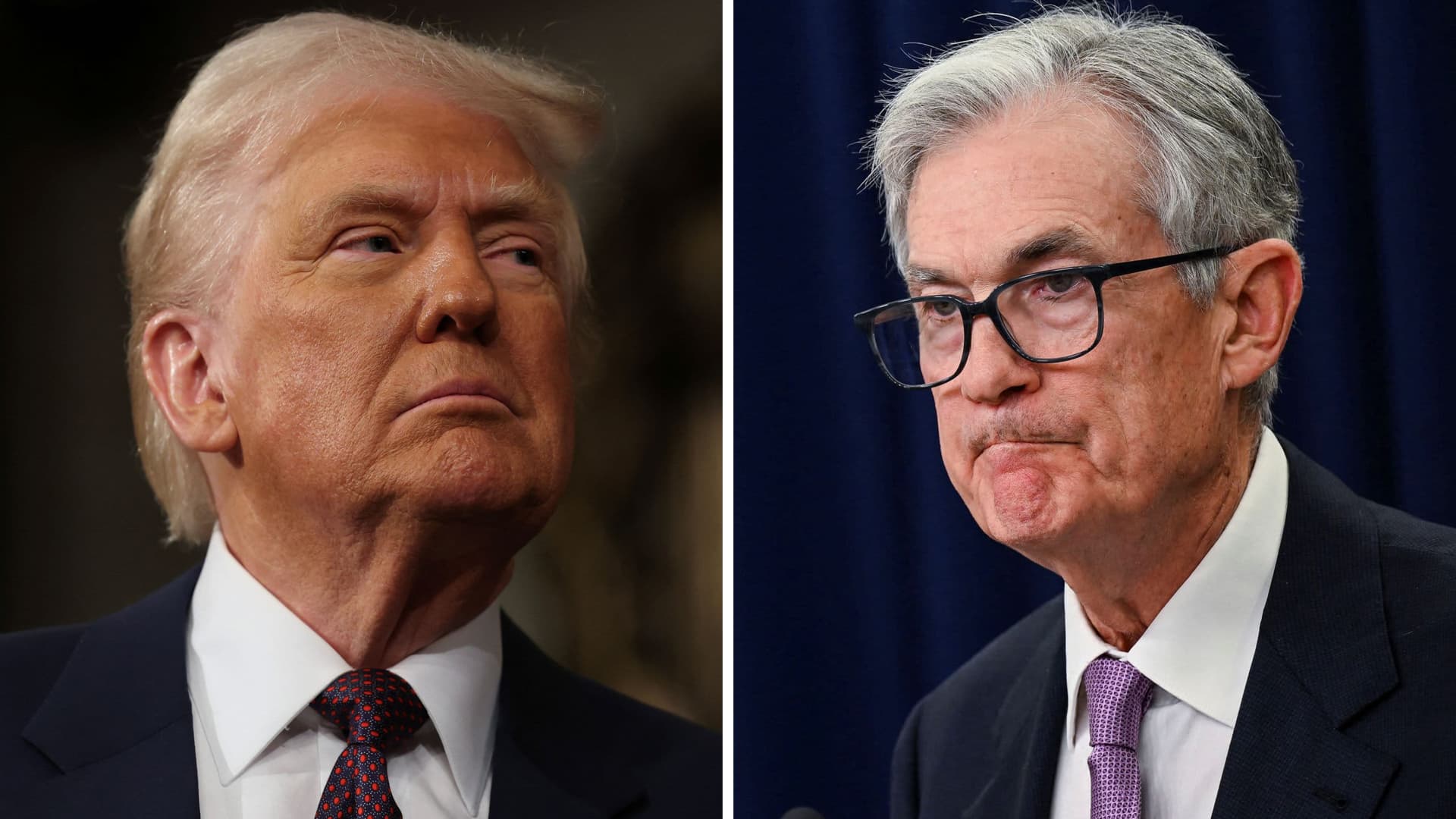

Ahead of next week’s Federal Reserve meeting, relations between President Donald Trump and Fed Chair Jerome Powell have hit a low.
“Families are being hurt because Interest Rates are too high,” Trump wrote in a Truth Social post on Wednesday.
Trump has said he wants the Fed to sharply lower interest rates by as much as 3 percentage points to spur economic growth. (Although the central bank typically adjusts its benchmark in 25-basis-point increments, rates were slashed to near zero as recently as the Covid pandemic. “The Fed only resorts to such extreme measures in response to severe economic distress,” said Greg McBride, chief financial analyst at Bankrate.)
The president has argued that maintaining a federal funds rate that is too high makes it harder for businesses and consumers to borrow and puts the U.S. at an economic disadvantage to countries with lower rates.
The Fed’s benchmark sets what banks charge each other for overnight lending, but also has a trickle-down effect on almost all of the borrowing and savings rates Americans see every day.
More from Personal Finance:
Trump’s ‘big beautiful bill’ slashes CFPB funding
78% say Trump’s tariffs will make it harder to deal with debt
Tax changes under Trump’s ‘big beautiful bill’ — in one chart
Powell said earlier this month that the Fed likely would have cut rates by now, but that it has held off due to the uncertainty and inflation risks posed by Trump’s tariff agenda. Many economists say that the full impact from tariffs on pricing has only just started to be felt, and inflation could pick up in the second half of the year.
Since December, the federal funds rate has remained steady in a target range of 4.25% to 4.5%. Futures market pricing is implying almost no chance of an interest rate cut when the Fed meets next week, according to the CME Group’s FedWatch gauge. Market pricing indicates the Fed is much more likely to consider a rate cut in September.
Once the fed funds rate comes down, consumers could see their borrowing costs start to fall as well.
However, “there is no guarantee this would translate into lower rates,” said Brett House, an economics professor at Columbia Business School — “largely because many types of borrowing, mortgage rates specifically, are not benchmarked off the Fed.”
From mortgage rates and auto loans to credit cards and savings accounts, here’s a look at how the Fed affects your finances.
Mortgages
Trump said in a July 23 social media post that “Housing in our Country is lagging because Jerome ‘Too Late’ Powell refuses to lower Interest Rates.”
But fixed mortgage rates, specifically, don’t directly track the Fed: They are largely tied to Treasury yields and the U.S. economy. As concerns over tariffs and the broader economy drive Treasury yields higher, mortgage rates also remain stubbornly high.

The average rate for a 30-year, fixed-rate mortgage is currently near 6.8%, according to Bankrate. The nationwide problem of limited inventory and housing affordability is a key issue, regardless of the Fed’s next move.
The housing market “continues to struggle under high home prices as well as high mortgage rates,” Eugenio Aleman, chief economist at Raymond James, said in a statement. The median price of a home sold hit a record high in June, according to recent data.
Credit cards
Most credit cards have a variable rate, so there’s a more direct connection to the Fed’s benchmark.
Yet, regardless of the central bank’s next move, credit card rates are high and likely to stay there. The average annual percentage rate is currently just over 20%, according to Bankrate, not far from last year’s all-time record.
“Credit card rates have been in a holding pattern at a very elevated level,” McBride said.
Even if APRs were 3 percentage points lower, that would not significantly ease the burden of a revolving balance, most experts say.
Auto loans
Auto loan rates are fixed for the life of the loan. Payments keep getting bigger because car prices are rising, in addition to pressure from Trump’s plan to impose higher tariffs on foreign-made vehicles and car parts.
Currently, the average rate on a five-year new car loan is 7.22%, according to Bankrate.
“Consumers are continuously stretching to afford new vehicles in this market,” said Ivan Drury, Edmunds’ director of insights. Now, the share of new-car buyers with a car payment of more than $1,000 a month is at all-time high.
Student loans
Savings
On the upside, top-yielding online savings accounts still offer above-average returns and currently pay more than 4%, according to Bankrate.
While the central bank has no direct influence on deposit rates, the yields tend to be correlated to changes in the target federal funds rate — so holding that rate unchanged has kept savings rates above the rate of inflation, which is considered a rare win.
“It’s not a good time to be a borrower, but it’s a great time to be a saver — lean into that,” said Bankrate’s McBride.


Personal Finance
Next-Generation Retirement Planning: Managing Longevity Risk and Variable Income Streams


U.S.- Canada Trade Talks Collapse; Carney Says Retaliatory Tariffs Begin September 8

Flock Cameras and the Future of Public Security

AI Infrastructure Boom Hits Physical Limits: Power, Financing, and Supply Chain Strain

Armanino adds Strategic Accounting Outsourced Solutions

New 2023 K-1 instructions stir the CAMT pot for partnerships and corporations

Tax Strategy: Employee Retention Credit update
-

 Stock News1 week ago
Nvidia Earnings Preview: What Wall Street Expects From the AI Bellwether’s Q2 Report
-

 Accounting1 week ago
SEC’s Semiannual Reporting Proposal Faces Investor Pushback: What CFOs Need to Know
-

 Stock News1 week ago
Nvidia Q2 FY2027 Earnings beats Wall Street Expectation with Record $96.2 Billion Revenue
-

 Finance1 week ago
Treasury Bond Volatility Forces Bessent to Double Debt Buyback Size as Yields Swing
-
 Technology5 days ago
AI Infrastructure Boom Hits Physical Limits: Power, Financing, and Supply Chain Strain
-
 Technology3 days ago
Flock Cameras and the Future of Public Security
-
 Economics3 days ago
U.S.- Canada Trade Talks Collapse; Carney Says Retaliatory Tariffs Begin September 8