
Personal Finance
Federal minimum wage has been $7.25 for 15 years. How that may change

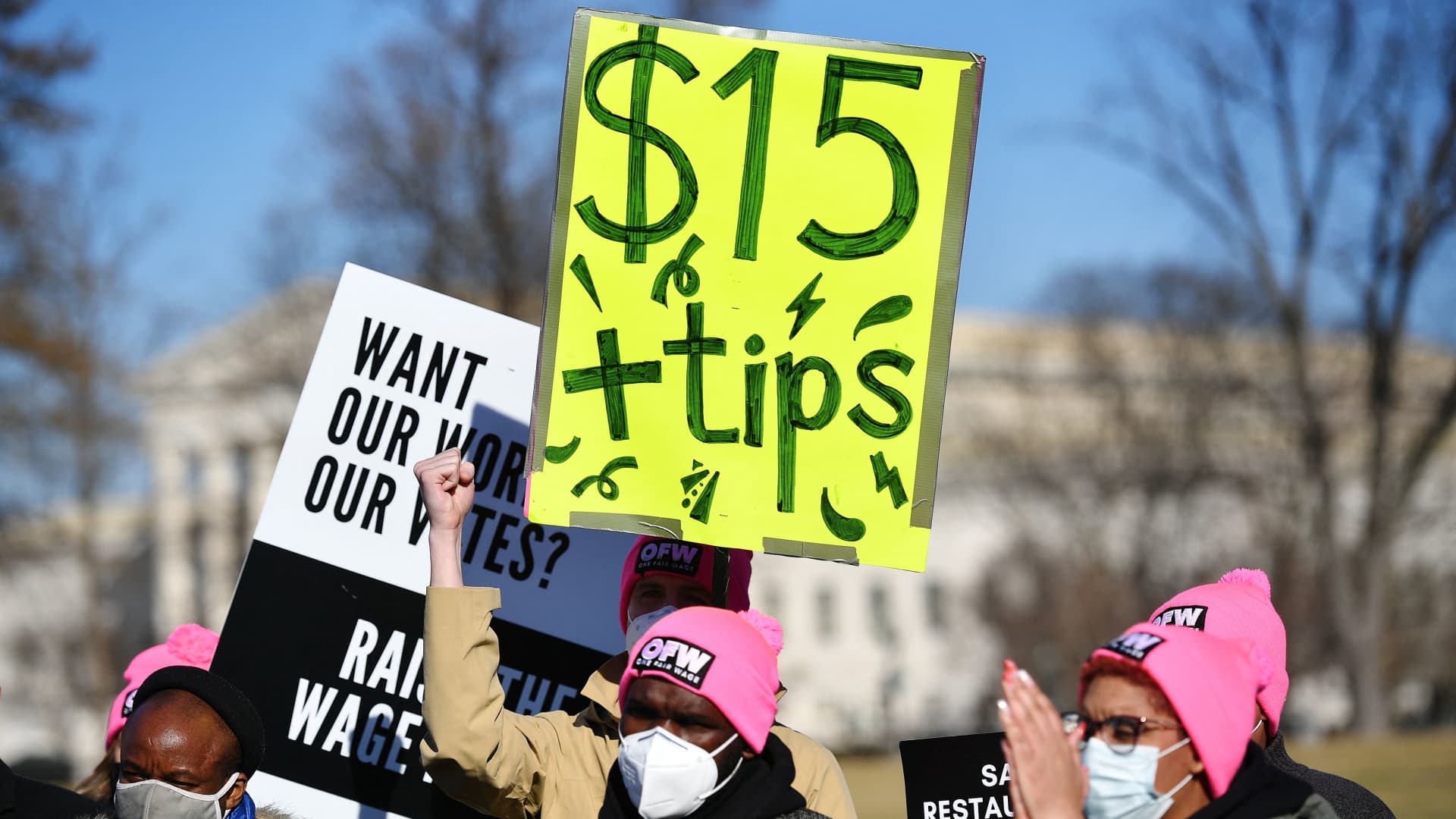
Activists demonstrate in support of a $15-per-hour minimum wage and tips for restaurant workers in Washington, D.C. on Feb. 8, 2022.
Mandel Ngan | AFP | Getty Images
The federal minimum wage recently marked a new anniversary. But for affected workers, that may not be something to celebrate.
The federal minimum wage has now been stuck at $7.25 per hour for 15 years.
On the campaign trail, Democratic presidential nominee Kamala Harris recently suggested that should change.
“When I am president, we will continue our fight for working families of America, including to raise the minimum wage and eliminate taxes on tips for service and hospitality workers,” Harris said at an Aug. 10 Nevada campaign event.
More from Personal Finance:
Trump and Harris both want no taxes on tips. Experts don’t like the idea
Walz vs. Vance: What candidates could mean for your wallet
Trump doubles down on call for presidential influence on Fed policy
Many states have enacted minimum hourly pay rates that are higher than the federal minimum wage. Yet 20 states have wages that are no higher than the federal level, according to Business for a Fair Minimum Wage. They include Alabama, Georgia, Idaho, Indiana, Iowa, Kansas, Kentucky, Louisiana, Mississippi, New Hampshire, North Carolina, North Dakota, Oklahoma, Pennsylvania, South Carolina, Tennessee, Texas, Utah, Wisconsin and Wyoming.
The federal minimum wage for tipped workers is $2.13 per hour, provided their tips bring them to the $7.25 per hour federal minimum wage. Michigan recently became the first state in more than four decades to eliminate the subminimum wage for tipped workers.
Harris has not said how high she wants to raise the minimum wage, though she has praised states that have raised the rate to at least $15 per hour.
The Harris campaign did not return a request for comment by CNBC.
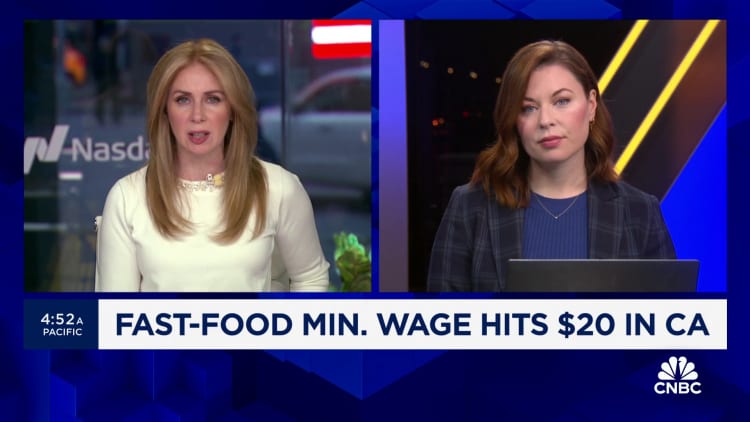
Congressional Democrats in 2021 tried to raise the federal minimum wage to $15 per hour as part of a broader Covid relief package. However, those efforts failed after it was determined the change could not be included in legislation handled through a one-party majority.
During a 2020 debate, then President Donald Trump expressed concerns about whether raising the federal pay threshold would hurt small businesses.
“How are you helping your small businesses when you’re forcing wages?” Trump said during the 2020 debate. “What’s going to happen and what’s been proven to happen is when you do that these small businesses fire many of their employees.”
Trump’s campaign did not respond a request for comment by CNBC.
A CNBC survey from earlier this year found a majority of small business owners — 61% — support raising their state’s minimum wage, though half said such a change could make it difficult to be able to afford to pay workers who are critical to their businesses.
One point that tends to get lost in the minimum wage debate is the connection between a higher wage and stronger consumer buying power, according to Holly Sklar, CEO of advocacy group Business for a Fair Minimum Wage.
“When you lose minimum wage buying power, it means you’re losing customer buying power,” Sklar said.
Once workers earn higher minimum wages, they will be more likely to spend that money, which will help businesses, she said.
Raising today’s federal minimum wage would help low-wage workers who are trying to earn a living and have a sense of economic security, said Ben Zipperer, senior economist at the Economic Policy Institute, a Washington, D.C., think tank that provides economic research.
“The minimum wage has basically lost, 29%, 30% of its purchasing power over the last 15 years, simply because Congress has failed to update it,” Zipperer said.
Lifting the minimum wage threshold to $15 per hour would increase the incomes of about 20 million workers, Zipperer said. That would include people who are low-wage workers who may be earning hourly pay that is slightly more than the federal minimum wage threshold.
“Changes in wages don’t necessarily result in big changes in employment,” Zipperer said.
“When you raise wages at a particular workplace, that makes it a lot easier to recruit and retain workers,” he said.
Some companies, such as Target and Walmart, have set their own higher minimum pay thresholds, at $15 and $14 per hour, respectively, in response to tight retail labor market conditions.
Still, advocates hope for a broader change at the national level.
“We look forward to supporting efforts to raise the minimum wage in the next White House, in the next Congress, and showing that there’s a very good business case for that,” Sklar said.


Personal Finance
Next-Generation Retirement Planning: Managing Longevity Risk and Variable Income Streams


S&P 500 September Outlook: Tech Rally Holds Index at 7,600

India Unveils ‘Saptadhara’ Reform Agenda Targeting Technology, Youth Skilling, and Growth

S&P 500 Outperforms Amid Strong Corporate Earnings as Treasury Yields Cap Equity Multiples

Armanino adds Strategic Accounting Outsourced Solutions

New 2023 K-1 instructions stir the CAMT pot for partnerships and corporations

Tax Strategy: Employee Retention Credit update
-

 Stock News1 week ago
Nvidia Q2 FY2027 Earnings beats Wall Street Expectation with Record $96.2 Billion Revenue
-

 Technology6 days ago
AI Infrastructure Boom Hits Physical Limits: Power, Financing, and Supply Chain Strain
-

 Economics4 days ago
U.S.- Canada Trade Talks Collapse; Carney Says Retaliatory Tariffs Begin September 8
-

 Technology4 days ago
Flock Cameras and the Future of Public Security
-

 Insights1 hour ago
Climate Resilience and Offshore Wind and Land Restoration Milestones
-
 Stock News3 minutes ago
S&P 500 September Outlook: Tech Rally Holds Index at 7,600
-
 Accounting1 hour ago
Mandatory ESG Reporting Standards Demand Standardized Non-Financial Audit Trails
-
 Finance39 minutes ago
S&P 500 Outperforms Amid Strong Corporate Earnings as Treasury Yields Cap Equity Multiples