
Accounting
Fireside chat with PCAOB acting chair George Botic

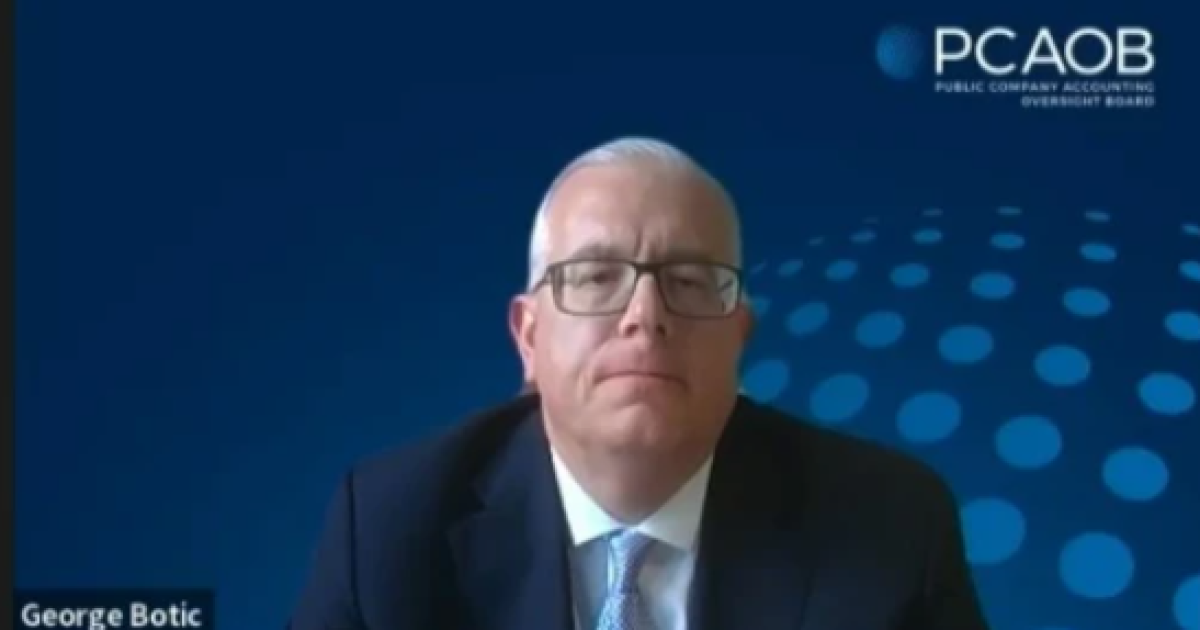
George Botic has a clear message for the auditing profession: Get back to basics while preparing for unprecedented change.
In an exclusive interview following his October speech at the Public Company Accounting Oversight Board’s Office of Economic and Risk Analysis Conference on Auditing and Capital Markets, the PCAOB’s acting chair outlined his vision for the regulator and the challenges faced by auditors today. His agenda centers on three critical issues: defining audit quality, monitoring the effects of the influx of private equity into accounting firms, and ensuring AI enhances rather than replaces professional judgment.
Defining what quality means
The PCAOB has spent two decades overseeing audits without a formal definition of audit quality. Botic wants to change that.
“Audit quality is like oxygen,” he said. “You don’t notice it until it’s gone.”

He proposes four core concepts: First, integrity and independence. Auditors must be free from conflicts of interest and maintain professional skepticism. Second, technical competence. Auditors need deep expertise in accounting principles and auditing standards. Third, audit performance. This includes rigorous testing, evidence gathering and due professional care. Fourth, outcomes and impacts. Audits must detect material misstatements and internal control weaknesses.
Botic believes the PCAOB should work with investors, auditors, audit committees, academics and preparers to create a unified definition. This won’t happen quickly. But Botic believes a clear benchmark will anchor the entire financial reporting ecosystem.
The private equity question
Private equity investments in accounting firms present both opportunities and risks. Private capital can fund succession planning, finance technology investments and support talent recruitment. It can help firms grow and potentially improve audit quality.
But Botic sees risks. Private equity firms seek returns by eventually selling their investments. This could reshape incentives in ways that prioritize profits over audit quality.
“The interests of private equity investors have the potential to reshape incentives for auditors in a way that prioritizes an accounting firm’s profits over audit quality,” Botic said.
He pointed to history for context. Arthur Wyatt wrote in 2003 about how profit focus affected auditors before Enron collapsed. Auditors took on more risk to maintain revenue. They scaled back procedures. Skepticism gave way to concurrence.
“The tension between an auditor’s professional obligations and the interest in maximizing profitability has always been with us,” Botic said. “But private equity threatens to dramatically increase the pressure on the profitability side of that tension.”
Over time, prioritizing profits can lead to reduced staffing on audit engagements, fewer specialists and compromised judgment in client acceptance decisions. The risks include impacts on auditor independence, changing incentive structures and reduced competition among firms that audit public companies.
PCAOB’s Standards and Emerging Issues Advisory Group recommended that the PCAOB work with the SEC and the National Association of State Boards of Accountancy on this issue. Botic also encourages the PCAOB to host public roundtables to explore near-term and long-term impacts of private equity on independence and audit quality.
AI and the automation paradox
Accounting firms are investing heavily in AI applications. The technology can scan massive datasets in seconds and flag anomalies humans might miss. But Botic worries about what he calls the automation paradox.
He quoted author Margaret Heffernan: “The less we do something, the worse we get at it.” If technology performs core audit procedures, auditors may lose the professional skepticism and judgment that form the foundation of audit quality.
“It leads one to believe that the more technology is used in performing an audit, the greater chance that the auditor’s professional skepticism and judgment could be at risk,” Botic said.
He’s not against AI. He recognizes its potential to improve audit quality. But the PCAOB needs to ensure technology enhances human oversight rather than replaces it. He thinks the PCAOB should study AI’s impact and host roundtables on how the technology will change audit execution in coming years with a focus on what the future of auditing may look like.
Near-term priorities and operational challenges
During our fireside chat on Friday, Nov. 7, Botic addressed three additional areas: audit standards implementation, enforcement activities and PCAOB funding.
On standards, the PCAOB has deferred the implementation date for
Smaller firms remain a priority. Botic noted they are critical to capital markets because the limited number of large firms cannot audit all public companies. The Board needs scalable standards that work for both Big Four firms and sole practitioners. The one-year QC 1000 delay should help smaller firms prepare.
On enforcement, Botic said it remains a key function for ensuring audit quality. Cases typically involve significant matters: repetition or recidivism, integrity issues such as exam cheating, or non-cooperation with the PCAOB. Most firms successfully remediate issues following the inspection process. Only a limited number face enforcement actions.
Botic declined to comment specifically on reported proposals for a 20% budget reduction for the PCAOB and cuts to Board member compensation. He emphasized the Board’s commitment to being good stewards of funding. “Core functions like inspections, standard setting, and enforcement must have sufficient funding. The Board is working closely with the SEC on budget matters, as it has in previous years.”
A marketplace of ideas
Throughout the interview, Botic returned to a central theme: The PCAOB must be a marketplace of ideas. The regulator needs input from academics, practitioners, investors and other stakeholders to make evidence-based decisions.
“To fulfill our statutory mission, I believe the PCAOB should be open to and actively seek out all ideas and viewpoints,” he said.
He has encouraged the PCAOB to host roundtables on private equity and artificial intelligence issues to bring stakeholders together for public discussion of pros and cons. The goal is to promote proactive regulation rather than reactive responses after problems occur. These areas are changing how audits are done. Botic believes the PCAOB needs to stay current rather than looking backward.
Botic made clear he speaks for himself, not the entire Board. But his emphasis on investor protection and the need for regulators to be current and proactive reflects his recognition that the marketplace is changing rapidly.
This approach reflects former PCAOB chair Jim Doty’s observation that the regulator has “some ability to reflect back on what it has seen, relate that to what it’s seeing now, and decide what needs to be done to enhance the quality of the audit.”
Botic’s vision represents a shift toward more engagement and transparency. He’s asking hard questions about fundamental issues the profession has debated for decades. Whether the PCAOB can deliver on this ambitious agenda remains to be seen. But auditors now know what their regulator is thinking and where it plans to focus.
The path forward requires what scholars Robert Mautz and Hussein Sharaf called “strenuous intellectual effort” in their 1961 treatise, “The Philosophy of Auditing.” That effort, Botic said, is not optional. It’s the price of trust.





U.S.- Canada Trade Talks Collapse; Carney Says Retaliatory Tariffs Begin September 8

Flock Cameras and the Future of Public Security

AI Infrastructure Boom Hits Physical Limits: Power, Financing, and Supply Chain Strain

Armanino adds Strategic Accounting Outsourced Solutions

New 2023 K-1 instructions stir the CAMT pot for partnerships and corporations

Tax Strategy: Employee Retention Credit update
-

 Stock News1 week ago
Nvidia Earnings Preview: What Wall Street Expects From the AI Bellwether’s Q2 Report
-

 Accounting1 week ago
SEC’s Semiannual Reporting Proposal Faces Investor Pushback: What CFOs Need to Know
-

 Stock News1 week ago
Nvidia Q2 FY2027 Earnings beats Wall Street Expectation with Record $96.2 Billion Revenue
-

 Finance1 week ago
Treasury Bond Volatility Forces Bessent to Double Debt Buyback Size as Yields Swing
-
 Technology5 days ago
AI Infrastructure Boom Hits Physical Limits: Power, Financing, and Supply Chain Strain
-
 Technology3 days ago
Flock Cameras and the Future of Public Security
-
 Economics3 days ago
U.S.- Canada Trade Talks Collapse; Carney Says Retaliatory Tariffs Begin September 8