
Accounting
Founder Files: Stephen Buller broke the Big Four mold

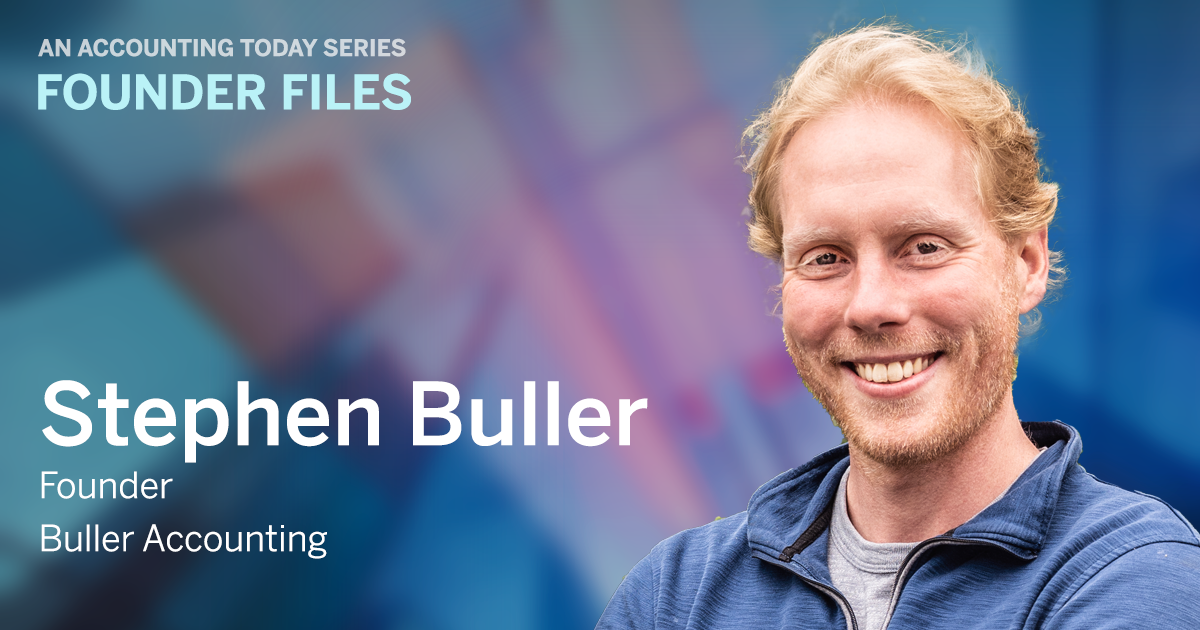

While most accountants dread conducting on-site inventory observations — often considered one of the rote tasks shoved onto those at the bottom of the food chain — Stephen Buller loved them.
While working for a Big Four firm, he remembers going to a lumber yard in his home state of Washington for an inventory count. He recalls walking around the snowy fields in soaked sneakers and socks, looking every bit the ill-dressed, out-of-place accountant, but loving every moment of it.
“I really enjoyed those experiences because I got to see the nuts and bolts of the business,” Buller said. “I think a lot of what I’ve taken into my own business now is that numbers are just numbers. Is a million dollars a lot? I don’t know, what’s the context? Is this a good revenue number? Am I paying too much for payroll?”
“The numbers are not enough,” he said. “You have to have context in the business.”
It’s one of the reasons he was never content working at the Big Four. Buller wanted to spend his hours helping business owners put more money in their bank account, not telling the Securities and Exchange Commission that a company’s finances check out.
“I never felt much satisfaction from the actual work that was being accomplished, and maybe that has to do with the intangible nature of numbers,” he said. “The final delivery of a $100,000 audit is a single page, written up, signed by the partner that basically says, ‘We don’t find any problems with your finances.’ That’s just the industry — it’s not necessarily a criticism of that product.”

‘It was really painful for me’
Buller studied accounting at the University of Washington. He was a member of Beta Alpha Psi, the accounting and finance honors society. From his interactions with recruiters through the society, he interned at the Big Four firm before graduating with his master’s degree and joining full time. But it wasn’t what he expected.
“It was really painful for me,” he said.
Buller didn’t enjoy the number of hours spent behind a desk. While the firm had an efficient and detailed audit methodology, he felt as though seniors and managers were always creating more work — even after the job was done.
“There were a couple of people I worked with, supervisors and managers, who bucked this trend,” he said. “They were really focused on, ‘These are the things we need to get done, and when we get those done we’re done. We don’t have to work hours we don’t need to.'”
He said it boils down to the billable hours you can charge a client: “I got the sense that partners never wanted to report fewer hours because that might justify a cut in the fee.”
Buller felt his proposed ideas for improving processes were usually shut down before even being considered. “This isn’t necessarily a criticism directly of [the firm] but just of any very large organization,” he said, referencing the “If it ain’t broke, don’t fix it” mentality.
He also disliked the lack of work-life balance: “The overall perspective of the public accounting industry is that 45 to 50 hours a week is a break. That’s like vacation to them.”
Buller left the firm in 2010 after about three years. He jumped around a variety of tech companies, startups and public companies as an accountant and controller. Around the same time as leaving the Big Four firm, Buller took his first swing at building his own company. He dropped a few thousand dollars on setting up a website to start an e-commerce business selling self-defense and security products, like pepper spray and tasers. The venture was unprofitable and he jumped ship after one of his managers told him he needed more time before he’d be ready to run a business.
He finally started his own practice, Buller Accounting, in 2015 after acquiring a bookkeeping firm from a local tax accountant who was selling. Buller’s firm offers a variety of services including bookkeeping, in-house payroll and more. With his five employees, he manages about 50 clients, mostly small-business owners based in Washington State and the Northwest Coast.
‘We can do things differently’
Buller’s creed is that he can do things differently at his firm.
“I felt like at [the Big Four firm] I was not treated like a human being, with thoughts and feelings, good ideas and bad ideas, wants and dreams, and hopes and fears. I felt very much like I was a tool. I was meant to be used, and when my productivity or patience had run out I was to be discarded. And I think that is awful,” he said. “I think there are plenty of good things that I take from [the Big Four firm], and then there are things that I say we can do differently.”
But Buller isn’t trying to rebuild the wheel. One of the things that he carries on from his time in the Big Four is the mantra, “If it’s not documented, it’s not done.”
Oftentimes, a business owner hiring an accountant doesn’t necessarily care how the work gets done — just as long as it gets done. Problems usually don’t arise until someone is audited, it’s tax season, or they receive a surprise letter from the IRS. That’s why showing his work is so important.
“Everybody messes up from time to time, and we can do our best to build processes that avoid mistakes, but they will still happen,” Buller said. “And so our real goal should not necessarily be to ensure no mistakes ever happen, but to ensure we can support what we did and why we did it.”
Where Buller does diverge from big firms is in his pricing model. He explained, “For me running my business, a huge part of being successful is knowing how much revenue is going to come in, and how many expenses are going to go out.”
It seems simple, he said, but it’s hard to do for many business owners who don’t know anything about accounting. For instance, when Buller tells a client they need to amend a filing, which may take a couple hours and result in an additional $500 added onto their bill, clients can feel blindsided.
So instead, Buller works with his clients for a couple of months to develop a thorough scope of what services they actually need, and then he quotes them a flat-rate fee. “If we do work outside of that scope, I do my best to tell the client ahead of time, ‘This is outside of scope, I think it’ll take about this much. Is that OK?’ And then anything that’s in scope that just happens to take us longer, then that’s on us.”
“So I just need to manage my hours very carefully and see what clients are consistently going over budget or under budget, and adjust accordingly,” he added.
For clients that consistently take him and his team less time than he has budgeted, he’ll voluntarily reach out and tell them he’s decreasing their bill by a certain amount. For clients that consistently take more time, he explains what he missed in the estimate that constitutes a higher bill, but he purposefully works on a month-to-month basis so as not to make clients feel as though they’re locked in to an unfavorable agreement.
Buller’s first piece advice, for young accountants especially, is the reminder, “You don’t know everything.”
“I think a really good way to start your career is to go to work in an industry that interests you. Work for a company, boss, team and people that you respect and enjoy,” he said.
He also does not recommend trying to start a business right out of college, warning that most people will lack the experience and knowledge necessary to do so effectively. “Instead, I would go to work for somebody who does what you want to do, learn as much as you can from them about what not to do and what to do, and then maybe move on to starting a business.”
And as someone who did not feel like he fit into the traditional accountant mold but loved the accounting itself, Buller emphasizes the broad scope for applying accounting skills: “Once you have that framework and you understand the debits and credits, the different accounts and how it all works, you can look at any business with a perceptive eye.”
“A lot of businesses come out of a couple of people working at some company, seeing the same complaint over and over again, and then saying, ‘Why don’t we start our own business and solve this problem?'” Buller said. “That’s the heart of entrepreneurship — seeing a problem and solving it — and people will pay you to do that.”
This story is part of





U.S.- Canada Trade Talks Collapse; Carney Says Retaliatory Tariffs Begin September 8

Flock Cameras and the Future of Public Security

AI Infrastructure Boom Hits Physical Limits: Power, Financing, and Supply Chain Strain

Armanino adds Strategic Accounting Outsourced Solutions

New 2023 K-1 instructions stir the CAMT pot for partnerships and corporations

Tax Strategy: Employee Retention Credit update
-

 Stock News1 week ago
Nvidia Q2 FY2027 Earnings beats Wall Street Expectation with Record $96.2 Billion Revenue
-
 Technology6 days ago
AI Infrastructure Boom Hits Physical Limits: Power, Financing, and Supply Chain Strain
-
 Economics4 days ago
U.S.- Canada Trade Talks Collapse; Carney Says Retaliatory Tariffs Begin September 8
-
 Technology4 days ago
Flock Cameras and the Future of Public Security