
Economics
From $1 trillion spending to F-35s, U.S.-Saudi pledges aren’t done deals yet

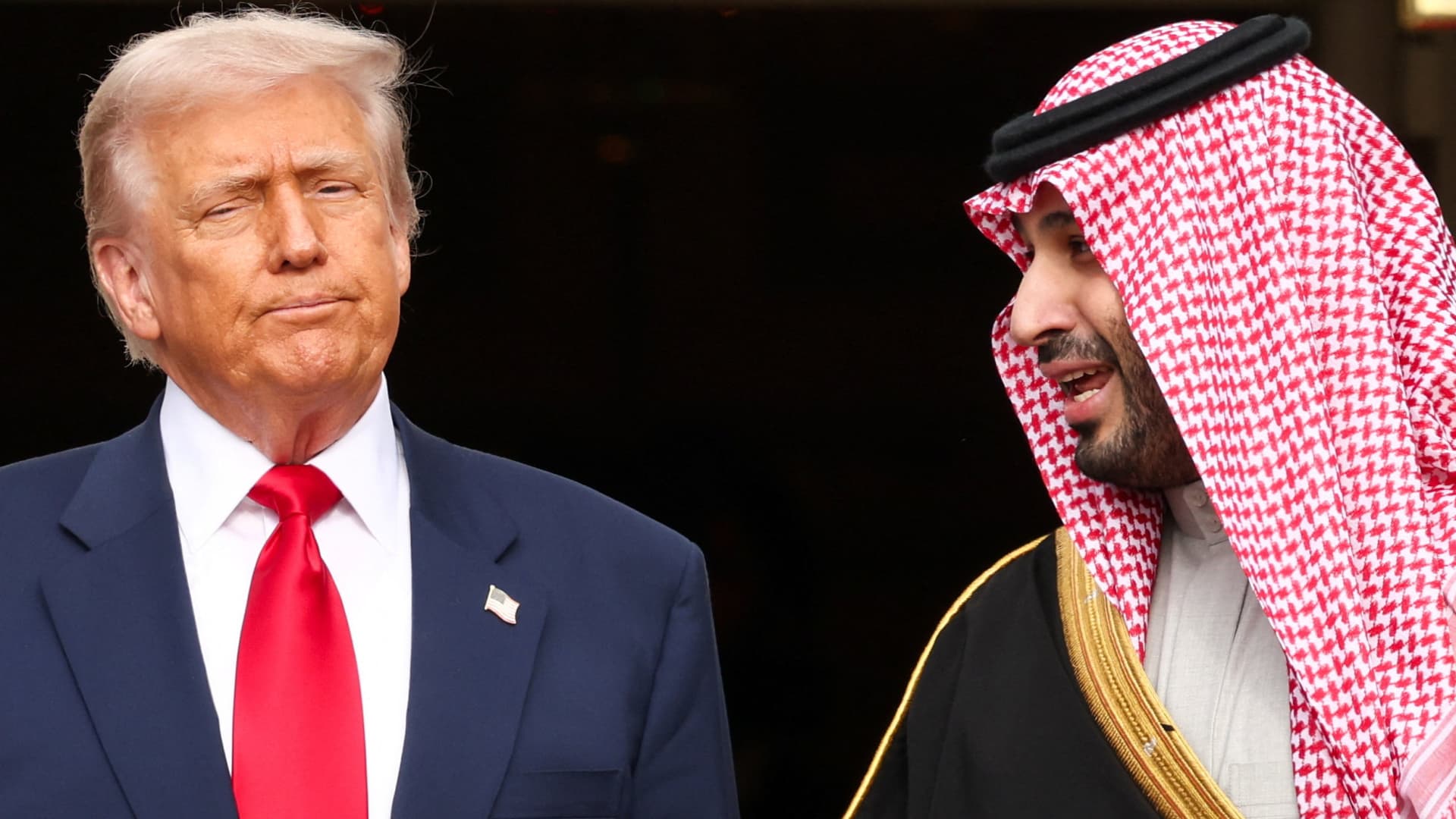
U.S. President Donald Trump welcomes Saudi Crown Prince and Prime Minister Mohammed bin Salman during an arrival ceremony on the South Lawn of the White House in Washington, D.C., U.S., November 18, 2025.
Kevin Lamarque | Reuters
U.S. President Donald Trump trumpeted Saudi Arabia’s $1 trillion investment pledge in the States and the potential sale of American fighter jets to Riyadh, but experts say there are lingering doubts over whether such deals will materialize.
Trump rolled out the red carpet for Saudi’s de facto ruler Crown Prince Mohammed bin Salman as he arrived in Washington on Tuesday for talks ranging from security to civil nuclear energy partnerships. The leaders signed a defense cooperation pact and held discussions about the potential sale of American F-35 fighter jets to the kingdom.
The U.S. visit by Mohammed bin Salman (or MBS, as he’s widely known) was not without controversy as it was the first time he had visited the States since the killing of Saudi critic and journalist Jamal Khashoggi in 2018.
U.S. intelligence determined that the crown prince had approved the operation that led to Khashoggi’s death in a Saudi consulate in Istanbul, but Riyadh denied any involvement in the murder.
Undeterred by global outrage over the death of Khashoggi, and question marks over Saudi Arabia’s rehabilitation and invitation to the White House, Trump and MBS said they had “finalized a series of landmark agreements that deepen the U.S.-Saudi strategic partnership.”
Among them, the White House said in a statement, was Saudi’s pledge to increase the $600 billion worth of investments in the U.S. that it made in May, to $1 trillion. The White House said the bump reflected “deepening trust and momentum for the United States under President Trump’s leadership.”
No further detail was given as to a time-scale around that trillion-dollar investment, however.
US President Donald Trump meets with Crown Prince and Prime Minister of the Kingdom of Saudi Arabia Mohammed bin Salman in the Oval Office of the White House in Washington, DC on Nov. 18, 2025.
Brendan Smialowski | AFP | Getty Images
A $1 trillion investment is equal to Saudi Arabia’s annual economic output in 2023 (of $1.07 trillion) and economists questioned whether that level of investment would, or could, materialize any time soon.
“These sort of pledges have become regular features of the international landscape, even when, as in the case of the EU [and it’s pledged investment in the U.S. as part of a trade deal] there’s absolutely no enforcement mechanism available,” Paul Donovan, chief economist at GBS Global Wealth Management, noted Wednesday.
“To put the Saudi pledge in context, that is the equivalent of almost an entire year’s GDP [gross domestic product] for the kingdom. The pledge may not therefore be honored in the near term,” he cautioned.
F-35s
In addition to the investment pledges, Trump and MBS discussed the sale of F-35 fighter jets to Saudi Arabia, with the kingdom reportedly looking to buy as many as 48 of the stealth fighter jets in what would be a multibillion-dollar deal.
The president “approved a major defense sale package, including future F-35 deliveries, which strengthens the U.S. defense industrial base and ensures Saudi Arabia continues to buy American,” the White House said. But no details were given on the number of planes sold, or any timeframe for their supply.

Such a sale could prove controversial with U.S. lawmakers whose sympathies and allegiance has traditionally leant toward Israel, the U.S.’ main and longstanding ally in the Middle East.
Israel is currently the only country in the Middle East to have F-35s and any sale of such advanced stealth technology to Saudi Arabia could be seen as risky, having the potential to shift military and power dynamics in the fractious region. For its part, the IDF is reportedly unhappy at the prospect of F-35 deal with Saudi Arabia, warning that Israel’s air superiority in the region would be jeapardized.
Trump shrugged off those concerns, telling reporters in the Oval Office on Tuesday that: “We’ll be selling F-35s,” although he alluded to Israel’s discontent, noting: “This [Saudi Arabia] is a great ally, and Israel is a great ally.”
“I know they’d like you to get planes of reduced calibre, but as far as I’m concerned, I think they are both at a level where they should get top of the line,” he added.
A U.S. Marine Corps F-35 fighter jet touches down at the former Roosevelt Roads military base in Ceiba, Puerto Rico, September 30, 2025.
Ricardo Arduengo | Reuters
Analysts say giving Saudi Arabia F-35s before it has signed the Abraham Accords thereby normalizing relations with Israel, would be a reward too far for Riyadh.
“Saudi Arabia is an important U.S. security partner, and increasing bilateral defense cooperation can further common interests and support efforts to build a regional security architecture that more effectively deters and defeats aggression,” Bradley Bowman, a senior director at the Foundation for Defense of Democracies, said in analysis.
“However, before providing Riyadh with the F-35, Washington should address concerns related to Riyadh’s relationship with China, follow the law regarding Israel’s Qualitative Military Edge, and demand that Saudi Arabia first normalize relations with Israel.”
‘Long road’ to supply
Lingering and deep-seated differences over a two-state solution could give the White House reasons to hesitate over the supply of F-35s to Saudi Arabia, analysts noted.
“It’s one thing to announce big deals. It’s one thing to announce that Saudi Arabia will be permitted to buy the F 35 this advanced stealth fighter, but it’s another thing to actually have planes touching down and taking off from Saudi runways,” Paul Musgrave, associate professor of Government at Georgetown University in Qatar, told CNBC Wednesday.
“And between here and there, there’s a lot of details. And when you start to get into the details about who’s going to transfer what technology at what point, that’s where Congress — which is, I think fair to say, a little bit more friendly toward Israel than to towards Saudi Arabia — is going to have some input.”

“Now, that’s not to say that this deal is not going to go through because, of course, Israel also has suffered some reverses in its public standing, but there is going to be, I think probably, a decently long road between where we are and where we get to,” he told CNBC’s “Squawk Box Europe.”











Economics
U.S. National Debt Surpasses $40 Trillion for the First Time: What It Means for the Economy



Executive Summary & Core Macro Outlook
The United States enters the 2026–2030 macroeconomic window as the unquestioned heavyweight of nominal economic output, retaining its status as the primary engine of global financial liquidity, private enterprise innovation, and high-margin technological deployment. According to multi-year projections from the International Monetary Fund (IMF) World Economic Outlook and complementary datasets from the World Bank, the US nominal Gross Domestic Product (GDP) is projected to reach $32.38 trillion by 2026, accounting for approximately 25% of global nominal output and roughly 14.5% of world GDP measured at Purchasing Power Parity (PPP).
Unlike many of its advanced-economy peers across Western Europe and East Asia—which are grappling with acute demographic contraction and structural energy shocks—the United States demonstrates remarkable macroeconomic resilience. The IMF projects a real GDP Compound Annual Growth Rate (CAGR) of 2.1% to 2.3% through 2030. This expansion is sustained by three structural anchors: unmatched capital depth driving massive private-sector investment in Artificial Intelligence (AI) infrastructure, complete energy independence as a net exporter of hydrocarbons and liquefied natural gas (LNG), and high labor productivity gains that cushion the economy against rising debt-servicing costs.
Macroeconomic Data Matrix (2026–2030 Projections)
| Economic Metric | IMF / World Bank Baseline (2026–2030) | Global Benchmark & Context |
| Nominal GDP (2026 Projection) | ~$32.38 Trillion | Rank #1 Globally |
| GDP at Purchasing Power Parity (PPP) | ~$32.40 Trillion | Rank #2 Globally (Behind China’s ~$38.5T PPP) |
| Projected Real GDP CAGR (2026–2030) | 2.1% – 2.3% | Top decile among G7 advanced economies |
| Gross Public Debt (% of GDP) | ~122.5% – 128.0% | Structural fiscal deficit trajectory |
| Core Inflation Rate (PCE Target) | Stabilizing at 2.0% – 2.2% | Federal Reserve inflation target alignment |
| Current Account Balance (% of GDP) | -2.8% to -3.2% | Persistent capital import & reserve currency demand |
Deep Structural Growth Drivers
1. The AI Infrastructure Hyper-Cycle & TFP Expansion
The defining growth catalyst for the US economy over the 2026–2030 horizon is the unprecedented scale of private capital expenditure (Capex) poured into artificial intelligence infrastructure, enterprise software integration, and advanced computing hardware.
Major technology mega-caps and private equity funds are directing hundreds of billions of dollars annually into hyper-scale data centers, domestic semiconductor fabrication, high-voltage electrical grid upgrades, and AI-driven workflow platforms. According to World Bank economic research, technological adoption across American service and manufacturing sectors is driving a notable uptick in Total Factor Productivity (TFP). This productivity surge allows US companies to expand profit margins and output even in an environment characterized by higher structural real interest rates and tight skilled-labor markets.
2. Deep Capital Markets and Private Sector Liquidity
The structural backbone of US economic outperformance remains its financial system. US capital markets represent over 40% of global equity market capitalization and a vast majority of global venture capital and private credit assets.
This liquidity creates an efficient mechanism for capital allocation: high-potential emerging industries (such as quantum computing, synthetic biology, and advanced defense technology) receive early-stage funding at a scale that no other national market can match. When global monetary conditions tighten, global capital flees toward safety and yield, reinforcing US capital depth and lowering the relative cost of equity capital for American corporations.
3. Net Energy Independence & Industrial Cost Advantages
Unlike industrial hubs in Germany, Japan, or South Korea—which remain highly vulnerable to volatile sea-lane logistics and imported fuel price spikes—the United States operates as a major net exporter of petroleum, natural gas, and refined chemical products.
Access to abundant, cheap domestic natural gas provides US heavy industry, advanced manufacturing, and electricity-hungry data centers with a persistent structural cost advantage. Furthermore, federal policy frameworks (including the CHIPS and Science Act and clean energy tax provisions) continue to catalyze domestic private manufacturing investment, re-shoring high-value supply chains from East Asia back to the American Sunbelt and Midwest.
Macroeconomic Vulnerabilities & Downside Risks
1. Structural Sovereign Debt Trajectory
The most significant medium-term threat to US macroeconomic stability is the path of federal public debt. With gross national debt exceeding 120% of GDP and annual federal deficits running between 5% and 7% of GDP, the US fiscal baseline faces increasing structural pressure.
As older legacy low-yield Treasury bonds mature, they are refinanced at higher prevailing interest rates. According to IMF fiscal monitor assessments, federal net interest payments are absorbing an expanding share of total fiscal revenue, crowding out discretionary spending and narrowing the government’s capacity to deploy counter-cyclical fiscal stimulus during future downturns.
2. Commercial Real Estate (CRE) & Banking Sector Realignment
The structural transformation toward hybrid work models has permanently altered office space utilization across major US metropolitan areas. Regional and community banks, which hold a disproportionate share of commercial real estate debt, face ongoing balance-sheet pressure as legacy office loans mature and require refinancing at lower property valuations and higher interest rates. While systemic money-center banks remain well-capitalized, localized credit tightening from regional lenders presents a headwind for small-and-medium enterprise (SME) borrowing.
High-Outperformance Sector Matrix (2026–2030)
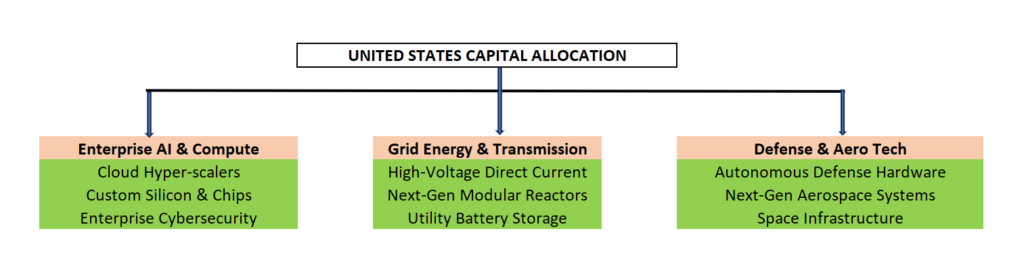
- Enterprise AI, Cloud Compute, & Cybersecurity: Companies building enterprise-grade software, AI agents, cloud architectures, and specialized hardware protection layers.
- Next-Generation Energy & Grid Modernization: Power generation utilities, high-voltage electrical equipment makers, small modular nuclear reactor (SMR) developers, and energy storage systems catering to exponential data center energy demands.
- Advanced Defense Technology & Aerospace: Autonomous systems, satellite networks, hypersonic defense, and advanced materials supplying both domestic security needs and global allied demand.
Strategic Summary for Global Investors & Executives
The United States through 2030 remains the ultimate high-volume, high-yield destination for institutional capital. While fiscal debt risks require long-term monitoring, the immediate 5-year outlook is defined by strong technology-driven productivity, resilient private consumption, and unmatched market liquidity. For global corporations and institutional allocators, exposure to the US economy remains an indispensable pillar of long-term growth strategy.
Top 65 Largest Economies in the World for 2027
Top 10 Largest Economies by 2030: IMF & World Bank GDP Projections for Global Powerhouses

U.S.- Canada Trade Talks Collapse; Carney Says Retaliatory Tariffs Begin September 8

Flock Cameras and the Future of Public Security

AI Infrastructure Boom Hits Physical Limits: Power, Financing, and Supply Chain Strain

Armanino adds Strategic Accounting Outsourced Solutions

New 2023 K-1 instructions stir the CAMT pot for partnerships and corporations

Tax Strategy: Employee Retention Credit update
-

 Stock News1 week ago
Nvidia Earnings Preview: What Wall Street Expects From the AI Bellwether’s Q2 Report
-

 Accounting1 week ago
SEC’s Semiannual Reporting Proposal Faces Investor Pushback: What CFOs Need to Know
-

 Stock News1 week ago
Nvidia Q2 FY2027 Earnings beats Wall Street Expectation with Record $96.2 Billion Revenue
-

 Finance1 week ago
Treasury Bond Volatility Forces Bessent to Double Debt Buyback Size as Yields Swing
-
 Technology4 days ago
AI Infrastructure Boom Hits Physical Limits: Power, Financing, and Supply Chain Strain
-
 Economics2 days ago
U.S.- Canada Trade Talks Collapse; Carney Says Retaliatory Tariffs Begin September 8
-
 Technology2 days ago
Flock Cameras and the Future of Public Security