
Economics
Global Stock Market Weekly Recap: Tech Sell-Off Sparks International Rout










Economics
U.S. National Debt Surpasses $40 Trillion for the First Time: What It Means for the Economy


Executive Summary & Core Macro Outlook
The United States enters the 2026–2030 macroeconomic window as the unquestioned heavyweight of nominal economic output, retaining its status as the primary engine of global financial liquidity, private enterprise innovation, and high-margin technological deployment. According to multi-year projections from the International Monetary Fund (IMF) World Economic Outlook and complementary datasets from the World Bank, the US nominal Gross Domestic Product (GDP) is projected to reach $32.38 trillion by 2026, accounting for approximately 25% of global nominal output and roughly 14.5% of world GDP measured at Purchasing Power Parity (PPP).
Unlike many of its advanced-economy peers across Western Europe and East Asia—which are grappling with acute demographic contraction and structural energy shocks—the United States demonstrates remarkable macroeconomic resilience. The IMF projects a real GDP Compound Annual Growth Rate (CAGR) of 2.1% to 2.3% through 2030. This expansion is sustained by three structural anchors: unmatched capital depth driving massive private-sector investment in Artificial Intelligence (AI) infrastructure, complete energy independence as a net exporter of hydrocarbons and liquefied natural gas (LNG), and high labor productivity gains that cushion the economy against rising debt-servicing costs.
Macroeconomic Data Matrix (2026–2030 Projections)
| Economic Metric | IMF / World Bank Baseline (2026–2030) | Global Benchmark & Context |
| Nominal GDP (2026 Projection) | ~$32.38 Trillion | Rank #1 Globally |
| GDP at Purchasing Power Parity (PPP) | ~$32.40 Trillion | Rank #2 Globally (Behind China’s ~$38.5T PPP) |
| Projected Real GDP CAGR (2026–2030) | 2.1% – 2.3% | Top decile among G7 advanced economies |
| Gross Public Debt (% of GDP) | ~122.5% – 128.0% | Structural fiscal deficit trajectory |
| Core Inflation Rate (PCE Target) | Stabilizing at 2.0% – 2.2% | Federal Reserve inflation target alignment |
| Current Account Balance (% of GDP) | -2.8% to -3.2% | Persistent capital import & reserve currency demand |
Deep Structural Growth Drivers
1. The AI Infrastructure Hyper-Cycle & TFP Expansion
The defining growth catalyst for the US economy over the 2026–2030 horizon is the unprecedented scale of private capital expenditure (Capex) poured into artificial intelligence infrastructure, enterprise software integration, and advanced computing hardware.
Major technology mega-caps and private equity funds are directing hundreds of billions of dollars annually into hyper-scale data centers, domestic semiconductor fabrication, high-voltage electrical grid upgrades, and AI-driven workflow platforms. According to World Bank economic research, technological adoption across American service and manufacturing sectors is driving a notable uptick in Total Factor Productivity (TFP). This productivity surge allows US companies to expand profit margins and output even in an environment characterized by higher structural real interest rates and tight skilled-labor markets.
2. Deep Capital Markets and Private Sector Liquidity
The structural backbone of US economic outperformance remains its financial system. US capital markets represent over 40% of global equity market capitalization and a vast majority of global venture capital and private credit assets.
This liquidity creates an efficient mechanism for capital allocation: high-potential emerging industries (such as quantum computing, synthetic biology, and advanced defense technology) receive early-stage funding at a scale that no other national market can match. When global monetary conditions tighten, global capital flees toward safety and yield, reinforcing US capital depth and lowering the relative cost of equity capital for American corporations.
3. Net Energy Independence & Industrial Cost Advantages
Unlike industrial hubs in Germany, Japan, or South Korea—which remain highly vulnerable to volatile sea-lane logistics and imported fuel price spikes—the United States operates as a major net exporter of petroleum, natural gas, and refined chemical products.
Access to abundant, cheap domestic natural gas provides US heavy industry, advanced manufacturing, and electricity-hungry data centers with a persistent structural cost advantage. Furthermore, federal policy frameworks (including the CHIPS and Science Act and clean energy tax provisions) continue to catalyze domestic private manufacturing investment, re-shoring high-value supply chains from East Asia back to the American Sunbelt and Midwest.
Macroeconomic Vulnerabilities & Downside Risks
1. Structural Sovereign Debt Trajectory
The most significant medium-term threat to US macroeconomic stability is the path of federal public debt. With gross national debt exceeding 120% of GDP and annual federal deficits running between 5% and 7% of GDP, the US fiscal baseline faces increasing structural pressure.
As older legacy low-yield Treasury bonds mature, they are refinanced at higher prevailing interest rates. According to IMF fiscal monitor assessments, federal net interest payments are absorbing an expanding share of total fiscal revenue, crowding out discretionary spending and narrowing the government’s capacity to deploy counter-cyclical fiscal stimulus during future downturns.
2. Commercial Real Estate (CRE) & Banking Sector Realignment
The structural transformation toward hybrid work models has permanently altered office space utilization across major US metropolitan areas. Regional and community banks, which hold a disproportionate share of commercial real estate debt, face ongoing balance-sheet pressure as legacy office loans mature and require refinancing at lower property valuations and higher interest rates. While systemic money-center banks remain well-capitalized, localized credit tightening from regional lenders presents a headwind for small-and-medium enterprise (SME) borrowing.
High-Outperformance Sector Matrix (2026–2030)
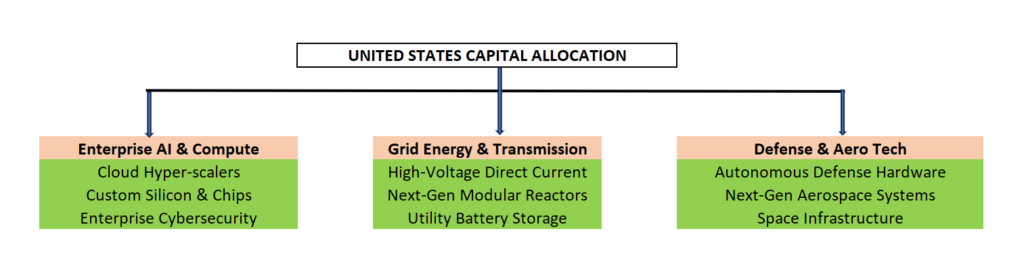
- Enterprise AI, Cloud Compute, & Cybersecurity: Companies building enterprise-grade software, AI agents, cloud architectures, and specialized hardware protection layers.
- Next-Generation Energy & Grid Modernization: Power generation utilities, high-voltage electrical equipment makers, small modular nuclear reactor (SMR) developers, and energy storage systems catering to exponential data center energy demands.
- Advanced Defense Technology & Aerospace: Autonomous systems, satellite networks, hypersonic defense, and advanced materials supplying both domestic security needs and global allied demand.
Strategic Summary for Global Investors & Executives
The United States through 2030 remains the ultimate high-volume, high-yield destination for institutional capital. While fiscal debt risks require long-term monitoring, the immediate 5-year outlook is defined by strong technology-driven productivity, resilient private consumption, and unmatched market liquidity. For global corporations and institutional allocators, exposure to the US economy remains an indispensable pillar of long-term growth strategy.
Top 65 Largest Economies in the World for 2027
Top 10 Largest Economies by 2030: IMF & World Bank GDP Projections for Global Powerhouses

Top 10 Largest Economies by 2030: IMF & World Bank GDP Projections for Global Powerhouses
The global macroeconomic landscape for the remainder of the decade is defined by structural divergence. According to updated multi-year projections from the International Monetary Fund (IMF) and the World Bank, the global economy is decoupling into two distinct tracks: mature powerhouses managing fiscal debt and artificial intelligence productivity gains, and rapid-scale emerging markets capitalizing on demographic dividends and trade corridor realignments.
Between 2026 and 2030, total global output is expected to expand significantly. However, nominal expansion remains intensely concentrated. Nearly half (~49.7%) of all net new global GDP generated through the end of the decade will originate from just three countries: China, the United States, and India.
This analytical report breaks down the macro baseline, structural growth drivers, and downside risks for the world’s top 10 economies through the 2030 horizon.
The Macro Baseline: Top 10 Economies (2026–2030)
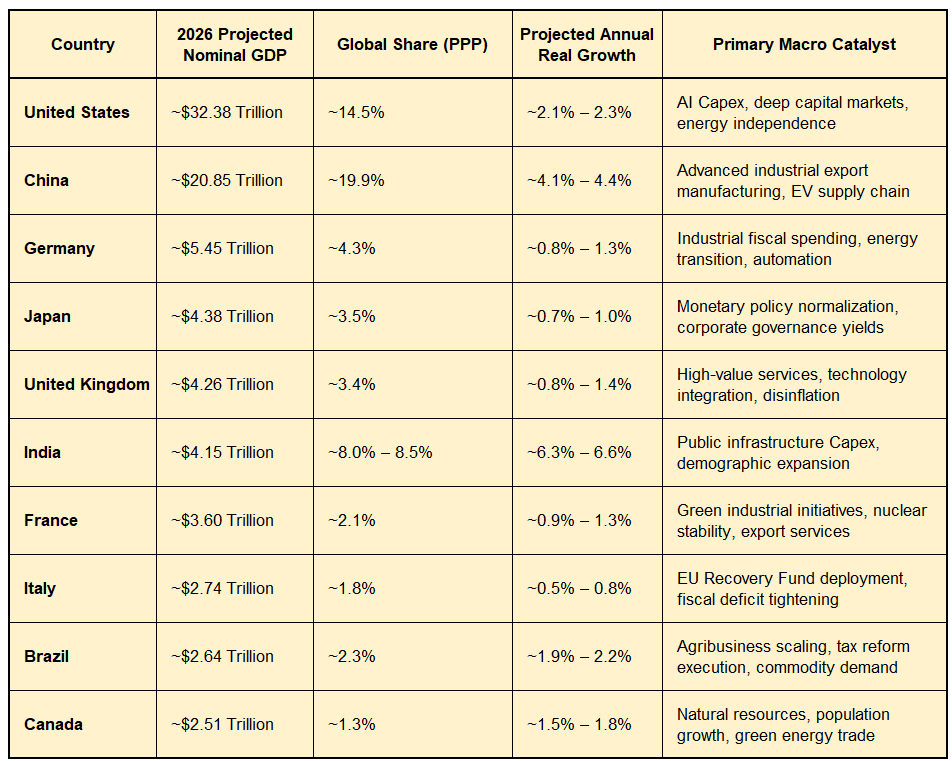
Executive Summary: Key Structural Shifts Through 2030
1. Nominal Hegemony vs. Purchasing Power Powerhouses
A fundamental divergence persists when evaluating absolute output in current US dollars versus Purchasing Power Parity (PPP). While the United States maintains a strong lead in nominal market volume (~$32.38 trillion in 2026), China commands the largest share of world GDP in PPP terms (~19.9%). This gap means US-based corporate entities and enterprise capital markets maintain dollar-denominated revenue advantages, while China remains the world’s largest physical production and localized market engine.
2. The Great AI & Capital Capex Divide
The IMF highlights technology adoption—specifically Generative AI deployment and advanced semiconductor integration—as the single largest factor altering total factor productivity (TFP) among advanced economies through 2030. Nations leading in technology capital expenditures (US, Japan, parts of Western Europe) are insulating themselves against structural labor shortages caused by declining birth rates.
Macro Analysis of the Top 10 Heavyweights
The Two Growth Giants
1. United States: AI Innovation & Capital Market Supremacy
- 2026 Projected Nominal GDP: ~$32.38 Trillion
- Key Growth Drivers: Massive institutional investment in technology infrastructure, deep venture and capital markets, liquid debt markets, and complete net energy independence. Consumer demand remains resilient, buffered by tax adjustments and high wage growth.
- Core Vulnerabilities: Sovereign debt accumulation exceeding 120% of GDP, high interest servicing costs, and localized commercial real estate pressures.
2. China: Strategic Manufacturing & High-Tech Export Pivot
- 2026 Projected Nominal GDP: ~$20.85 Trillion
- Key Growth Drivers: A deliberate strategic transition from real estate-driven debt expansion toward “New Productive Forces”—specifically electric vehicles, advanced batteries, photovoltaics, and green industrial hardware.
- Core Vulnerabilities: Local government debt restructuring, household consumption constraints, demographic contraction, and Western trade tariffs impacting export margins.
India’s Acceleration vs. European Stagnation
3. India: The World’s Fastest-Growing Major Economy
- 2026 Projected Nominal GDP: ~$4.15 Trillion
- Key Growth Drivers: Compounding real annual growth above 6.3%. Accelerated government capital expenditure on railways, highways, and digital public infrastructure, combined with global supply chain re-shoring (e.g., electronics manufacturing).
- Trajectory to 2030: IMF long-term baseline scenarios project India overtaking both Japan and Germany in nominal GDP during the 2028–2030 window to become the world’s third-largest economy.
4. Germany, United Kingdom, and France: Industrial Restructuring
- Germany ($5.45T): Re-tooling its heavy industrial base post-Russian energy decoupling. Unlocking federal fiscal expansion for defense and green automation helps lift growth to 1.1%–1.3%.
- United Kingdom ($4.26T): Stabilizing fiscal policy, cooling inflation, and expanding tech services exports. However, structural labor tightness remains a key constraint.
- France ($3.60T): Benefiting from low-carbon nuclear energy security, but facing strict EU fiscal deficit mandates that necessitate budget tightening.
5. Japan & Italy: Navigating Demographic Aging
- Japan ($4.38T): Exiting decades of ultra-loose monetary policy. Corporate governance reforms, rising inward foreign direct investment (FDI) in semiconductor fabs, and mild inflation are restoring nominal growth.
- Italy ($2.74T): Reliant on targeted execution of the EU National Recovery and Resilience Plan (NRRP) to modernize infrastructure amid structural demographic headwinds.
Resource & Commodity Powerhouses
6. Brazil & Canada: Agri-Resource & Energy Anchors

- Brazil ($2.64T): Broadening its export footprint across soy, corn, iron ore, and crude oil. Implementation of a landmark value-added tax (VAT) reform improves corporate tax efficiency through 2030.
- Canada ($2.51T): Benefiting from natural resource exports, critical mineral reserves (lithium, nickel), and immigration-driven population growth that expands domestic labor supply.
Downside Risks to the 2026–2030 Baseline
- Geopolitical & Trade Fragmentation: Increasing tariff barriers and localized supply chain mandates threaten to slow global trade throughput.
- Sovereign Debt Strain: High global interest rates increase refinancing costs for both advanced economies (US, UK) and developing nations.
- Energy Market Disruption: Volatility in oil and natural gas prices risks re-igniting headline inflation, forcing central banks to tighten monetary policy.
Strategic Takeaways for Corporate Leaders & Investors
- Capital Allocation: Target the US and India for high market volume, capital depth, and consumer scaling.
- Supply Chain Re-shoring: Build manufacturing resilience by diversifying hardware production across Asia (China, India) and Europe (Germany).
- Productivity Levers: Institutionalize AI and automation early to offset demographic labor constraints in Western Europe and East Asia.

Nvidia Q2 FY2027 Earnings beats Wall Street Expectation with Record $96.2 Billion Revenue

Treasury Bond Volatility Forces Bessent to Double Debt Buyback Size as Yields Swing

Nvidia Earnings Preview: What Wall Street Expects From the AI Bellwether’s Q2 Report

Armanino adds Strategic Accounting Outsourced Solutions

New 2023 K-1 instructions stir the CAMT pot for partnerships and corporations

Tax Strategy: Employee Retention Credit update
-

 Economics1 week ago
Top 10 Largest Economies by 2030: IMF & World Bank GDP Projections for Global Powerhouses
-
 Stock News4 days ago
Nvidia Earnings Preview: What Wall Street Expects From the AI Bellwether’s Q2 Report
-

 Stock News1 week ago
How to understand Intel $15B Stock Offering
-

 Economics1 week ago
Economic Profile of the United States of America (2026–2030 Horizon)
-

 Leaders6 days ago
Jackson Hole 2026: What the First Symposium Under Fed Chair Kevin Warsh Means for Markets
-

 Economics6 days ago
U.S. National Debt Surpasses $40 Trillion for the First Time: What It Means for the Economy
-

 Accounting4 days ago
SEC’s Semiannual Reporting Proposal Faces Investor Pushback: What CFOs Need to Know
-
 Finance4 days ago
Treasury Bond Volatility Forces Bessent to Double Debt Buyback Size as Yields Swing