
Personal Finance
Gold prices have spiked in 2025 — what investors need to know

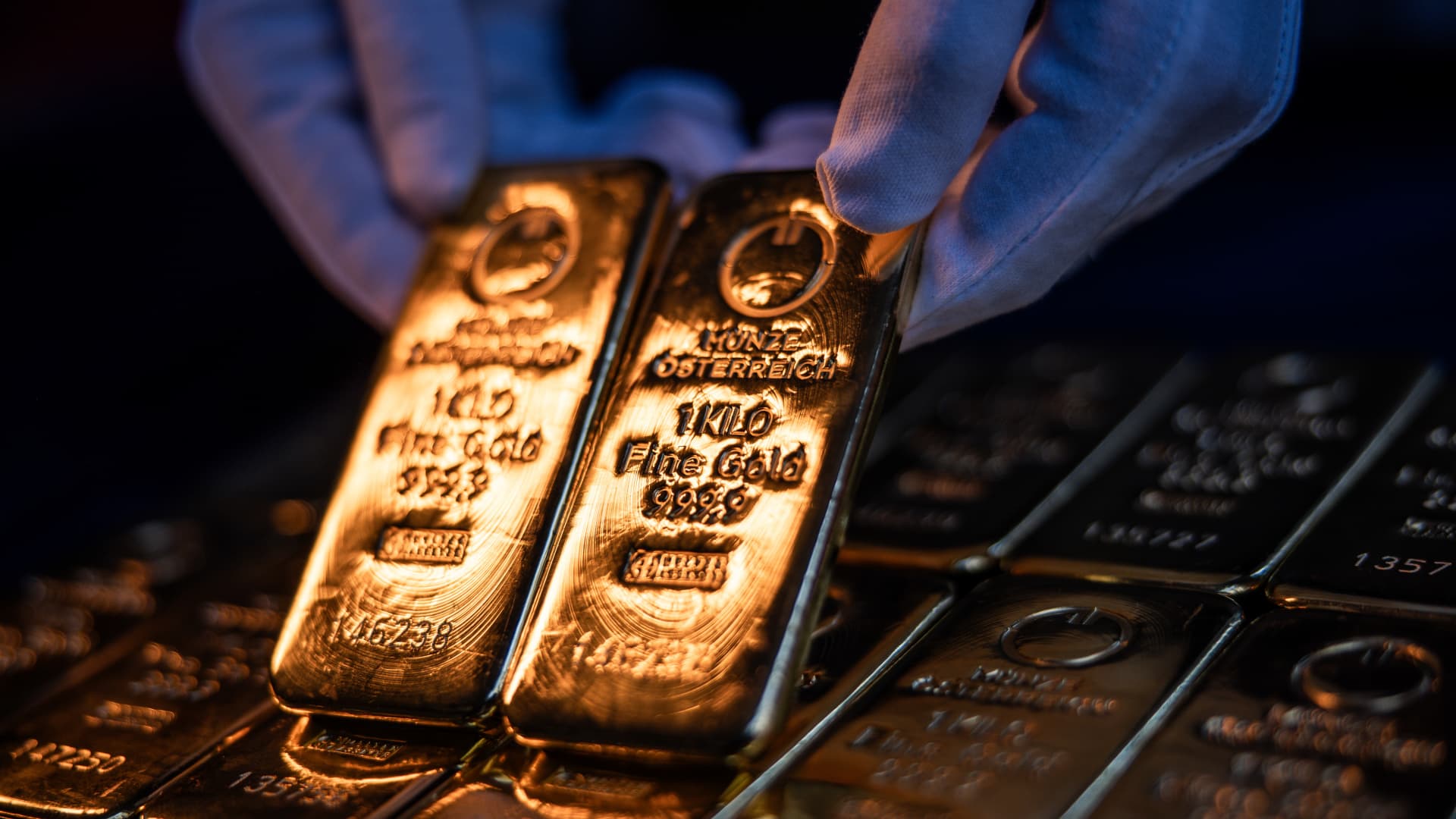
An attendant holds 1-kilogram gold bars on Feb. 17, 2025.
Akos Stiller/Bloomberg via Getty Images
Gold prices are popping. But investors should avoid the temptation to chase a shiny object, investment experts said.
The SPDR Gold Shares fund (GLD), which tracks the price of gold bullion, is up about 11% in 2025 as of 2 p.m. ET Tuesday. Returns are up about 42% over the past year. (Prices were down more than 1% on Tuesday.)
Gold futures prices are also up about 10% year-to-date and currently 36% higher compared to the price a year ago.
By comparison, the S&P 500 U.S. stock index is up about 1.5% in 2025 and 17% in the past year.
Lee Baker, a certified financial planner, said he wasn’t getting client calls about gold a year ago. Now, he fields them regularly.
He thinks investors would be wise to remember the classic rule from Warren Buffett, “Be fearful when others are greedy, and be greedy when others are fearful.”

“It feels to me everyone is starting to get greedy as it pertains to gold,” said Baker, owner and president of Claris Financial Advisors, based in Atlanta, and a member of CNBC’s Advisor Council.
The typical investor shouldn’t have an allocation to gold that exceeds 3% of a diversified portfolio, Baker said.
Investors enticed by lofty returns may make a knee-jerk reaction and buy a big chunk of gold (literally or figuratively) — and, in the process, make the common investment mistake of buying high and selling low, he said.
“If you’re going to make money with gold you need to buy and sell it — and hopefully sell it at right time,” Baker said. “And if you’re getting in now, are you buying at a peak? I don’t know.”
Why gold prices are up
Investors often perceive gold as a safe haven in times of turmoil and buy the asset when there are high levels of uncertainty, explained Sameer Samana, senior global market strategist and head of global equities and real assets at the Wells Fargo Investment Institute.
“I think we can check that box right now,” he said.
That said, “in true times of crisis, bonds have shone brighter than gold has,” Samana said.
More from Personal Finance:
How Trump, DOGE job cuts may affect the economy
Why Trump tariffs may raise your car insurance premiums
This tax break for retirement savers is a ‘well-kept secret’
Additionally, many investors buy gold because they think it’s a good inflation hedge, Samana said. (The data doesn’t always support that investment thesis.) Investors have been concerned by recent data that suggests progress on bringing down inflation may have stalled, he said.
U.S. sanctions on Russia dating to 2022 have been the “turbocharger” for gold returns over the past year or more, Samana said.

The sanctions led some central banks — in China, most notably — to buy more gold instead of U.S. Treasury bonds to avoid the potential difficulty of accessing assets denominated in U.S. dollars during a future geopolitical conflict, Samana said.
That has driven up gold demand higher compared to the price a year ago — and prices with it, he said.
“Don’t chase” gold returns, Samana said: “As a whole, you probably want to hold off on precious metals at [current] levels.”
Experts don’t expect gold to continue to shine.
“There’s no reason in my mind gold will continue to have a significant uptrend, barring — and I certainly hope not — some sort of protracted war,” Baker said.
How to invest in gold
Sanshandao Gold mine in Laizhou, Shandong province, China, on Jan. 17, 2025.
CFOTO/Future Publishing via Getty Images
Baker recommends getting investment exposure to gold via a fund like an exchange-traded fund or by investing in the stocks of gold mining companies, for example, instead of buying physical gold.
Funds and stocks are generally more liquid in the event an investor needs to sell the asset, Baker said. Investors with a lot of physical gold likely have the additional hassle of storing it somewhere and insuring it, Baker said. Insurance may cost investors 1% to 2% or more of their gold’s value per year.
Similar to Baker, Samana believes it may be okay for investors to hold 1% to 2% of a well-diversified portfolio in gold.
Investors interested in buying gold should consider it as a piece of a broader commodities portfolio, which likely includes allocations to energy, agriculture and base metals like copper alongside precious metals like gold, Samana said.
Wells Fargo’s investment models have an overall commodities allocation that ranges from 2% for conservative investors to 7% for more aggressive growth, he said.


Personal Finance
Next-Generation Retirement Planning: Managing Longevity Risk and Variable Income Streams


U.S.- Canada Trade Talks Collapse; Carney Says Retaliatory Tariffs Begin September 8

Flock Cameras and the Future of Public Security

AI Infrastructure Boom Hits Physical Limits: Power, Financing, and Supply Chain Strain

Armanino adds Strategic Accounting Outsourced Solutions

New 2023 K-1 instructions stir the CAMT pot for partnerships and corporations

Tax Strategy: Employee Retention Credit update
-

 Stock News1 week ago
Nvidia Q2 FY2027 Earnings beats Wall Street Expectation with Record $96.2 Billion Revenue
-
 Technology5 days ago
AI Infrastructure Boom Hits Physical Limits: Power, Financing, and Supply Chain Strain
-
 Technology3 days ago
Flock Cameras and the Future of Public Security
-
 Economics3 days ago
U.S.- Canada Trade Talks Collapse; Carney Says Retaliatory Tariffs Begin September 8