
Personal Finance
Harvard, Trump battle over international enrollment; students scramble


Immediately after the Trump administration blocked Harvard University on Thursday from enrolling future international students and retaining currently enrolled foreign students, some members of next year’s freshman class started scrambling.
“I was on the phone with a parent who was visibly shaken and completely frantic,” said Christopher Rim, president and CEO of college consulting firm Command Education.
Rim, who works with a large share of international students from abroad, said a few of his clients were accepted into the Class of 2029 and committed to Harvard on May 1, also known as National College Decision Day, which was just three weeks ago.
Now, they don’t know what to do.
“This is a major moment in these students’ lives,” Rim said. “Given the circumstances and policies and laws that we have right now, we are advising these families to look into taking a gap year — hopefully by then, the Trump administration and Harvard can come to an agreement.”
An escalating legal battle
On Thursday, the Department of Homeland Security terminated Harvard’s student and exchange visitor program certification, therefore blocking foreign students from enrolling and forcing existing foreign students to transfer or lose their legal status.
Harvard sued the Trump administration on Friday, asking a federal judge to reverse the ban on international students.
International students accounted for 27% of Harvard’s total enrollment in the 2024-25 academic year. That’s up from 20% during 2006-07.
More from Personal Finance:
Wage garnishment for defaulted student loans to begin
What loan forgiveness opportunities remain under Trump
Is college still worth it? It is for most, but not all
The latest move came amid an escalating standoff between the government and the Ivy League school after Harvard refused to meet a set of demands issued by the Trump administration’s Task Force to Combat Anti-Semitism.
“It is a privilege, not a right, for universities to enroll foreign students and benefit from their higher tuition payments to help pad their multibillion-dollar endowments,” Homeland Security Secretary Kristi Noem said in a statement Thursday.
In a statement on Friday, Harvard called Thursday’s action “unlawful and unwarranted.”
“It imperils the futures of thousands of students and scholars across Harvard and serves as a warning to countless others at colleges and universities throughout the country who have come to America to pursue their education and fulfill their dreams,” Harvard said.
Colleges rely on international enrollment
“It’s a shock,” said Hafeez Lakhani, founder and president of Lakhani Coaching in New York.
“At a time when international applications — and international yield — are under pressure, this sends a signal to the rest of the world that not only is Harvard closed to the international best and brightest, but that the U.S. is not a welcome place for international students,” Lakhani said.
International enrollment is an important source of revenue for schools, which is why colleges tend to rely on a contingent of foreign students, who typically pay full tuition.
Altogether, international student enrollment contributed $43.8 billion to the U.S. economy in 2023-24, according to a report by NAFSA: Association of International Educators.
During that academic year, there were more than 1.1 million international undergraduate and graduate students in the U.S., mostly from India and China, making up slightly less than 6% of the total U.S. higher education population, according to the latest Open Doors data, released by the U.S. Department of State and the Institute of International Education.
In the 2023-24 academic year, the U.S. hosted a record number of students from abroad, marking a 7% increase from the previous year.
Next steps for Harvard students in limbo
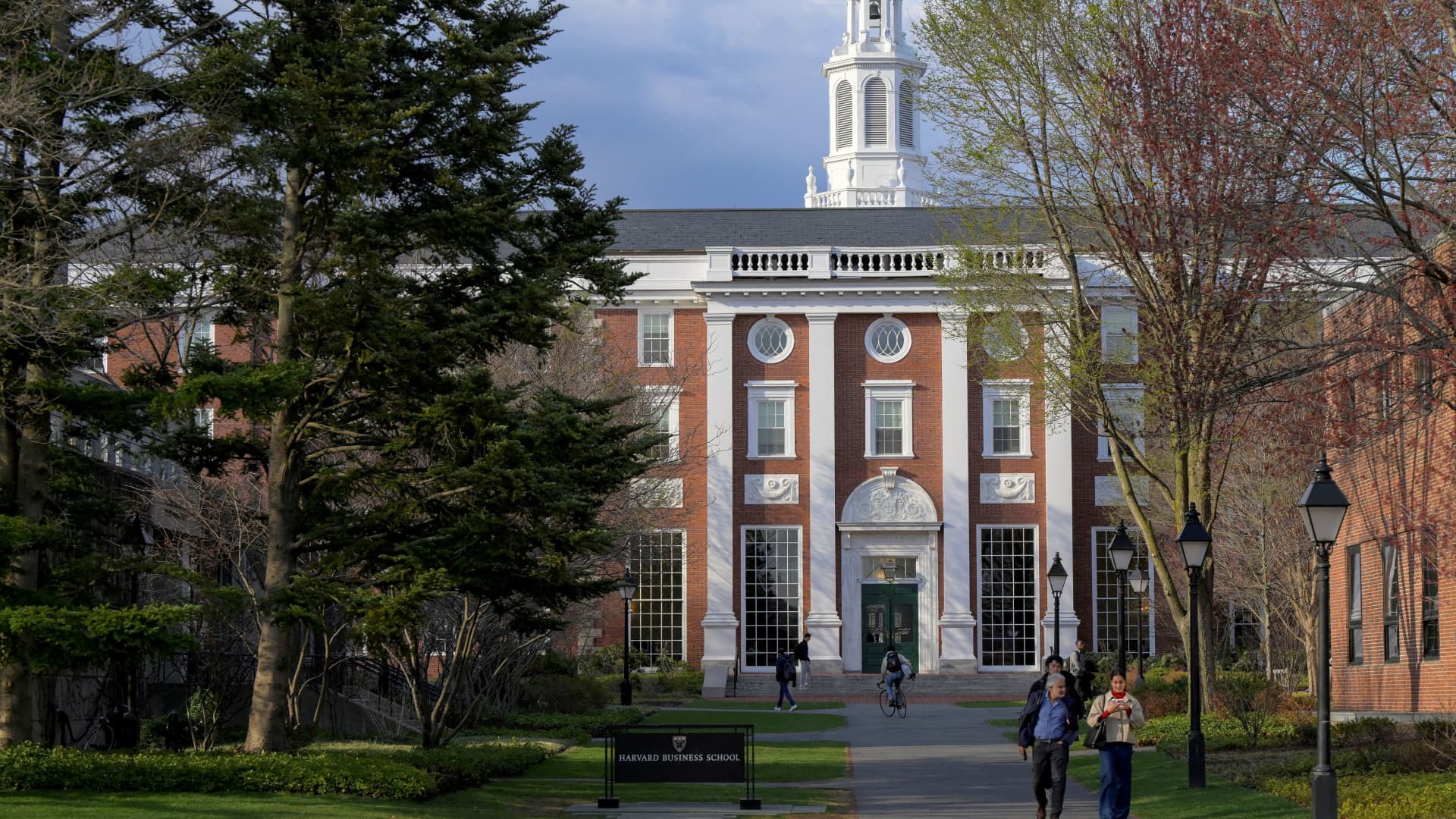
FILE PHOTO: People walk on the Business School campus of Harvard University in Cambridge, Massachusetts, U.S., April 15, 2025.
Faith Ninivaggi | Reuters
The Trump administration’s move puts Harvard international students in a “limbo state,” said Mark Kantrowitz, a higher education expert.
His advice to admitted or enrolled international students: Start exploring your options but don’t make any sudden moves until you hear from the university.
“Harvard is going to be scrambling to deal with this, and they will issue guidance to admitted students and the enrolled students,” Kantrowitz said.
In its statement, Harvard called international students and scholars “vital members of our community.”
“We will support you as we do our utmost to ensure that Harvard remains open to the world,” it said.
Kantrowitz doesn’t expect the Trump administration to prevail in Harvard’s lawsuit, though of course it’s a possibility, he said. Transferring to another U.S. school may have its own risks.
“I’ve heard from [Harvard] students who are seeking to transfer,” Kantrowitz said. “But that might be jumping from the frying pan into fire. These other colleges could be targeted soon enough.”
It may also be difficult for Harvard’s incoming freshman class to transfer to another university, Kantrowitz said. Many institutions may already be at full enrollment for the coming academic year, he said.
There are currently more than 300 U.S. schools still accepting applications for prospective first-year and transfer students for the upcoming fall term, according to the National Association for College Admission Counseling.
Harvard students who require financial aid may have a tougher time transferring, depending on the university, compared to those who don’t need assistance, Kantrowitz said.
That’s because many schools use “need sensitive” or “need aware” admissions for international students, Kantrowitz said. That means they consider the student’s financial need when choosing whether to accept the student.
Already, some of Lakhani’s college-bound clients have started considering schools outside the U.S., fueled by fear about rapid policy changes, he said.
Indeed, some schools overseas are trying to woo Harvard’s international students in light of the Trump administration’s recent maneuver. The Hong Kong University of Science and Technology, for example, issued an “open invitation” to Harvard students on Friday to continue their education there, to “pursue their educational goals without disruption.”
“This sends a clear signal for the best and brightest to look elsewhere — including other countries — to thrive intellectually,” Lakhani said.


Personal Finance
Next-Generation Retirement Planning: Managing Longevity Risk and Variable Income Streams


U.S.- Canada Trade Talks Collapse; Carney Says Retaliatory Tariffs Begin September 8

Flock Cameras and the Future of Public Security

AI Infrastructure Boom Hits Physical Limits: Power, Financing, and Supply Chain Strain

Armanino adds Strategic Accounting Outsourced Solutions

New 2023 K-1 instructions stir the CAMT pot for partnerships and corporations

Tax Strategy: Employee Retention Credit update
-

 Stock News1 week ago
Nvidia Earnings Preview: What Wall Street Expects From the AI Bellwether’s Q2 Report
-

 Accounting1 week ago
SEC’s Semiannual Reporting Proposal Faces Investor Pushback: What CFOs Need to Know
-

 Stock News1 week ago
Nvidia Q2 FY2027 Earnings beats Wall Street Expectation with Record $96.2 Billion Revenue
-

 Finance1 week ago
Treasury Bond Volatility Forces Bessent to Double Debt Buyback Size as Yields Swing
-
 Technology5 days ago
AI Infrastructure Boom Hits Physical Limits: Power, Financing, and Supply Chain Strain
-
 Technology3 days ago
Flock Cameras and the Future of Public Security
-
 Economics3 days ago
U.S.- Canada Trade Talks Collapse; Carney Says Retaliatory Tariffs Begin September 8