
Personal Finance
Harvard, Trump international enrollment battle affects college applicants


Jamie Beaton has built a career helping students from around the world gain admission to Harvard University and other top-tier institutions.
Now, days after the Trump administration banned Harvard from enrolling international students and stopped scheduling appointments for student visas, Beaton, co-founder and CEO of Crimson Education, a college consulting firm, is advising his clients to “ignore the chaos.”
Getting into an Ivy League school like Harvard is a years-long process, Beaton said. For recently admitted applicants, current students and this year’s graduating class, he says, “remain steadfast in that goal.”
And for Harvard hopefuls, particularly from abroad, there could even be a benefit to applying in the upcoming cycle even amid the ongoing political strife. “You may have an advantage in the eye of the storm,” Beaton said, as some applicants turn their attention to other schools.
More from Personal Finance:
Harvard students are ‘frantic,’ college consultant says
Wage garnishment for defaulted student loans to begin
Is college still worth it? It is for most, but not all
Over time, Harvard has become the gold standard of the Ivy League. As of last year, Harvard’s acceptance rate was just under 4%, down from more than 10% two decades ago. Roughly 18% of the Class of 2028 came from abroad.
“I think Harvard’s brand on the world stage is so strong and so viral, it would take a long time to lose some of that trust and excitement,” Beaton said. “The brand can take a lot of big hits.”
Of course, students are justifiably nervous as the federal government continues to fire blows at one of the nation’s oldest and most venerable institutions of higher education.
“It’s been a rollercoaster ride since last Thursday,” said Fangzhou Jiang, a student at Harvard’s Kennedy School and co-founder of Crimson Education.
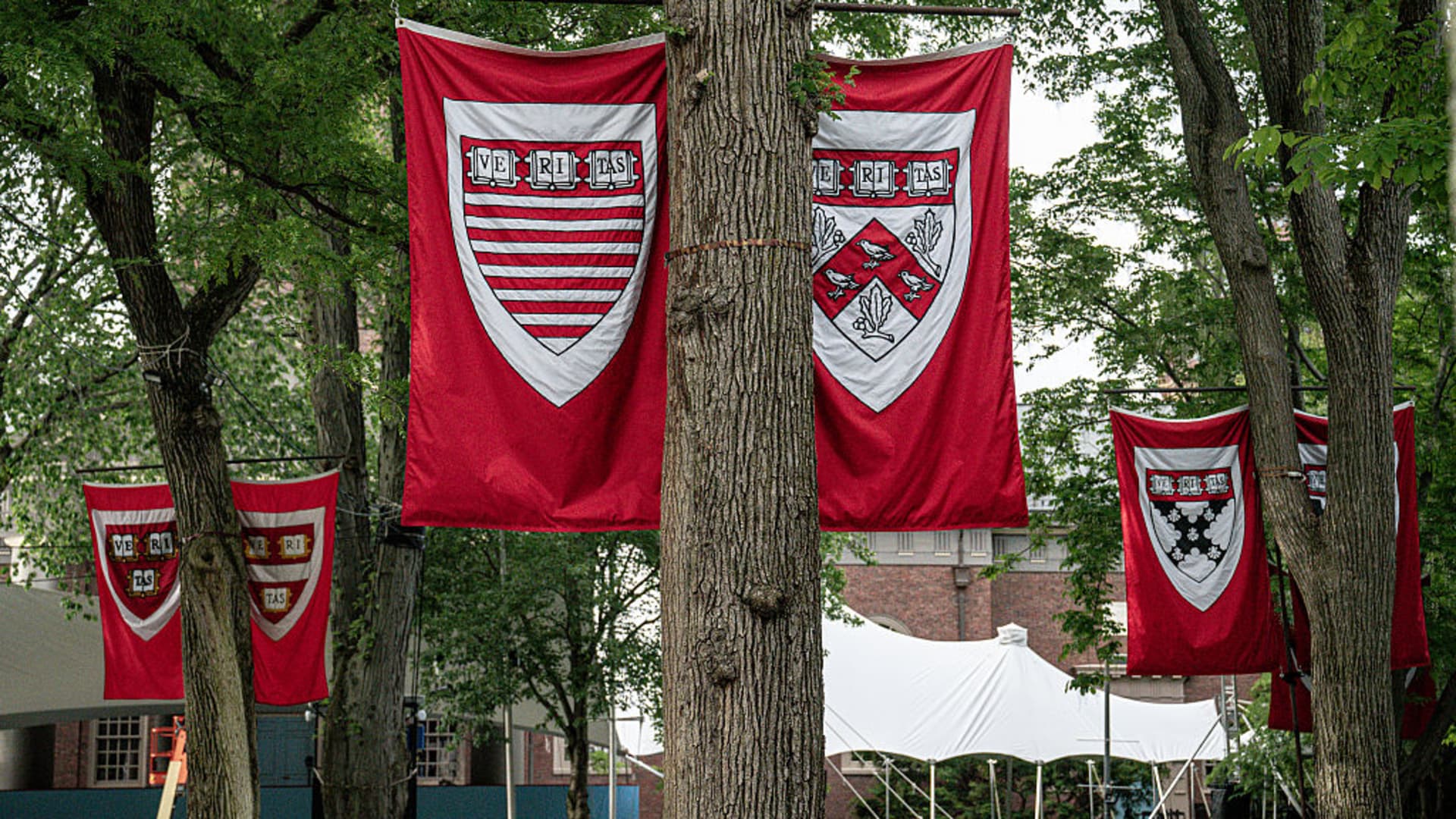
A glimpse into the Harvard University campus on May 24, 2025 in Cambridge, Massachusetts.
Vcg | Visual China Group | Getty Images
Harvard, Trump battle over international enrollment
On Tuesday, the Trump administration moved to stop scheduling new interviews for international students seeking visas to come to the U.S. and said it plans to expand social media vetting of foreign students, effectively disrupting international enrollment. Politico first reported the stop to new student visa interviews.
In the escalating standoff between the federal government and Harvard, the White House also attempted to terminate Harvard’s student and exchange visitor program certification and cancel all remaining federal government contracts with Harvard, which are worth a reported $100 million.
This latest moves come after Harvard refused to meet a set of demands issued by the Trump administration’s Task Force to Combat Anti-Semitism.
“The whole instability or uncertainty is quite damaging,” said Jiang, who has a student visa and would consider transferring across the country to Stanford University, where he is pursuing a dual degree.
“It is a privilege, not a right, for universities to enroll foreign students and benefit from their higher tuition payments to help pad their multibillion-dollar endowments,” Homeland Security Secretary Kristi Noem said in a statement Thursday.
A federal judge in Massachusetts on Friday temporarily halted the Trump administration’s ban on international students, following a petition from Harvard. A hearing is set for Thursday, May 29, to determine whether the temporary order should be extended.
“This is a critical step to protect the rights and opportunities of our international students and scholars, who are vital to the University’s mission and community,” Harvard’s president Alan Garber said in a statement. On its website, the Harvard International Office says “Harvard is committed to maintaining our ability to host our international students and scholars.”
Beaton predicts that by the time college applications are due this fall, the university and the federal government “will come to a compromise.”
Why international enrollment is so important

“International students make up such a vital part of the undergraduate student population,” said Robert Franek, The Princeton Review’s editor-in-chief.
Further, foreign students typically pay full tuition, which makes international enrollment an important source of revenue for Harvard and many colleges and universities in the U.S., according to Franek.
Altogether, international student enrollment contributed $43.8 billion to the U.S. economy in 2023-24, according to a report by NAFSA: Association of International Educators.
During that academic year, the U.S. hosted a record number of students from abroad, marking a 7% increase from 2022-23, according to the latest Open Doors data, released by the U.S. Department of State and the Institute of International Education.


Personal Finance
Next-Generation Retirement Planning: Managing Longevity Risk and Variable Income Streams


U.S.- Canada Trade Talks Collapse; Carney Says Retaliatory Tariffs Begin September 8

Flock Cameras and the Future of Public Security

AI Infrastructure Boom Hits Physical Limits: Power, Financing, and Supply Chain Strain

Armanino adds Strategic Accounting Outsourced Solutions

New 2023 K-1 instructions stir the CAMT pot for partnerships and corporations

Tax Strategy: Employee Retention Credit update
-

 Stock News1 week ago
Nvidia Earnings Preview: What Wall Street Expects From the AI Bellwether’s Q2 Report
-

 Accounting1 week ago
SEC’s Semiannual Reporting Proposal Faces Investor Pushback: What CFOs Need to Know
-

 Stock News1 week ago
Nvidia Q2 FY2027 Earnings beats Wall Street Expectation with Record $96.2 Billion Revenue
-

 Finance1 week ago
Treasury Bond Volatility Forces Bessent to Double Debt Buyback Size as Yields Swing
-
 Technology5 days ago
AI Infrastructure Boom Hits Physical Limits: Power, Financing, and Supply Chain Strain
-
 Technology3 days ago
Flock Cameras and the Future of Public Security
-
 Economics3 days ago
U.S.- Canada Trade Talks Collapse; Carney Says Retaliatory Tariffs Begin September 8