
Personal Finance
Here’s how tuition-free college aid programs can backfire

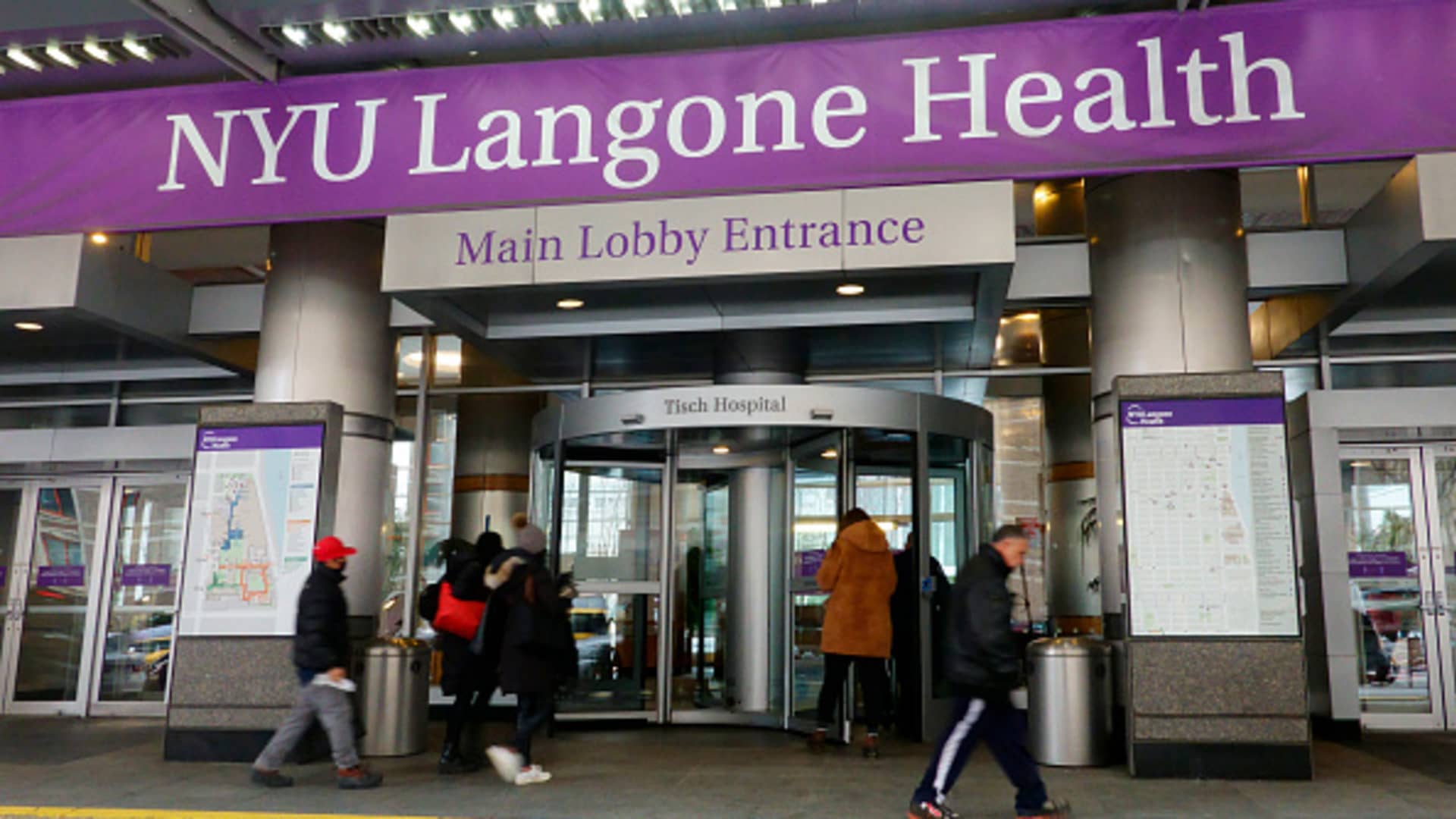
Entrance to NYU Langone Hospital, New York City.
Joan Slatkin | Universal Images Group | Getty Images
New York University’s Grossman School of Medicine made history in 2018 when it became the first top-ranked medical program to offer full-tuition scholarships to all students, regardless of need or merit.
The number of applicants, predictably, spiked in the year that followed. But then, the share of incoming students considered “financially disadvantaged” sank to 3% in 2019, down from 12% in 2017, reports showed.
“Tuition-free schools can actually increase inequity,” said Jamie Beaton, co-founder and CEO of Crimson Education, a college consulting firm.
“Tuition-free colleges experience surges in application numbers, dramatically boosting the competitive intensity of the admissions process,” he said. “This in turn can skew admissions towards middle- or higher-income applicants who may be able to access more effective admissions resources, such as tutoring or extracurriculars.”
More from Personal Finance:
How to maximize your college financial aid offer
Top colleges roll out more generous financial aid packages
College hopefuls have a new ultimate dream school
“Our goal for tuition-free education was to clear pathways for the best and brightest future doctors from all backgrounds to attend NYU Grossman School of Medicine without the stress of taking on the average $200,000 in debt medical students typically incur,” Arielle Sklar, a spokesperson for the school told CNBC. “This allows students to align career choices with their passions in medicine rather than immediate economic pressures.”
Sklar, however, did not directly address the issue of declining low-income student enrollment.
Since the initiative by NYU’s Grossman School of Medicine, other top schools and programs have embraced the tuition-free model.
Harvard University was the latest undergraduate school to announce that it will be tuition free for undergraduates with family incomes of up to $200,000 beginning in the 2025-26 academic year, following similar initiatives at Vanderbilt University, Dartmouth, University of Pennsylvania and Massachusetts Institute of Technology.
Nearly two dozen more schools have also introduced “no-loan” policies, which means student loans are eliminated altogether from their financial aid packages.
In the case of Harvard, “you may see a trend of families with income closer to $200,000 outcompeting low-income students for slots,” Beaton said. “This may shift the proportion of Harvard students from the top 1% of income down, but it might also decrease the share of low-income students to the benefit of middle or middle-upper income families.”

More generous aid packages and tuition-free policies remove the most significant financial barrier to higher education but attract more higher-income applicants, other experts also say.
“Even though it sounds like lower-income students are going to be advantaged, it’s the middle class that’s going to win here,” said Christopher Rim, president and CEO of college consulting firm Command Education.
“These colleges are trying to build a well-rounded class, they need middle class and wealthy students as well,” he added. “They are not trying to take fewer rich kids — they need them because they’re the ones that are also going to be donating.”
For lower income students, “anything that increases the number of applications will be detrimental,” said Eric Greenberg, president of Greenberg Educational Group, a New York-based consulting firm.
Nearly all students worry about high college costs
These days, taking on too much debt is the top worry among all college-bound students, according to a survey by The Princeton Review.
College tuition has soared by 5.6% a year, on average, since 1983, significantly outpacing other household expenses, a recent study by J.P. Morgan Asset Management also found.
This rapid increase means that college costs have risen much faster than inflation, leaving families to shoulder a larger share of the expenses, experts say.
For the 2024-25 school year, tuition and fees plus room and board for a four-year private college averaged $58,600, up from $56,390 a year earlier. At four-year, in-state public colleges, it was $24,920, up from $24,080, according to the College Board.
To bridge the affordability gap, some of the nation’s top institutions are in an “affordability arms race,” according to Hafeez Lakhani, founder and president of Lakhani Coaching in New York.
However, overall, most institutions do not have the financial wherewithal to offer tuition-free or no-loan aid programs, added Robert Franek, The Princeton Review’s editor in chief. “More than 95% of four-year colleges in the U.S. are tuition driven,” he said.
Even if a school does not offer enough aid at the outset, there are other ways to bring costs down, according to James Lewis, co-founder of National Society of High School Scholars.
“Get beyond, ‘I can’t afford that,”‘ he said. “A lot of institutions will have a retail price but that’s not necessarily what a student will pay.”
Many schools will provide access to additional resources that can lower the total tab, he said, either through scholarships, financial aid or work-study opportunities.

Personal Finance
Next-Generation Retirement Planning: Managing Longevity Risk and Variable Income Streams


U.S.- Canada Trade Talks Collapse; Carney Says Retaliatory Tariffs Begin September 8

Flock Cameras and the Future of Public Security

AI Infrastructure Boom Hits Physical Limits: Power, Financing, and Supply Chain Strain

Armanino adds Strategic Accounting Outsourced Solutions

New 2023 K-1 instructions stir the CAMT pot for partnerships and corporations

Tax Strategy: Employee Retention Credit update
-

 Stock News1 week ago
Nvidia Earnings Preview: What Wall Street Expects From the AI Bellwether’s Q2 Report
-

 Accounting1 week ago
SEC’s Semiannual Reporting Proposal Faces Investor Pushback: What CFOs Need to Know
-

 Stock News1 week ago
Nvidia Q2 FY2027 Earnings beats Wall Street Expectation with Record $96.2 Billion Revenue
-

 Finance1 week ago
Treasury Bond Volatility Forces Bessent to Double Debt Buyback Size as Yields Swing
-
 Technology5 days ago
AI Infrastructure Boom Hits Physical Limits: Power, Financing, and Supply Chain Strain
-
 Technology3 days ago
Flock Cameras and the Future of Public Security
-
 Economics3 days ago
U.S.- Canada Trade Talks Collapse; Carney Says Retaliatory Tariffs Begin September 8