
Finance
Here’s the inflation breakdown for May 2025 — in one chart

David Paul Morris/Bloomberg via Getty Images
The annual inflation rate increased slightly in May as an uptick in grocery inflation somewhat offset lower prices at the gasoline pump.
And while inflation was relatively tame, economists said they expect President Trump’s tariff policy to raise consumer prices in coming months — and that there was already some evidence of their impact.
The consumer price index, an inflation barometer, rose 2.4% in the 12 months through May, up from 2.3% in April, the Bureau of Labor Statistics said Wednesday.
‘Calm before the inflation storm’
That increase to the annual inflation rate was largely due to a data quirk called “base effects,” economists said. (Basically, inflation one year prior, in May 2024, was unusually low, making the May 2025 numbers look high by comparison.)
The monthly inflation rate paints a rosier picture and gives a better indicator of underlying trends, economists said: CPI increased 0.1% from April to May, down from 0.2% the prior month, the BLS said.
A consistent monthly rate around 0.2% would generally be adequate to bring inflation down to the Federal Reserve’s long-term target, economists said.
“It was a very good report,” said Mark Zandi, chief economist at Moody’s. “Basically, it says inflation has finally gotten back to the Federal Reserve’s annual inflation target.”
However, tariffs President Trump levied on many countries and products will likely start to show up noticeably into the summer and fall, he said.
“I think it’s the calm before the inflation storm,” Zandi said. “This [report] still reflects the disinflation that began a few years ago and continued on through the month of May.”
Tariff impact on energy prices
That said, tariffs already had some impact on consumer prices in May, economists said.
For one, gasoline prices fell almost 3% from April to May, according to the BLS. They’re down 12% from a year ago, it said.
This is largely the result of falling oil prices, which reflect concerns about a slowdown in global economic growth due to tariffs, said Bernard Yaros, lead U.S. economist at Oxford Economics.

Lower energy prices filter down to the gasoline pump and lower household bills, he said. Lower oil prices also feed through more broadly to reduced costs for transportation, in categories like airline fares, Zandi said.
Airfare fell about 3% from April to May and is down 7% for the year, the BLS said.
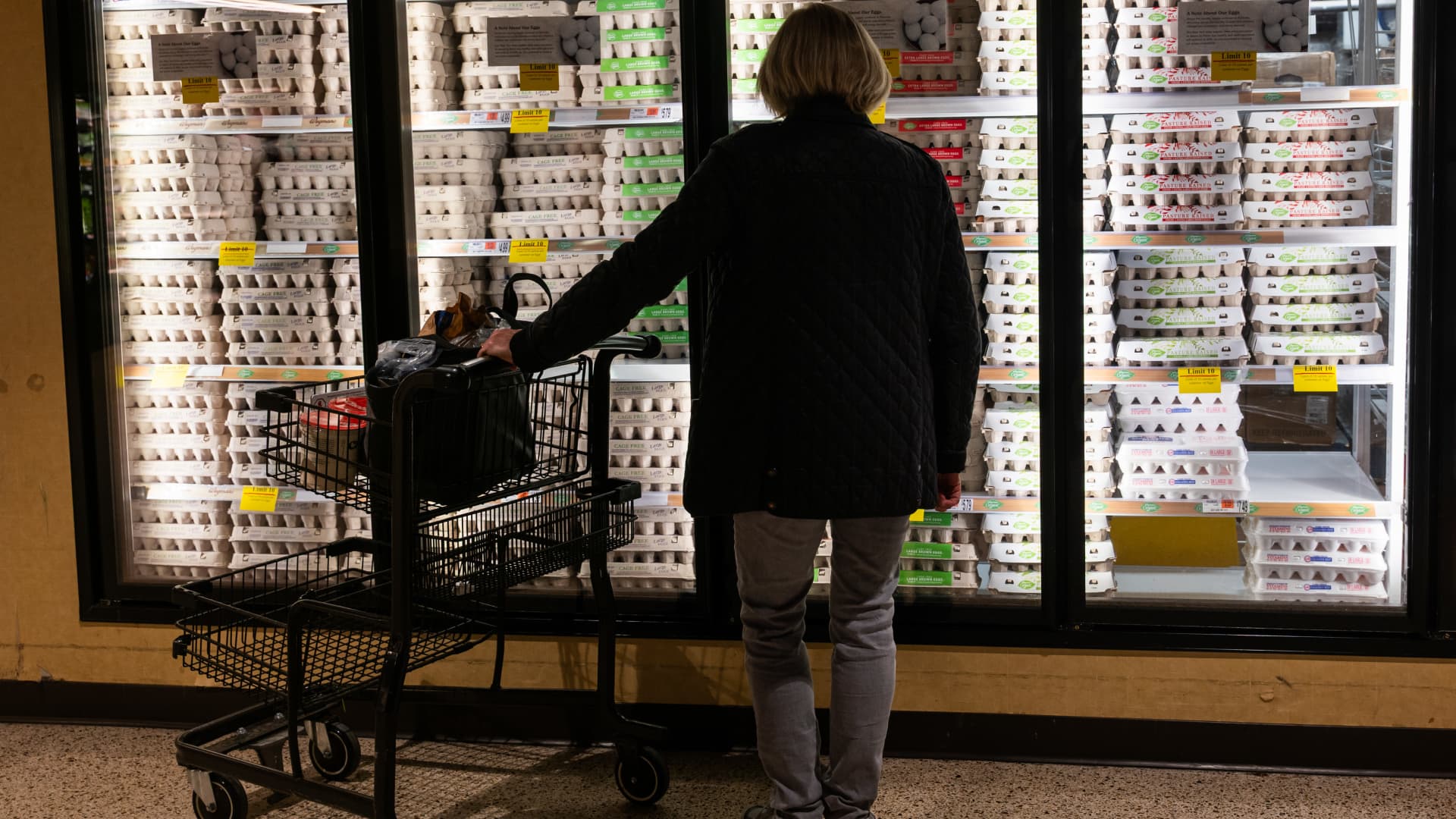
Grocery prices were a sticking point in May, though, economists said. Inflation for food at home rose by 0.3% for the month, after having deflated 0.4% the prior month.
Food prices give “a little bit of a queasy feeling,” Zandi said. It’s one of the categories he’s most concerned about, he said.
Other disinflationary factors
Healing supply chains and a weakening of the labor market are factors that have helped rein in U.S. inflation broadly, said Sarah House, a senior economist at Wells Fargo Economics.
Data indicate consumers are continuing to spend money and haven’t shown much reluctance to accept higher prices, House said.
“The consumer hasn’t buckled yet,” she said.
Housing inflation has also moderated, an important element since the category is the largest component of the consumer price index, economists said.
Indeed, monthly inflation for rent and “owners’ equivalent rent” (a rent measure applied to homeowners) have “returned to their pre-pandemic norms,” Stephen Brown, deputy chief North America economist at Capital Economics, wrote in a research note Wednesday.
These trends together signaled “a steady downtrend in inflation” back to the Fed’s long-term target at least by the end of this year or early next year, Oxford Economics’ Yaros said.
Tariff risk ‘stalling out’ disinflation
Tariffs complicate that narrative, economists said.
“The disinflationary trend we’ve been seeing in fits and starts is at risk of stalling out again,” House said.
President Trump has levied a barrage of import duties since his inauguration in January.
Federal data show the effective tariff rate in April was about 6% — and is likely to increase — relative to 2% at end of 2024, House said.
The Yale Budget Lab estimates the average U.S. household would pay about $2,500 more in 2025 due to tariff policy in effect as of June 1.

There were some early signs of tariff impacts in the May CPI report for people “looking through a microscope,” Brown wrote.
For example, major appliance prices jumped 4.3% for the month, and toy prices by 2.2%, he wrote, citing CPI data.
“Unless all retailers are raising prices at the same time, it may trickle not flood into the data,” Elizabeth Renter, senior economist at NerdWallet, wrote Wednesday.




Treasury Bond Volatility Forces Bessent to Double Debt Buyback Size as Yields Swing

Nvidia Earnings Preview: What Wall Street Expects From the AI Bellwether’s Q2 Report

SEC’s Semiannual Reporting Proposal Faces Investor Pushback: What CFOs Need to Know

Armanino adds Strategic Accounting Outsourced Solutions

New 2023 K-1 instructions stir the CAMT pot for partnerships and corporations

Tax Strategy: Employee Retention Credit update
-

 Economics1 week ago
U.S. Retail Sales Fall for the First Time in Nine Months as Consumer Spending Slows
-

 Economics1 week ago
Nvidia’s Potential $3 Billion SB Energy Investment Could Reshape AI Infrastructure
-

 Economics4 days ago
Top 10 Largest Economies by 2030: IMF & World Bank GDP Projections for Global Powerhouses
-
 Stock News4 days ago
How to understand Intel $15B Stock Offering
-

 Technology1 week ago
U.S.-China AI Competition Intensifies as Washington Pushes Allies to Choose Sides
-
 Economics4 days ago
Economic Profile of the United States of America (2026–2030 Horizon)
-
 Leaders3 days ago
Jackson Hole 2026: What the First Symposium Under Fed Chair Kevin Warsh Means for Markets
-
 Stock News19 hours ago
Nvidia Earnings Preview: What Wall Street Expects From the AI Bellwether’s Q2 Report