
Personal Finance
Here’s what President-elect Trump’s tariff plan may mean for your wallet

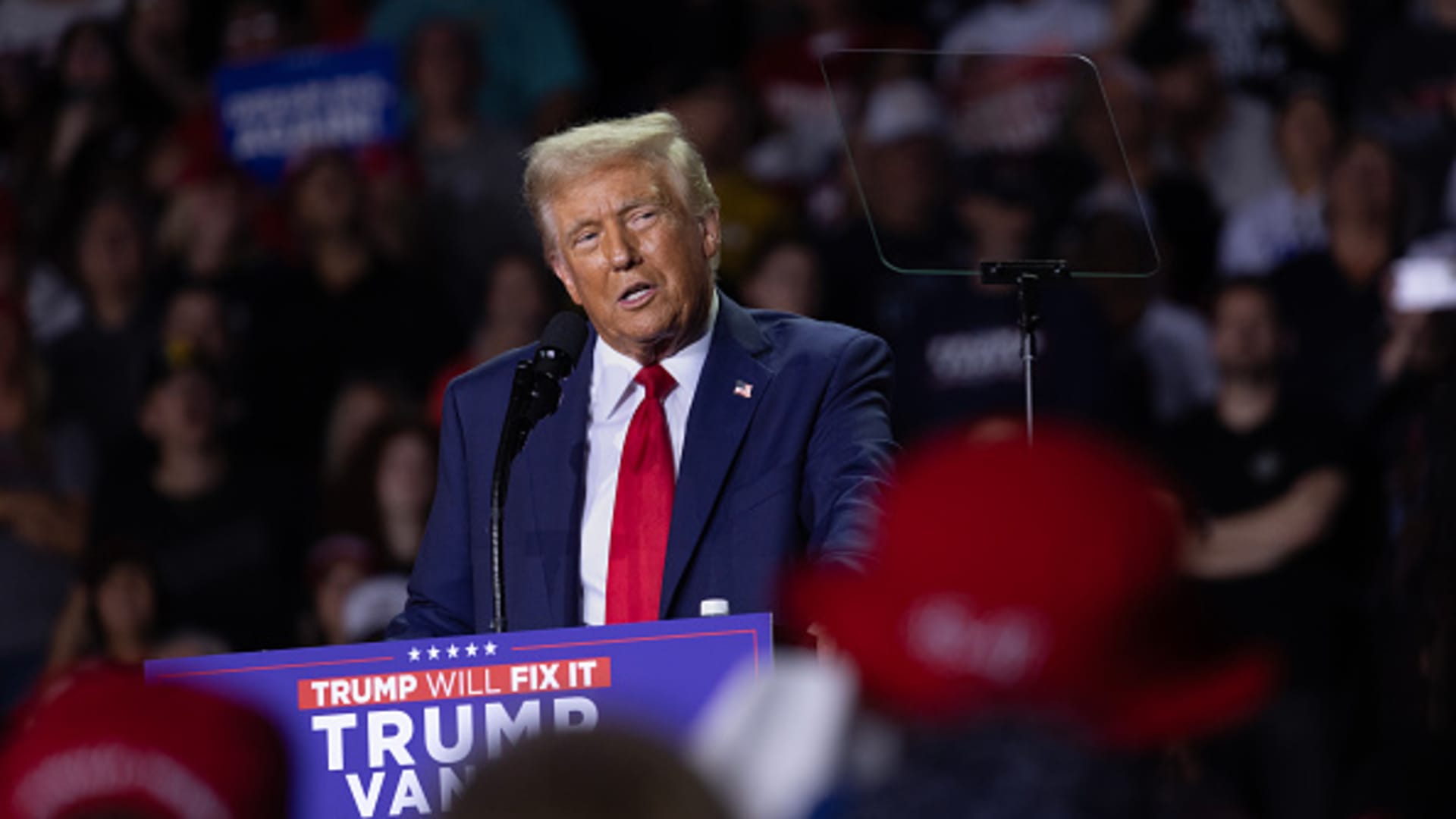
Donald Trump speaks at a rally on Nov. 5, 2024 in Grand Rapids, Michigan.
Scott Olson | Getty Images News | Getty Images
President-elect Donald Trump won Tuesday’s presidential election partly by addressing Americans’ economic anxieties over higher prices.
Nearly half of all voters said they were worse off financially than they were four years ago, the highest level in any election since 2008, according to an NBC News exit poll.
But a cornerstone of Trump’s economic policy — sweeping new tariffs on imported goods — would likely exacerbate the very Biden-era inflation Trump lambasted on the campaign trail, according to economists.
There’s still much uncertainty around how and when such tariffs might be implemented. If they were to take effect, they would likely raise prices for American consumers and disproportionately hurt lower earners, economists said.
The typical U.S. household would pay several thousand more dollars each year on clothing, furniture, appliances and other goods, estimates suggest.

“It’s bad for consumers,” said Mark Zandi, chief economist at Moody’s. “It’s a tax on consumers in the form of higher prices for imported goods.”
“It’s inflationary,” he added.
He and other economists predict the proposed tariffs would also lead to job loss and slower economic growth, on a net basis.
The Trump campaign didn’t immediately respond to a request for comment from CNBC on the impact of tariffs or their scope.
How Trump’s tariff proposal might work
A tariff is a tax placed on imported goods.
Tariffs have been around for centuries. However, their importance as a source of government revenue has declined, especially among wealthy nations, according to Monica Morlacco, an international trade expert and assistant professor of economics at the University of Southern California.
Now, the U.S. largely uses tariffs as a protectionist policy to shield certain industries from foreign competition, according to the Brookings Institution, a think tank.
More from Personal Finance:
Presidential election prompts Americans to ‘doom spend’
Next U.S. president could face a tax battle in 2025
How the ‘vibecession’ influences investors
Trump imposed some tariffs in his first term — on washing machines, solar panels, steel, aluminum and a range of Chinese goods, for example. The Biden administration kept many of those intact.
However, Trump’s proposals from the campaign trail are much broader, economists said.
He has floated a 10% or 20% universal tariff on all imports and a tariff of at least 60% on Chinese goods, for example. Last month, the president-elect suggested vehicles from Mexico have a tariff of 200% or more, and in September threatened to impose a similar amount on John Deere if the company were to shift some production from the U.S. to Mexico.
“To me, the most beautiful word in the dictionary is ‘tariff,'” Trump said at the Chicago Economic Club in October. “It’s my favorite word. It needs a public relations firm.”

How much tariffs cost consumers
A 20% worldwide tariff and a 60% levy on Chinese goods would raise costs by $3,000 in 2025 for the average U.S. household, according to an October analysis by the Tax Policy Center. Trump’s plan would reduce average after-tax incomes by almost 3%, according to the tax think tank.
Additionally, a 200% Mexico-vehicle tariff would increase household costs by an average $600, TPC said.
American consumers would lose $46 billion to $78 billion a year in spending power on apparel, toys, furniture, household appliances, footwear and travel goods, according to a National Retail Federation analysis published Monday.
“I feel pretty confident saying [tariffs] are a price-raising policy,” said Mike Pugliese, senior economist at Wells Fargo Economics. “The question is just the magnitude.”
The reason for these higher costs: Tariffs are paid by U.S. companies that import goods. The “vast majority” of that additional cost is passed on to American consumers, while only some of it is paid for by U.S. distributors and retailers or by foreign producers, said Zandi of Moody’s.
Philip Daniele, president and CEO of AutoZone, alluded to this dynamic in a recent earnings call.
“If we get tariffs, we will pass those tariff costs back to the consumer,” Daniele said in September.
The U.S. imported about $3.2 trillion of goods in 2022, for example, said Olivia Cross, a North America economist at Capital Economics. A back-of-the-envelope calculation suggests a 10% across-the-board tariff would be roughly equivalent to a $320 billion tax on consumers, Cross said.
Tariffs reduce economic growth and jobs
Of course, the financial fallout likely wouldn’t be quite that large, Cross said.
Trump’s plan could boost the strength of the U.S. dollar, and there may also be tariff exemptions for certain categories of goods or imports from certain countries, all of which would likely blunt the overall impact, Cross said.

A 20% universal tariff and 60% Chinese import tax would also generate about $4.5 trillion in net new revenue for the federal government over 10 years, according to the Tax Policy Center.
“The administration could take tariff revenue and redistribute to households via tax cuts in some form or another,” explained Pugliese of Wells Fargo.
Trump has proposed various tax breaks on the campaign trail. Additionally, tax cuts enacted by Trump in 2017 are due to expire next year, and tariff revenue may potentially be used to extend them, should Congress pass such legislation, economists said.
However, the typical U.S. household would still lose $2,600 a year from Trump’s tariff plan, even after accounting for an extension of the 2017 tax cuts, according to an analysis by the Peterson Institute for International Economics.

The U.S. economy would also likely suffer due to other tariff “cross currents,” Zandi said.
While U.S. companies that financially benefit from protectionist tariff policies may add jobs, the total economy would likely shed jobs on a net basis, Zandi said.
This is because countries on which the U.S. imposes tariffs would likely retaliate with their own tariffs on U.S. exports, hurting the bottom lines of domestic businesses that export goods, for example, Zandi said.
Higher prices for imported goods would likely also lead to lower consumer demand, weighing on business profits and perhaps leading to layoffs, he said.
In June, the Tax Foundation estimated Trump’s tariff plan would shrink U.S. employment by 684,000 full-time jobs and reduce its gross domestic product, a measure of economic output, by at least 0.8%.
Capital Economics expects the Trump administration would introduce tariffs — and a curb on immigration — in the second quarter of next year, the group said in a note Tuesday night. Together, those policies would cut Gross Domestic Product growth by about 1% from the second half of 2025 through the first half of 2026 and add 1 percentage point to inflation, it said.


Personal Finance
Next-Generation Retirement Planning: Managing Longevity Risk and Variable Income Streams


U.S.- Canada Trade Talks Collapse; Carney Says Retaliatory Tariffs Begin September 8

Flock Cameras and the Future of Public Security

AI Infrastructure Boom Hits Physical Limits: Power, Financing, and Supply Chain Strain

Armanino adds Strategic Accounting Outsourced Solutions

New 2023 K-1 instructions stir the CAMT pot for partnerships and corporations

Tax Strategy: Employee Retention Credit update
-

 Stock News1 week ago
Nvidia Q2 FY2027 Earnings beats Wall Street Expectation with Record $96.2 Billion Revenue
-
 Technology6 days ago
AI Infrastructure Boom Hits Physical Limits: Power, Financing, and Supply Chain Strain
-
 Technology4 days ago
Flock Cameras and the Future of Public Security
-
 Economics4 days ago
U.S.- Canada Trade Talks Collapse; Carney Says Retaliatory Tariffs Begin September 8