
Finance
Honor launches AI phone tools that help users get online shopping discounts

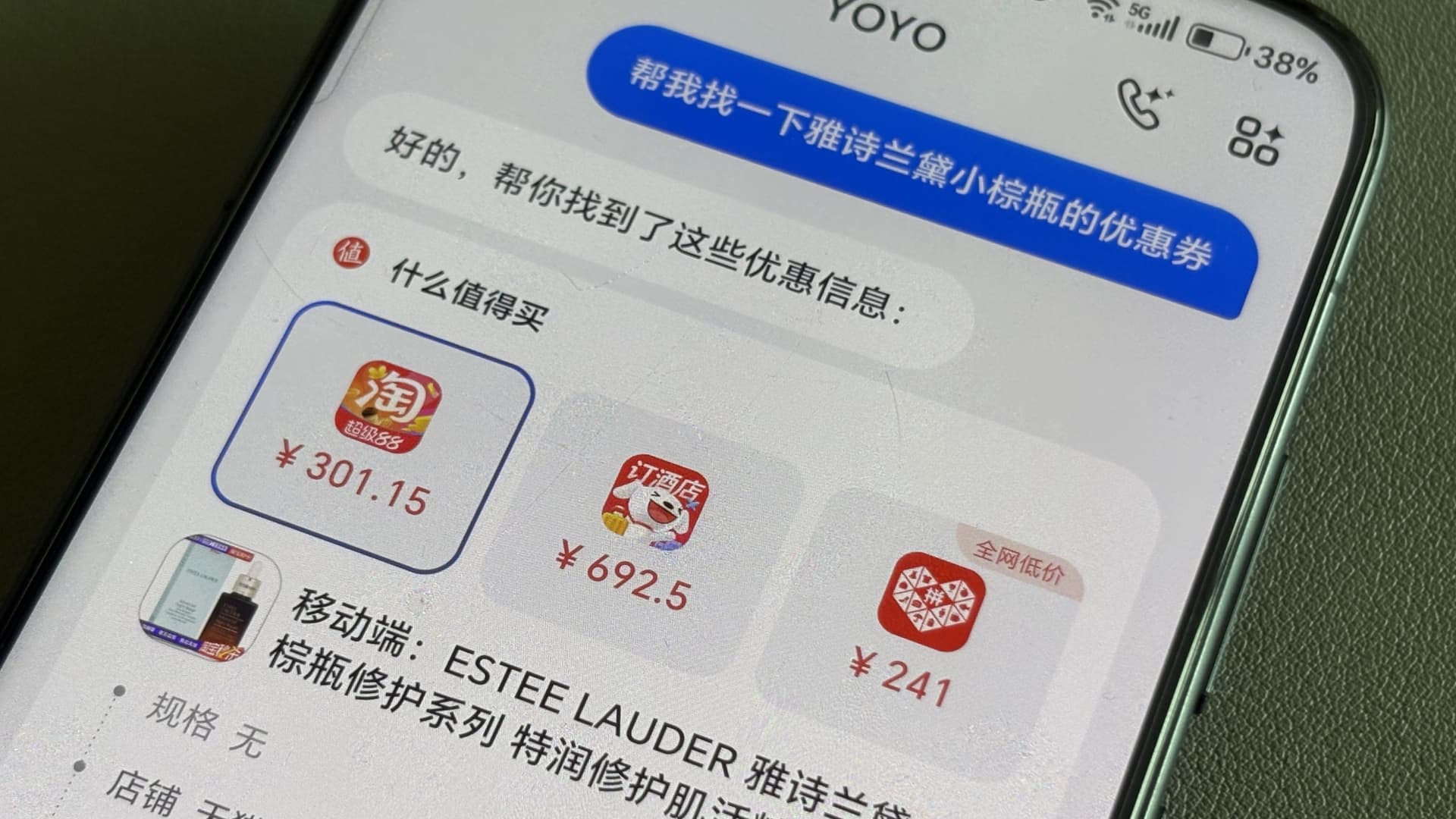
Chinese smartphone company Honor announced on Oct. 15 a slew of new AI features, including the ability to compare deals across different e-commerce sellers.
CNBC | Evelyn Cheng
BEIJING — Imagine if Amazon gave 20% discounts for every purchase made using an iPhone Air.
That’s essentially how Chinese smartphone company Honor wants to attract local buyers — by giving them an on-device AI tool that lets them quickly compare deals across Chinese e-commerce sites, including JD.com and different merchants on Alibaba‘s Taobao. In one example seen by CNBC, the Honor AI-powered shopping search helped save 20% since the tool was able to find coupons that a user might otherwise overlook.
The features and a slew of other AI functions are set to roll out Wednesday on Honor’s newly launched Magic8 smartphone as well as the company’s other devices in China. The timing is notable. China is entering its busiest shopping season of the year akin to Black Friday: the Nov. 11 Singles Day promotional period.
With the AI upgrade, Honor expects to climb into the top three smartphone brands by market share in mainland China by the end of this year, Fei Fang, president of products at Honor Device, told CNBC in an exclusive interview. That’s according to a CNBC translation of the remarks made in Mandarin.
In the future, she expects that rather than opening smartphone apps directly, users will increasingly access the functions via an AI portal — which can then automatically provide customized services down the road.
“We believe this will happen and we are working along this direction,” she said, noting Honor will release more AI features in sports, health and companionship at its own ecosystem conference on Oct. 23.
Honor’s AI features are activated through the company’s “Yoyo” chatbot, which sits inside the company’s Android-based operating system called MagicOS.

While Honor said the overseas market has come to account for about half of its revenue, the Shenzhen-based company must first take on Apple to recover the first spot in China.
In the second quarter of this year, Huawei and Vivo shipped the most phones in China with 18% market share each, while Oppo and Xiaomi vied for second place at 16% share each, Counterpoint data showed. Apple had 15%, followed by Honor at 13%.
Apple has tried to make a comeback in China this year. CEO Tim Cook visited Shanghai this week, according to his social media account, coinciding with news that the slim iPhone Air would finally begin sales in China this month — weeks after the new iPhone 17 hit stores.
However, the U.S. smartphone giant has yet to release its AI features in China, despite Alibaba Group Chair Joe Tsai’s announcement this year that the company would work with Apple on the tech tools. Neither side has yet released additional details.
AI chatbots
Honor, which spun off from Huawei in 2020, signed a strategic partnership with Alibaba in September to co-develop AI smartphone features. Alibaba operates the Gaode maps app in China, a Fliggy travel booking platform, as well as the Taobao and Tmall e-commerce platforms.
Fang emphasized that shopping is just one of many AI functions that Honor is releasing this week. Other tools include guiding users on how to take the best photo angle, suggesting nearby restaurants from just a photo of a specific location and hailing a taxi using a simple voice command.
With a prompt as vague as “book me a ride back home,” the tech learns from on-device data and user preferences to automatically know what the home address is. Personal information stays on the smartphone and isn’t transferred to the cloud, Honor said. When it comes to payments, the user still needs to manually approve it, even if the AI helps with making the online order.
The new AI features for China users also come as ChatGPT is starting to let U.S. users shop on Etsy, and soon Walmart, through the AI chatbot interface. Other AI chatbots can also search the internet for specific products.
It remains to be seen whether AI will be consistently useful for consumers. But Honor said its edge comes from using AI to complete multiple steps, including accounting for individual e-commerce memberships and personalized coupons, to show consumers the cheapest option — with a prompt as simple as asking for the best deal on a product.
Honor said most of its new AI features are based on a self-developed graphical user interface (GUI) AI model that learns from how a human interacts with a smartphone screen and across apps.
The company claimed that the AI’s ability to learn has enabled rapid expansion from 200 tasks in July to more than 3,000 this fall.
In other cases, Honor said it has agreements with companies such as food delivery giant Meituan and video-streaming platform Bilibili to allow the phone’s AI to interact with the Chinese apps’ systems using the “Model Context Protocol (MCP)” tech pioneered by Anthropic.
Spending big first
Honor also incorporates some AI functions from other companies, such as Kuaishou‘s Kling AI video generation model. Since Kling and other tools charge per use, that comes at a cost to the smartphone company, which is offering the features to consumers for free right now, according to Fang.
“This is one of our current challenges,” Fang said. “We have invested quite a lot of money in AI. But we believe we must first create value for consumers before commercialization.”
Honor announced in March it would spend $10 billion on AI over the next five years. The company indicated it would make a significant portion of the initial investment this year.
The spending is part of Honor’s ambitious plan announced in March to become an AI device company — and a platform to connect companies with consumers. Like Apple, Honor also sells smart watches, tablets and laptops.
Outside of China, Honor works with Google for AI and is ranked fourth by market share in Europe as of the second quarter, according to Counterpoint.
While Honor doesn’t have immediate plans to roll out AI-powered shopping overseas, the company at the Mobile World Congress in Barcelona in March showed off an AI agent for making restaurant reservations on OpenTable.





U.S.- Canada Trade Talks Collapse; Carney Says Retaliatory Tariffs Begin September 8

Flock Cameras and the Future of Public Security

AI Infrastructure Boom Hits Physical Limits: Power, Financing, and Supply Chain Strain

Armanino adds Strategic Accounting Outsourced Solutions

New 2023 K-1 instructions stir the CAMT pot for partnerships and corporations

Tax Strategy: Employee Retention Credit update
-

 Stock News1 week ago
Nvidia Earnings Preview: What Wall Street Expects From the AI Bellwether’s Q2 Report
-

 Accounting1 week ago
SEC’s Semiannual Reporting Proposal Faces Investor Pushback: What CFOs Need to Know
-

 Stock News1 week ago
Nvidia Q2 FY2027 Earnings beats Wall Street Expectation with Record $96.2 Billion Revenue
-

 Finance1 week ago
Treasury Bond Volatility Forces Bessent to Double Debt Buyback Size as Yields Swing
-
 Technology5 days ago
AI Infrastructure Boom Hits Physical Limits: Power, Financing, and Supply Chain Strain
-
 Technology3 days ago
Flock Cameras and the Future of Public Security
-
 Economics3 days ago
U.S.- Canada Trade Talks Collapse; Carney Says Retaliatory Tariffs Begin September 8