
Personal Finance
Housing ‘affordability has just totally collapsed,’ economist says


10’000 Hours | Digitalvision | Getty Images
Housing costs are outpacing median household incomes in the U.S., further straining affordability.
Would-be homebuyers need to earn $113,520 a year to afford the typical house in the U.S. That is 35% more than what the typical household earns annually, which is $84,072, according to a new analysis by Redfin, a national real estate brokerage site.
“Since the pandemic, affordability has just totally collapsed,” said Chen Zhao, a senior economist at Redfin.
February 2021 was the last month when the typical household earned more money than it needed to afford the median home. There’s been a deficit ever since, Zhao said.
More from Personal Finance:
Top colleges expand financial aid awards to eliminate student loans
What you need to know about Social Security’s new overpayment policies
What car shoppers need to know
“That deficit hit a peak in October of 2023,” she added. “The reason why it hit a peak then is because that’s when mortgage rates peaked as well.”
Meanwhile, home prices also remained high because of an inventory crunch: the median sale price for a house was $412,778 in February 2024, according to Redfin.
Affordability deficit narrowed in February
The average household fell short $29,448 to afford a home in February, according to Redfin. In October 2023, households were short by $40,810. At that time, buyers needed an average income of $120,500 to afford a home.
The affordability deficit narrowed because mortgage rates have been on a consistent decline since the last peak in October, according to Zhao. At that peak, the average 30-year fixed mortgage rate hit 8% for the first time since 2000.
“It’s been a pretty big change since last October,” Zhao said.
Other reasons such as seasonal pricing may be reflected, as home prices tend to decline in the winter months, said Jeff Ostrowski, a housing analyst at Bankrate.
However, potential buyers are still on the sidelines, said Veronica Fuentes, a certified financial planner at Northwestern Mutual.
“They’re either holding off or they’re taking their time,” she said.
Recent layoffs in the technology industry have affected some of her clients’ attitudes, Fuentes said. While her clients may not be on the chopping block, seeing their co-workers get laid off has made many of them more cautious.
“If you were laid off, could you still afford this mortgage? Do you have six months [of] emergency savings or even a year [of] emergency savings? … Can you still afford the mortgage for six months if you have no job?” Fuentes said.
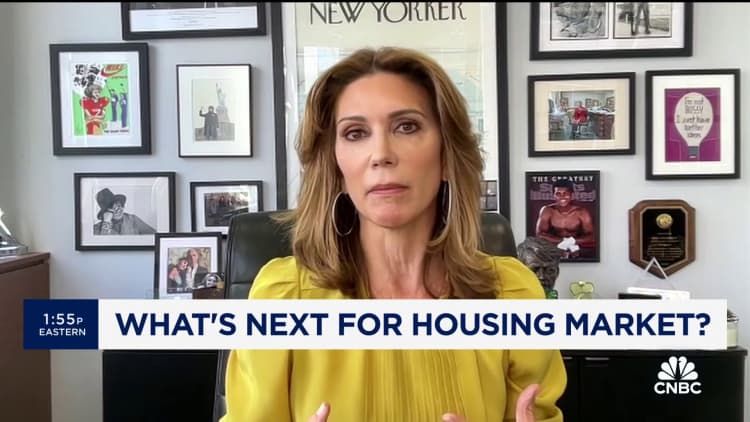
Navigating high costs in the housing market
In a time when a potential buyer needs to earn about $114,000 a year to afford a median-priced house in the U.S., a starter home would make the most sense for price-sensitive buyers, experts say.
A potential buyer should make about $76,000 a year to afford a starter home, which Redfin defines as a home in approximately the bottom 1/3 of the housing distribution in terms of price.
Starter homes are hard to come by. Home builders over the past 15 years or so have moved away from building entry-level homes, said Ostrowski.
For almost the entire second half of the 20th century, someone could buy a home for $120,000 in many parts of the U.S., he said.
“That just doesn’t exist anymore,” Ostrowski said.
Buyers could seek lower costs in certain markets in the U.S. There are 13 metropolitan areas where buyers might afford the typical home without earning six figures, Redfin found.
In Detroit, the typical household needed to earn $46,168 to afford the median-priced home in February, making it the most affordable market in the country. It was followed by Cleveland ($58,186), Pittsburgh ($61,603), St. Louis ($66,755) and Philadelphia ($73,182). The other metros where homebuyers making less than $100,000 can afford the typical home are Indianapolis, Cincinnati, Milwaukee, Warren, Michigan; Kansas City, Missouri; Virginia Beach, Virginia; San Antonio, Texas, and Columbus, Ohio.
What’s to come for the housing market
Experts say borrowing costs should come down as the Fed solidifies its plans to cut back interest rates. Home price growth is also expected to soften as inventory increases.
New listings climbed 5% during the last four weeks ended March 17, the biggest year-over-year jump since May 2023, Redfin found.
“People are getting kind of tired of waiting, so we’re starting to see a lot more inventory come on,” Zhao said.
However, take this with a grain of salt, Ostrowski said, as the outlook six months ago was very different from how things played out.
“If you’re ready and you can afford it, buy now,” he said. “Conditions probably aren’t going to get significantly better.”
Indeed, while the combination of lower rates and boosted supply should help with affordability, “it’s not going to completely change the picture,” said Zhao.


Personal Finance
Next-Generation Retirement Planning: Managing Longevity Risk and Variable Income Streams


U.S.- Canada Trade Talks Collapse; Carney Says Retaliatory Tariffs Begin September 8

Flock Cameras and the Future of Public Security

AI Infrastructure Boom Hits Physical Limits: Power, Financing, and Supply Chain Strain

Armanino adds Strategic Accounting Outsourced Solutions

New 2023 K-1 instructions stir the CAMT pot for partnerships and corporations

Tax Strategy: Employee Retention Credit update
-

 Stock News1 week ago
Nvidia Earnings Preview: What Wall Street Expects From the AI Bellwether’s Q2 Report
-

 Accounting1 week ago
SEC’s Semiannual Reporting Proposal Faces Investor Pushback: What CFOs Need to Know
-

 Stock News1 week ago
Nvidia Q2 FY2027 Earnings beats Wall Street Expectation with Record $96.2 Billion Revenue
-

 Finance1 week ago
Treasury Bond Volatility Forces Bessent to Double Debt Buyback Size as Yields Swing
-
 Technology4 days ago
AI Infrastructure Boom Hits Physical Limits: Power, Financing, and Supply Chain Strain
-
 Economics2 days ago
U.S.- Canada Trade Talks Collapse; Carney Says Retaliatory Tariffs Begin September 8
-
 Technology2 days ago
Flock Cameras and the Future of Public Security