
Economics
How 39% Swiss tariffs will hit prices


Premium collection of dark, milk and white chocolates.
Anna Kurzaeva | Moment | Getty Images
U.S. buyers of Swiss products, from luxury watches and skincare to artisan chocolates, could soon face sharp price rises if negotiators are unable to strike a deal to avert 39% tariffs due to come into effect on Thursday.
The announcement last week that Switzerland faces one of the highest U.S. tariff rates in the world stunned many politicians, analysts and businesses, who had thought the country was close to negotiating a deal similar to those of the European Union and U.K., which got baseline rates of 15% and 10% respectively.
The U.S. has a hefty trade deficit with Switzerland, totaling $38.3 billion in 2024. The Swiss government points out that the gap is in part because of the latter’s status as the world’s biggest center of gold refining, with huge quantities of the precious metal passing through the country for processing before it is sent around the world. Both gold and silver were exempted from the White House’s “reciprocal tariff” policy launched in April.
The U.S. is also a major importer of Swiss pharmaceuticals, an industry that has been mired in confusion over the tariff rates it will face, and medical devices. Pharma products are currently exempt from the 39% levies, though sector-specific tariffs may yet come under the U.S.’s separate Section 232 investigation.
But consumers will mostly be familiar with the Alpine country’s high-end products, from Rolex watches to premium skincare and beauty products. Sales could be rocked if the 39% tariffs remain in place for an extended period — something Swiss negotiators are currently scrambling to avoid, as economists warn of a massive hit to growth, jobs and stocks.
Watches
The U.S. was the biggest overseas market for Swiss watches in 2024, with exports totaling 4.37 billion Swiss francs ($5.4 billion), according to the Federation of the Swiss Watch Industry.
To qualify as Swiss-made, at least 60% of a watch’s production cost must be Swiss-based, while its technical development must be conducted in the country.
“Swiss watches have long been a cornerstone of the U.S. market, and a 39% tariff would be a real shake-up,” Paul Altieri, founder and CEO of online resale platform Bob’s Watches, told CNBC.
“Suddenly, every import would carry a hefty extra cost, and dealers would face tough choices — absorb the tariff, eat into margins, or pass it on to customers. You’d likely see longer lead times as brands and retailers realign logistics, and higher sticker prices across the board.” The retail price of a Rolex Submariner could jump from $10,000 to nearly $14,000, he noted.
For Swiss watch businesses, a 39% tariff would be “devastating,” Jean-Philippe Bertschy, head of Swiss equity research at Vontobel, told CNBC’s “Squawk Box Europe” on Tuesday.

“They increased the prices already in spring by an average of 5 to 10%, I think another hit will be quite difficult for the U.S. consumer for sure, especially for the entry into the mid-segment level.” In a research note, Vontobel flagged Swatch as vulnerable to a tariff hit, with shares falling 2.3% on Monday.
“For the luxury watches, for the brands like Rolex, Patek Philippe and Audemars Piguet, you have some long waiting lists. So I think it’s going to be more comfortable for these companies to increase the prices,” Bertschy continued.
“You have very limited measures to take. You can, of course, increase efficiencies and to try to do some other measures to counter U.S. tariffs, but overall, very challenging for the industry.”
Coffee
Consumer goods giant Nestlé is one of Switzerland’s biggest firms. The company says that it faces a minimal direct impact from tariffs because it produces more than 90% of what it sells in the U.S. locally.
That’s generally the case for consumer staples such as instant coffee or bottled water which are high-volume, low-ticket items, James Edwardes Jones, managing director of consumer research at RBC Capital Markets, told CNBC’s “Squawk Box Europe.”
Its popular Nespresso coffee brand, known for at-home coffee machines and capsule pods, could, however, be among those goods exposed to higher rates and therefore price hikes.
“In Nestle’s case specifically, Nespresso is all manufactured in Switzerland and then exported around the world, so it seems likely that will be caught in a small way,” Edwardes Jones added.
Nestle did not immediately respond to CNBC’s request for comment on the impact of Swiss levies. The company does not specify the level of its U.S. sales for Nespresso, but its half-year results showed North America grew at a “strong double-digit rate.”
Skincare
Switzerland’s world-renowned beauty and skincare products could also be subject to price hikes as brands not included in a pharmaceutical tariff exemption look to offset higher import costs.
That could be most notable for companies that pride themselves on Swiss production, such as caviar-based anti-aging skincare brand La Prairie, spa supplier Valmont and nail care business Mavala, none of which responded to CNBC’s request for comment.
“While Swiss firms can generally weather a 10-15% tariff without major margin erosion or demand loss, 39% sets the bar much higher,” Lombard Odier said in a Monday note.
Lausanne-headquartered Galderma, whose products include injectable aesthetics and Cetaphil facewash, meanwhile, said that it does not produce in Switzerland and is currently largely excluded from global tariffs under pharma exemptions.
However, its large production capacity in the European Union, U.K. and Canada could be subject to higher levies, potentially hitting consumer costs.
Luxury
Higher import duties are also seen pushing up the price of luxury goods, including Richemont-owned high-end jewelry brands Cartier and Van Cleef & Arpels.
BofA Securities said in a note Tuesday that 7% of Richemont’s input costs would be exposed to higher Swiss tariffs, likely adding to higher consumer prices. “Price increases would be the most obvious way to mitigate the headwind,” the analysts wrote.
Cartier, a unit of Cie. Richemont SA, luxury watches sit on display in a store front.
Bloomberg | Getty Images
Richemont did not respond to CNBC’s request for comment on the 39% rate, however it flagged in its first-quarter earnings that tariffs could lead to “increased prices,” which could impact consumer demand.
Lombard Odier noted that a “small fraction” of luxury exports could see demand for their products increase with price, but broadly price hikes were set to hurt consumer demand.
Chocolate
Roger Wehrli, director of Swiss chocolatiers’ manufacturing association Chocosuisse, said a 39% tariff rate would be passed on via prices and cause a steep loss of U.S. business for many of the group’s members. The recent appreciation of the Swiss franc against the U.S. dollar, which causes imports to become more expensive, means the effective price increase would be closer to 55%, he noted.
The main impact will be on small- and medium-sized businesses that are unable to utilize U.S. production sites like big multinationals can, Wehrli said. Industry juggernauts Lindt & Sprüngli and Barry Callebaut already have factories stateside, while smaller Chocosuisse members such as Camille Bloch and Läderach produce exclusively in Switzerland.
“There’s another specific problem with producing in the United States,” Wehrli continued.
“If you want to label your chocolate as Swiss then it has to be produced in Switzerland. That’s a quality sign in the international market, so you will more or less lose your customers if it’s not Swiss origin anymore,” Wehrli told CNBC.
These rules of origin forced Toblerone, owned by U.S. group Mondelez International, to change its packaging in 2023 to refer to itself as being “established in Switzerland” rather than “Swiss chocolate” after it moved some of its production from the Swiss capital Bern to Slovakia. CNBC has contacted Mondelez for comment on the impact of tariffs on Toblerone in the U.S.










Economics
U.S. National Debt Surpasses $40 Trillion for the First Time: What It Means for the Economy

Executive Summary & Core Macro Outlook
The United States enters the 2026–2030 macroeconomic window as the unquestioned heavyweight of nominal economic output, retaining its status as the primary engine of global financial liquidity, private enterprise innovation, and high-margin technological deployment. According to multi-year projections from the International Monetary Fund (IMF) World Economic Outlook and complementary datasets from the World Bank, the US nominal Gross Domestic Product (GDP) is projected to reach $32.38 trillion by 2026, accounting for approximately 25% of global nominal output and roughly 14.5% of world GDP measured at Purchasing Power Parity (PPP).
Unlike many of its advanced-economy peers across Western Europe and East Asia—which are grappling with acute demographic contraction and structural energy shocks—the United States demonstrates remarkable macroeconomic resilience. The IMF projects a real GDP Compound Annual Growth Rate (CAGR) of 2.1% to 2.3% through 2030. This expansion is sustained by three structural anchors: unmatched capital depth driving massive private-sector investment in Artificial Intelligence (AI) infrastructure, complete energy independence as a net exporter of hydrocarbons and liquefied natural gas (LNG), and high labor productivity gains that cushion the economy against rising debt-servicing costs.
Macroeconomic Data Matrix (2026–2030 Projections)
| Economic Metric | IMF / World Bank Baseline (2026–2030) | Global Benchmark & Context |
| Nominal GDP (2026 Projection) | ~$32.38 Trillion | Rank #1 Globally |
| GDP at Purchasing Power Parity (PPP) | ~$32.40 Trillion | Rank #2 Globally (Behind China’s ~$38.5T PPP) |
| Projected Real GDP CAGR (2026–2030) | 2.1% – 2.3% | Top decile among G7 advanced economies |
| Gross Public Debt (% of GDP) | ~122.5% – 128.0% | Structural fiscal deficit trajectory |
| Core Inflation Rate (PCE Target) | Stabilizing at 2.0% – 2.2% | Federal Reserve inflation target alignment |
| Current Account Balance (% of GDP) | -2.8% to -3.2% | Persistent capital import & reserve currency demand |
Deep Structural Growth Drivers
1. The AI Infrastructure Hyper-Cycle & TFP Expansion
The defining growth catalyst for the US economy over the 2026–2030 horizon is the unprecedented scale of private capital expenditure (Capex) poured into artificial intelligence infrastructure, enterprise software integration, and advanced computing hardware.
Major technology mega-caps and private equity funds are directing hundreds of billions of dollars annually into hyper-scale data centers, domestic semiconductor fabrication, high-voltage electrical grid upgrades, and AI-driven workflow platforms. According to World Bank economic research, technological adoption across American service and manufacturing sectors is driving a notable uptick in Total Factor Productivity (TFP). This productivity surge allows US companies to expand profit margins and output even in an environment characterized by higher structural real interest rates and tight skilled-labor markets.
2. Deep Capital Markets and Private Sector Liquidity
The structural backbone of US economic outperformance remains its financial system. US capital markets represent over 40% of global equity market capitalization and a vast majority of global venture capital and private credit assets.
This liquidity creates an efficient mechanism for capital allocation: high-potential emerging industries (such as quantum computing, synthetic biology, and advanced defense technology) receive early-stage funding at a scale that no other national market can match. When global monetary conditions tighten, global capital flees toward safety and yield, reinforcing US capital depth and lowering the relative cost of equity capital for American corporations.
3. Net Energy Independence & Industrial Cost Advantages
Unlike industrial hubs in Germany, Japan, or South Korea—which remain highly vulnerable to volatile sea-lane logistics and imported fuel price spikes—the United States operates as a major net exporter of petroleum, natural gas, and refined chemical products.
Access to abundant, cheap domestic natural gas provides US heavy industry, advanced manufacturing, and electricity-hungry data centers with a persistent structural cost advantage. Furthermore, federal policy frameworks (including the CHIPS and Science Act and clean energy tax provisions) continue to catalyze domestic private manufacturing investment, re-shoring high-value supply chains from East Asia back to the American Sunbelt and Midwest.
Macroeconomic Vulnerabilities & Downside Risks
1. Structural Sovereign Debt Trajectory
The most significant medium-term threat to US macroeconomic stability is the path of federal public debt. With gross national debt exceeding 120% of GDP and annual federal deficits running between 5% and 7% of GDP, the US fiscal baseline faces increasing structural pressure.
As older legacy low-yield Treasury bonds mature, they are refinanced at higher prevailing interest rates. According to IMF fiscal monitor assessments, federal net interest payments are absorbing an expanding share of total fiscal revenue, crowding out discretionary spending and narrowing the government’s capacity to deploy counter-cyclical fiscal stimulus during future downturns.
2. Commercial Real Estate (CRE) & Banking Sector Realignment
The structural transformation toward hybrid work models has permanently altered office space utilization across major US metropolitan areas. Regional and community banks, which hold a disproportionate share of commercial real estate debt, face ongoing balance-sheet pressure as legacy office loans mature and require refinancing at lower property valuations and higher interest rates. While systemic money-center banks remain well-capitalized, localized credit tightening from regional lenders presents a headwind for small-and-medium enterprise (SME) borrowing.
High-Outperformance Sector Matrix (2026–2030)
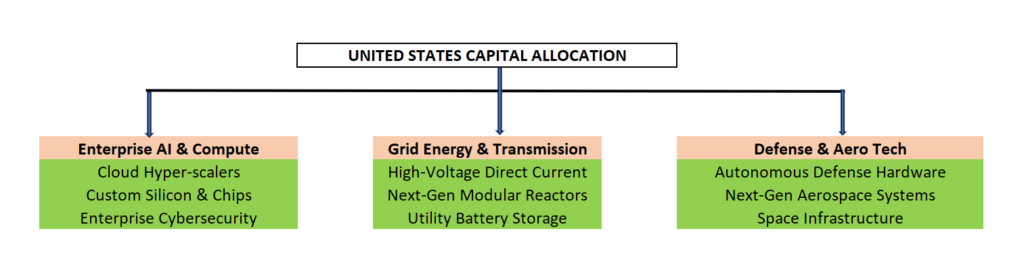
- Enterprise AI, Cloud Compute, & Cybersecurity: Companies building enterprise-grade software, AI agents, cloud architectures, and specialized hardware protection layers.
- Next-Generation Energy & Grid Modernization: Power generation utilities, high-voltage electrical equipment makers, small modular nuclear reactor (SMR) developers, and energy storage systems catering to exponential data center energy demands.
- Advanced Defense Technology & Aerospace: Autonomous systems, satellite networks, hypersonic defense, and advanced materials supplying both domestic security needs and global allied demand.
Strategic Summary for Global Investors & Executives
The United States through 2030 remains the ultimate high-volume, high-yield destination for institutional capital. While fiscal debt risks require long-term monitoring, the immediate 5-year outlook is defined by strong technology-driven productivity, resilient private consumption, and unmatched market liquidity. For global corporations and institutional allocators, exposure to the US economy remains an indispensable pillar of long-term growth strategy.
Top 65 Largest Economies in the World for 2027
Top 10 Largest Economies by 2030: IMF & World Bank GDP Projections for Global Powerhouses

U.S.- Canada Trade Talks Collapse; Carney Says Retaliatory Tariffs Begin September 8

Flock Cameras and the Future of Public Security

AI Infrastructure Boom Hits Physical Limits: Power, Financing, and Supply Chain Strain

Armanino adds Strategic Accounting Outsourced Solutions

New 2023 K-1 instructions stir the CAMT pot for partnerships and corporations

Tax Strategy: Employee Retention Credit update
-

 Stock News1 week ago
Nvidia Earnings Preview: What Wall Street Expects From the AI Bellwether’s Q2 Report
-

 Accounting1 week ago
SEC’s Semiannual Reporting Proposal Faces Investor Pushback: What CFOs Need to Know
-

 Stock News1 week ago
Nvidia Q2 FY2027 Earnings beats Wall Street Expectation with Record $96.2 Billion Revenue
-

 Finance1 week ago
Treasury Bond Volatility Forces Bessent to Double Debt Buyback Size as Yields Swing
-
 Technology4 days ago
AI Infrastructure Boom Hits Physical Limits: Power, Financing, and Supply Chain Strain
-
 Economics2 days ago
U.S.- Canada Trade Talks Collapse; Carney Says Retaliatory Tariffs Begin September 8
-
 Technology2 days ago
Flock Cameras and the Future of Public Security