
Personal Finance
How abortion access can impact personal finance: Turnaway Study author

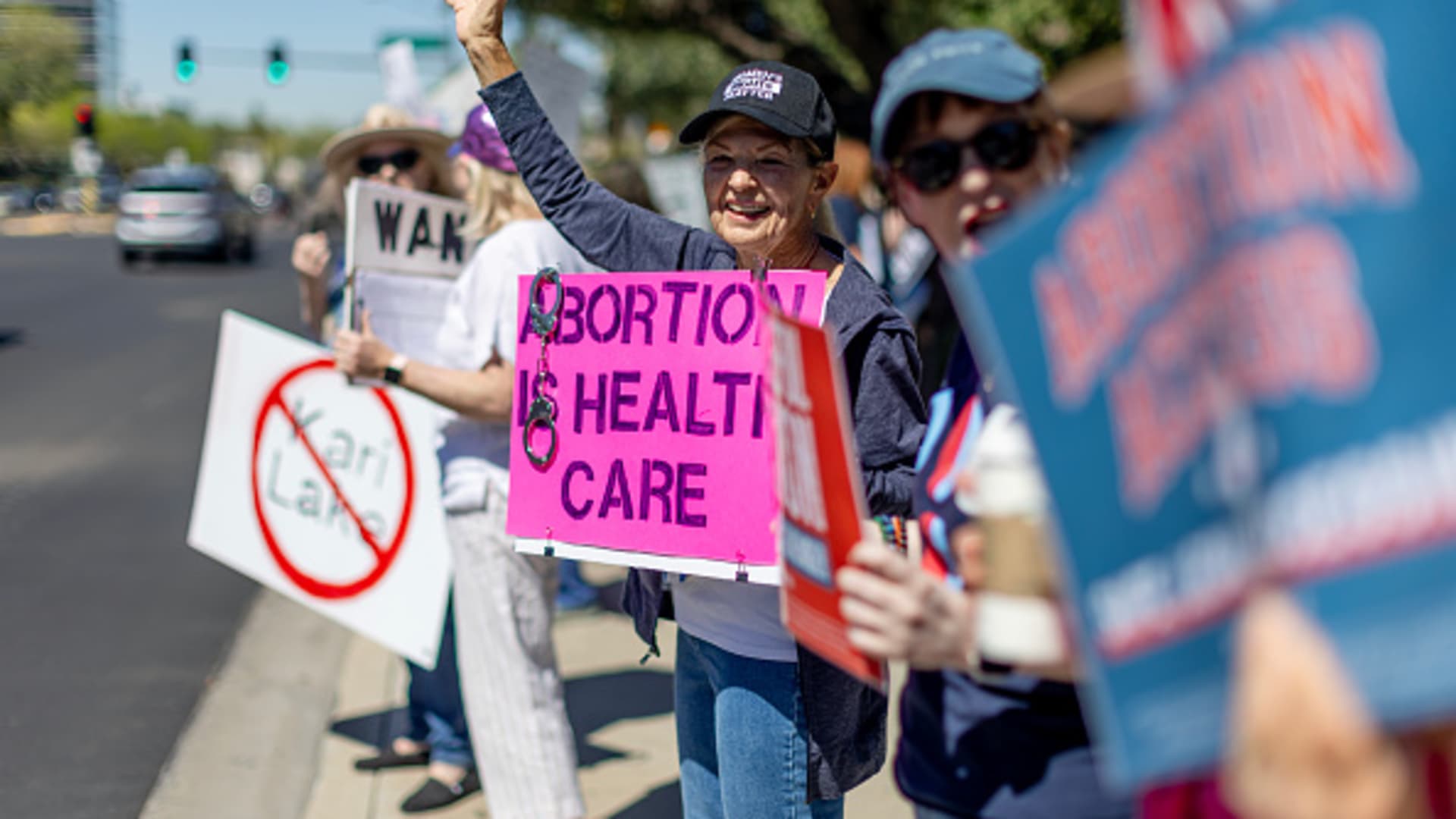
Arizona residents rally for abortion rights on April 16, 2024 in Phoenix, Arizona.
Gina Ferazzi | Los Angeles Times | Getty Images
Abortion is an important issue for many voters, especially young women, heading into the November election.
Abortion access is about more than politics, or health care: It’s also a personal finance issue, said Diana Greene Foster, a demographer who studies the effects of unwanted pregnancies on people’s lives.
Foster, a professor at the University of California San Francisco, led The Turnaway Study, a landmark research study on the socioeconomic outcomes for Americans who are “turned away” from abortion. The study tracked 1,000 women over a five-year period ending January 2016. The women in the study had all sought abortions at some point before the study commenced; not all received one.
More from Personal Finance:
How to lower healthcare costs during open enrollment
Ozempic is driving up the cost of your health care
Working moms are still more likely to handle child care
In November, voters in 10 states — Arizona, Colorado, Florida, Maryland, Missouri, Montana, Nebraska, Nevada, New York and South Dakota — will choose whether to adopt state ballot measures about abortion access.
Such ballot measures follow a U.S. Supreme Court decision in 2022 that struck down Roe v. Wade, the ruling that had established a constitutional right to abortion five decades earlier.
Nationally, women under age 30 rank abortion as the most important issue to their vote on Election Day, according to the KFF Survey of Women Voters, which polled 649 women from Sept. 12 to Oct. 1. It ranked as the third-most-important issue among women voters of all ages, behind inflation and threats to democracy, according to the KFF poll.

Abortion is among the least-important issues for registered Republicans, according to a Pew Research Center poll of 9,720 U.S. adults conducted Aug. 26 to Sept. 2.
CNBC spoke to Foster about the economics of abortion access and the financial impacts of the end of Roe v. Wade.
The conversation has been edited and condensed for clarity.
Low earners most likely to seek an abortion
Greg Iacurci: Can you describe the population of women that typically seek abortions in the U.S.?
Diana Greene Foster: One good thing about The Turnaway Study is that our demographics closely resemble national demographics on who gets abortions.
More than half are already parenting a child. More than half are in their 20s. A small minority are teenagers, even though lots of people think teenagers are the main recipients.
It’s predominantly people who are low-income. That’s been increasingly the case over time. It’s become disproportionately concentrated among people with the least economic resources.
GI: Why is that?
DGF: I think wealthier people have better access to contraceptives, even after the Obamacare-mandated coverage. Not everyone benefits from that. Not all states participate in that.
[Medical providers] still give contraceptives out. There are 20 states that have laws that say you should be able to get a year’s supply at a time, but almost nowhere is that actually available. The law says you should be able to get it, but you don’t. I led the studies that showed that if you make people go back for resupply every month or three months, as is very commonly done, you’re much more likely to have an unintended pregnancy. The laws have changed, but practice hasn’t changed. Access is not perfect yet.
Also, some people have abortions who have intended pregnancies because something went wrong with their health, with the fetus’ health, with their life circumstances. So even contraceptives aren’t the ultimate solution.
Greater likelihood of poverty and evictions
GI: What are the economic findings of your research?
DGF: When we follow people over time, we see that people who are denied an abortion are more likely to say that their household income is below the federal poverty line. They’re more likely to say that they don’t have enough money to meet basic living needs like food, housing and transportation.
Diana Greene Foster
Courtesy: Diana Greene Foster
Wanting to provide for the kids you already have is a common reason for abortion. We see that the existing children are more likely to be in poverty and in households where there aren’t enough resources if their mom couldn’t get an abortion.
[They’re also] more likely to have evictions, have a larger amount of debt if they’re denied an abortion.
GI: Can we quantify those impacts?
DGF: For example, six months after seeking an abortion, 61% of those denied an abortion were below the poverty line compared to just under half — 45% — of those who received an abortion. The higher odds of being below the [federal poverty line] persisted through four years.
And based on credit reports, we find that women denied abortions experienced significant increases in the amount of debt 30 days or more past due of $1,749.70, a 78% increase relative to their pre-pregnancy [average]. The number of public records, such as bankruptcies, evictions and court judgements, significantly increased for those denied abortions, by 81%.
GI: Why does this happen?
DGF: Having a kid is a massive investment. Deciding to parent a child relies on an amount of social support and housing security and access to health care, and our country isn’t at all set up to provide those things for low-income people.
Why costs are both rising and falling for women
GI: Your study took place at a time when Roe v. Wade was still the law. That’s no longer the case. How do you expect these economic consequences might be impacted?
DGF: In The Turnaway Study, people were denied abortions because they were too far along in pregnancy, but now you can be denied an abortion at any point in pregnancy in something like 13 states. So, it potentially affects a much larger group of people.
But there have been other changes which have to do with resources to help people travel and information about how to order medication abortion pills online. So, it isn’t the case that everyone who wants an abortion is now carrying a pregnancy to term.
There has been a lot of effort to circumvent state laws, and I think The Turnaway Study really reveals why. People understand their circumstances, and they are very motivated to get care, even when their state tries to ban it.
GI: What are the financial impacts some women in those states might encounter?
DGF: I’m actually studying the economic costs of the end of Roe and travel [expense]. Costs went up by $200 for people traveling out of state. People were delayed more than a week.
Under Roe, people could drive to an abortion clinic or get a ride; [after,] they were much more likely to be flying, having to take more modes of transportation. Over half stayed overnight. They traveled an average of 10 hours. That means taking time off work too. So, it dramatically increased the cost for those who traveled to get an abortion.
There are people who ordered pills online who are not [included] in the study. For those people, the cost may have gone down because it’s possible to order pills online for less than $30.
But you have to know about it, and you have to have an address, and you have to have internet, and it takes a level of knowledge to be able to pull that off. There can be a need for follow up medical care, so you have to be able to get that.


Personal Finance
Next-Generation Retirement Planning: Managing Longevity Risk and Variable Income Streams


U.S.- Canada Trade Talks Collapse; Carney Says Retaliatory Tariffs Begin September 8

Flock Cameras and the Future of Public Security

AI Infrastructure Boom Hits Physical Limits: Power, Financing, and Supply Chain Strain

Armanino adds Strategic Accounting Outsourced Solutions

New 2023 K-1 instructions stir the CAMT pot for partnerships and corporations

Tax Strategy: Employee Retention Credit update
-

 Stock News1 week ago
Nvidia Q2 FY2027 Earnings beats Wall Street Expectation with Record $96.2 Billion Revenue
-
 Technology6 days ago
AI Infrastructure Boom Hits Physical Limits: Power, Financing, and Supply Chain Strain
-
 Technology4 days ago
Flock Cameras and the Future of Public Security
-
 Economics4 days ago
U.S.- Canada Trade Talks Collapse; Carney Says Retaliatory Tariffs Begin September 8