
Accounting
How American tax breaks brought a Chinese solar energy giant to Ohio

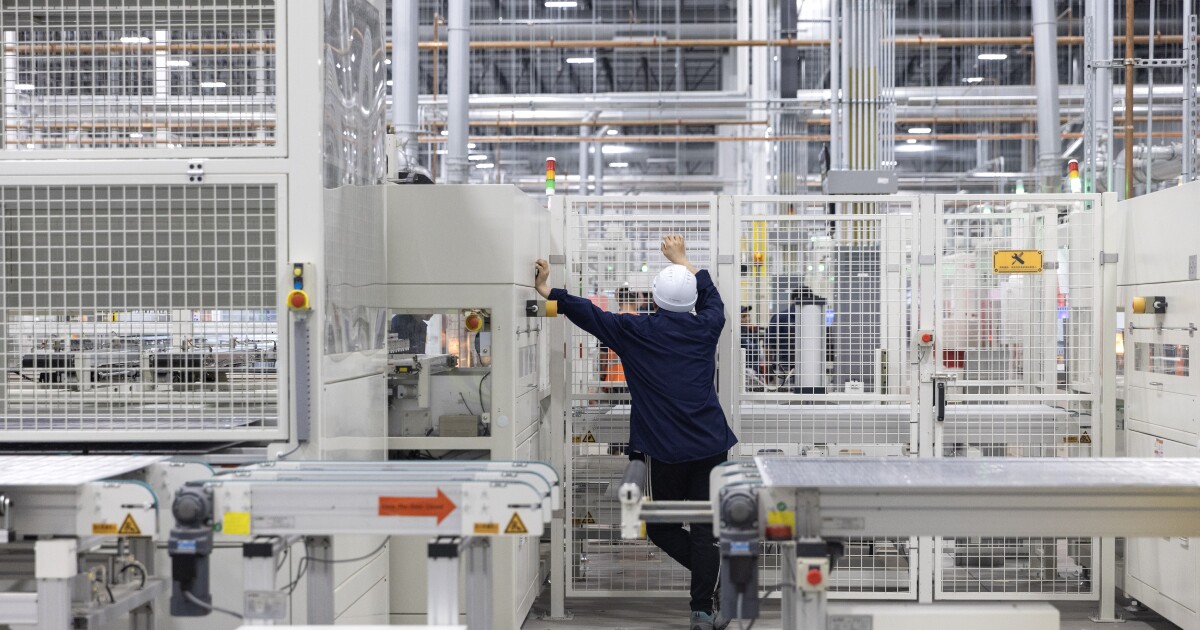

Nestled among the corn fields of Pataskala, Ohio, Illuminate USA’s sprawling new solar factory is buzzing. Hundreds of freshly hired local employees are hoisting pallets, soldering equipment and inspecting their work as sheets of glass are transformed into state-of-the-art photovoltaic panels. They’re collecting hourly wages that start at double the state minimum. The factory has also delivered contracts to area electricians and suppliers.
From the outside, these are the hallmarks of the 21st century clean energy manufacturing boom promised by the Biden administration, the result of sweeping incentives designed to restore national prowess in a market dominated by China.
In reality, what looks like a domestic triumph is also a win for America’s primary industrial and geopolitical rival. Invenergy, America’s biggest private renewable power developer, owns 51% of the plant. Longi Green Energy Technology Co., the Chinese solar giant, owns the other 49%, and it’s Longi’s panel-making expertise, technology and supply chain that are churning out tariff-free equipment for the U.S. market.
Inside the plant, signs in both English and Mandarin admonish workers to clean up trash. Machine displays also toggle between the two languages. More than 100 Chinese nationals are on site working alongside more than 1,000 American colleagues, and bridging the language barrier requires lots of hand gestures and smartphone-enabled translation. Illuminate says much of this is temporary, and most of the Chinese workers will leave once the Americans are up to speed.
But long after they return home, Longi will continue to profit. The joint venture benefits from millions in economic development incentives and federal tax credits for domestic clean energy manufacturing. For its part, Longi avoids anti-China tariffs and deepens its foothold in one of the
Companies based in or linked to China are replicating the strategy across the U.S. They are building or planning to build at least a dozen plants with 30 gigawatts of module-making capacity, according to a Bloomberg review of public statements, filings and other documentation. All told, the facilities would be able to supply roughly three-quarters of today’s U.S. panel needs. (BloombergNEF projects U.S. domestic demand for solar panels will be 45.5 gigawatts in 2024 and 50.4 gigawatts in 2025.)
American manufacturers are crying foul, saying these factories undermine their quest to build a domestic solar supply chain. Although other countries have taken advantage of the IRA’s subsidies, political objections have focused on Chinese investment. Bipartisan momentum is building in Congress to block China-backed firms from claiming tax credits for manufacturing anything central to the energy transition — a category that extends beyond solar panels to electric vehicles and batteries.
In Ohio, retired middle-school science teacher Eileen DeRolf has become an outspoken critic of Illuminate and the policies that brought it to Pataskala. She points to a 15-year tax abatement from the city and $4 million in incentives from a state economic development agency, to say nothing of the $350 million in potential annual tax subsidies from the Inflation Reduction Act.
“To me, this is betraying America, to allow an uneven playing field,” DeRolf said. “I happen to not particularly want our geopolitical No. 1 enemy to benefit off our economic system.”
Illuminate and its American and Chinese parent companies see it differently. They point to an influx of well-paying jobs and to a resurrection of manufacturing in a fast-growing sector of the economy.
“We’re a majority-owned American company,” said John Duer, Illuminate’s chief legal officer. “We have a minority partner based in China. We’re not a Chinese company trying to do business in the U.S.”
Executives at Invenergy and Longi had been talking about collaborating for years, but it took the Inflation Reduction Act — the 2022 law meant to jumpstart U.S. clean energy manufacturing — to spur them to action. Less than seven months after President Joe Biden signed the IRA, they
In addition to the tax credits Illuminate can claim for its U.S.-made panels, its parent companies reap significant benefits from the tie-up. Invenergy is the factory’s first and biggest customer, earning additional credits for using domestically produced components in its solar arrays. And Longi, like other Chinese panel-makers, brings advantages gained through decades of experience and generous support from Beijing.
In addition, the industry has been dogged by allegations that some suppliers
What no one disputes is that today Chinese companies dominate the market for solar panels and all of their component parts.
For environmental advocates, China’s cheap panels have been a boon, driving a more than 50-fold increase in emissions-free solar power generation globally since 2010. But to American rivals, something more nefarious was at work. They argued Chinese solar companies were selling their products below cost to unfairly corner the market, and trade authorities agreed, kicking off a cycle of tariffs meant to level the playing field.
Today, steep U.S. tariffs have effectively killed domestic demand for made-in-China solar panels. Companies, including Longi, first responded by shifting operations to other Asian nations, spurring another round of trade probes and enforcement. By producing panels in Ohio, Longi steps out of this game of
(The estimate is based on the average price in September for panels exported to the U.S. ($0.25 per watt), Longi’s share of Illuminate’s planned annual production capacity (5GW) and a potential combined antidumping and countervailing duty rate for Malaysian modules exported to the U.S. of 25%. Note: Any final
Combined with the incentives from the IRA, Longi and other panel-makers can “make huge profits,” said Yana Hryshko, chief solar analyst at consulting group Wood Mackenzie. After surviving two decades of industry turbulence, these “are not stupid companies,” she said. “They will not make a move without being confident.”
On a June Friday morning, job-seekers started to gather at the Perry County, Ohio, career center well before Illuminate’s recruitment event was scheduled to begin. Many of the plant’s workers come from outside Pataskala, including areas hit hard by the collapse of coal mining.
A job at the plant would mean a longer commute for Tricia Tilley, a 47-year-old janitor and church secretary. It would also nearly double her income and provide health insurance for her and her teenage son.
As for the company’s ties to China? “I know they’re from another country, but they’re here trying to put money into our country,” she said. “As long as it’s a good job and they’re paying everybody — keeping on the up-and-up — I don’t see any problem with it. Follow the rules like everybody else, we’re cool.”
Right now, Illuminate depends on the expertise of Chinese workers who’ve spent years handling specialized module-making machinery and brittle crystalline silicon cells. For many, it’s their first time outside of China, drawn by higher salaries and a sense of adventure.
“We’re here just to teach the American workers,” said Li, a production line technician who asked to be identified by her family name because she wasn’t authorized to speak to reporters. “When they can start a production line by themselves, there’ll be no need for us to be here anymore.”
Li’s days begin with a video chat around 5 a.m., a chance to talk with her children in China before a company shuttle takes her from suburban Columbus to the factory. Many of the Chinese workers at Illuminate work 12-hour shifts, six days a week, logging 60% more hours every month than the plant’s typical American employees.
Longi’s expats went through language training, though most rely on translators to communicate with their trainees. They also got a crash course in American culture, with advice to avoid commenting on race, skin color or body type. Li said her American colleagues have been kind.
“I hadn’t been out of China before. Now I get to come out and take a look,” she said. Li pegged her timeline at “two or three years. After that I’ll go back. Then I can say I’m a person who has been to the United States!”
Illuminate is leaning into its heartland identity. Its website touts its role “investing in Ohio” and “onshoring America’s supply chains.” It’s partnering with local high schools for a robotics challenge and also has sponsored the
DeRolf and other local skeptics deride these efforts as a charm offensive, albeit an effective one. It’s made it “ever so much more difficult to get this town and the people to pay attention to what we’ve got in that building,” DeRolf said.
Like DeRolf, activists in Mesquite, Texas, are taking aim at a $270 million plant that began producing panels late last year. Some 1,400 Texans now work at the factory owned by Canadian Solar Inc. — and while the company’s corporate headquarters are in Ontario, most of its directors and much of its manufacturing reside in China.
Foreign direct investment has always been critical to countries trying to build domestic industry. In the late 1990s, China, for its part, welcomed Western automakers, providing access to its growing market while learning from their decades of experience.
“Most of the companies that are building solar panels right now that have the know-how or skills are Chinese,” said Ilaria Mazzocco, a senior fellow at the Center for Strategic and International Studies. They also have well-established supply chains outside the U.S. At Illuminate, for example, panels are made with photovoltaic cells and glass from Malaysia and aluminum frames from Vietnam.
Many key materials aren’t yet produced domestically, and Illuminate says it’s actively working to expand its U.S. supply base.
The promise of the Inflation Reduction Act was that “you’re restoring the American industrial base,” said Nathan Picarsic, the founder of consulting group Horizon Advisory, which has investigated Chinese supply chain dominance and the use of forced labor. But as more Chinese-backed solar companies operate on U.S. soil, it betrays “the story that we’re telling ourselves about the manufacturing renaissance.”
The clash reverberates beyond solar to the fast-growing field of electric vehicles and battery manufacturing, also subsidized by the Inflation Reduction Act. In rural northwest Michigan, the town government is opposing an electric vehicle battery factory planned by a subsidiary of China’s
In Virginia, Governor Glenn Youngkin discouraged Ford Motor Co.’s interest in building an electric vehicle battery plant with China’s Contemporary Amperex Technology Co. Ltd. in the state, calling it a “
Licensing is one way the U.S. can tap Chinese manufacturing expertise and technical know-how while retaining more control over operations, said Mazzocco. Regardless, the issue is a flashpoint for politicians — and is fueling bipartisan efforts in Congress to bar companies with ties to China and other so-called “foreign entities of concern” from claiming the IRA’s manufacturing tax incentives. (It’s also a way lawmakers could try to offset spending in the next budget fight.) The Treasury Department could also move unilaterally to impose restrictions on what projects qualify for the credit.
Cory Ford, a school bus mechanic in the Pataskala area, doesn’t share his community’s embrace of the Illuminate plant. He doesn’t want U.S. taxpayer dollars to benefit Chinese industry; he’s also concerned that the firms could leave as quickly as they arrived. After all, Chinese companies have become expert at rapidly relocating in response to unfavorable tariffs or taxation.
“We’ve given so much in subsidies and government funding,” he said. “When that runs dry, how quickly is that building going to empty out?” And, he asks, what happens to the local American workers left behind?
Illuminate isn’t going anywhere, Duer said, even if Washington puts the manufacturing subsidies outside of reach: “We would adjust. Nothing is fatal. Nothing can’t be overcome. The fact of the matter is, we’re here to stay.”





Treasury Bond Volatility Forces Bessent to Double Debt Buyback Size as Yields Swing

Nvidia Earnings Preview: What Wall Street Expects From the AI Bellwether’s Q2 Report

SEC’s Semiannual Reporting Proposal Faces Investor Pushback: What CFOs Need to Know

Armanino adds Strategic Accounting Outsourced Solutions

New 2023 K-1 instructions stir the CAMT pot for partnerships and corporations

Tax Strategy: Employee Retention Credit update
-

 Economics1 week ago
U.S. Retail Sales Fall for the First Time in Nine Months as Consumer Spending Slows
-
 Economics1 week ago
Nvidia’s Potential $3 Billion SB Energy Investment Could Reshape AI Infrastructure
-

 Economics4 days ago
Top 10 Largest Economies by 2030: IMF & World Bank GDP Projections for Global Powerhouses
-
 Stock News4 days ago
How to understand Intel $15B Stock Offering
-
 Technology1 week ago
U.S.-China AI Competition Intensifies as Washington Pushes Allies to Choose Sides
-
 Economics4 days ago
Economic Profile of the United States of America (2026–2030 Horizon)
-
 Stock News21 hours ago
Nvidia Earnings Preview: What Wall Street Expects From the AI Bellwether’s Q2 Report
-

 Leaders3 days ago
Jackson Hole 2026: What the First Symposium Under Fed Chair Kevin Warsh Means for Markets