
Finance
How China’s consumers are spending this Singles Day shopping festival

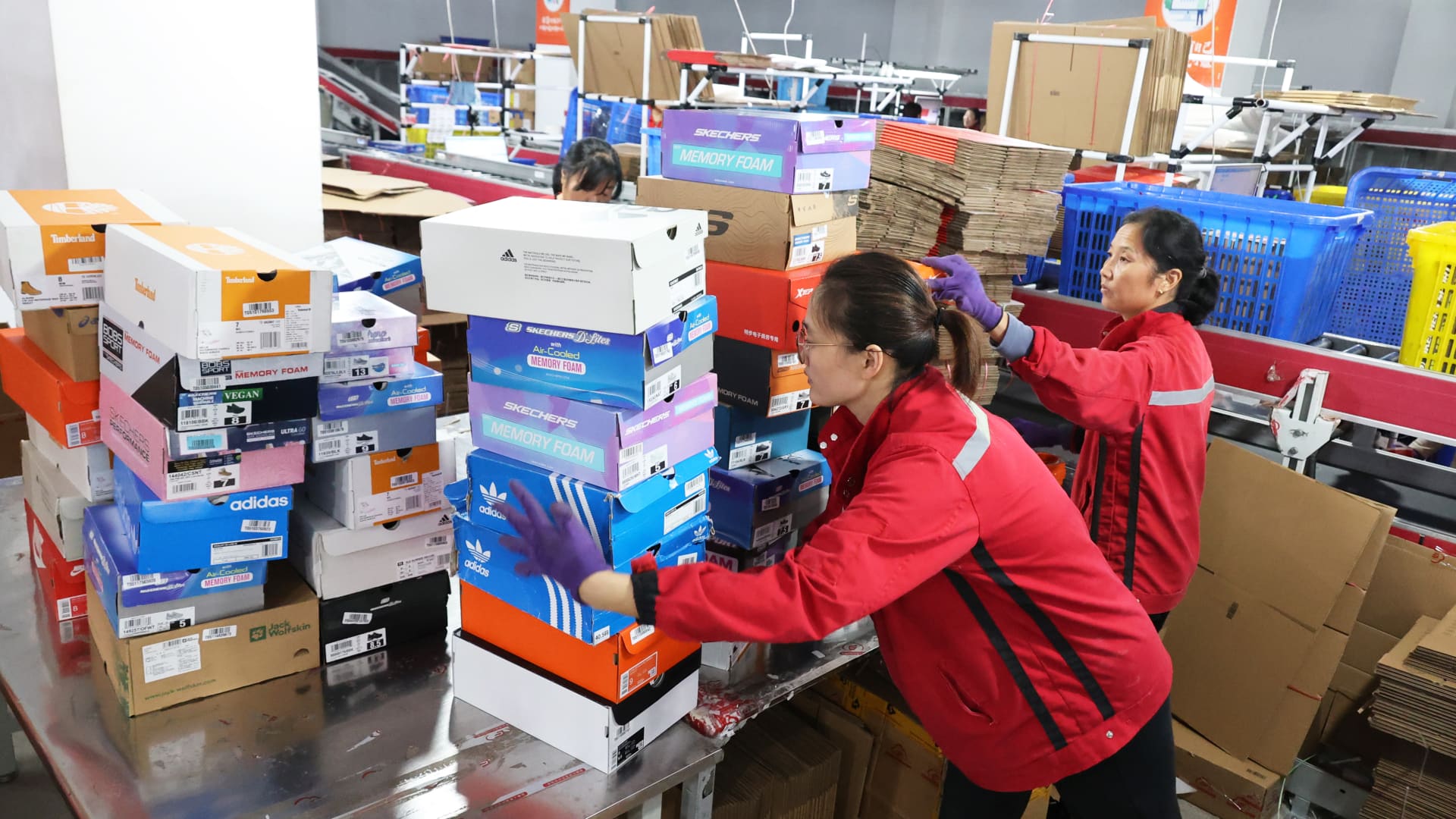
Employees package and sort express parcels at an e-commerce company on Nov. 1, 2024, around the Double 11 Shopping Festival in Lianyungang, Jiangsu Province of China.
Vcg | Visual China Group | Getty Images
BEIJING — Early indicators of China’s biggest shopping event of the year reveal a pickup in select categories amid expectations of relatively modest growth in overall sales.
China’s version of Black Friday kicked off on Oct. 14, more than a week earlier than last year, as e-commerce players Alibaba and JD.com grapple with tepid consumer spending. The shopping festival, also known as Singles Day or 11.11, has in recent years evolved into a weeks-long promotional period since Alibaba launched it in 2008 on Nov. 11.
“What we’re seeing so far, it’s going to be slightly better in terms of GMV growth over last year,” Jacob Cooke, co-founder and CEO of WPIC Marketing + Technologies, told CNBC Thursday. The company helps foreign brands — such as Vitamix and IS Clinical — sell online in China and other parts of Asia.
GMV refers to gross merchandise value, an industry measure of sales over time. China’s e-commerce giants stopped reporting Singles Day GMV in 2022 during the pandemic. In 2021, Alibaba said its GMV rose by 8% while JD’s climbed by 28%, totaling more than $139 billion.
Singles Day GMV this year as of Oct. 30 was 845 billion yuan ($119.1 billion), according to research firm Syntun. It was not clear how the GMV figures compared to 2023 given the extended promotional period this year.
Around 80%, or roughly $95 billion, came from Alibaba, JD.com and PDD, while nearly 20% was generated via livestreaming sales platforms Kuaishou and ByteDance’s Douyin, the Syntun report showed.

While Singles Day GMV no longer grows by 30%, Cooke said he expects around 15% growth this year, better than the 11% increase in 2023, when the festival lasted for 19 days, according to his company’s data.
“Things that are experiential-based are starting to do really well, less on the Louis Vuitton luxury and more on the lululemon is kind of what we’ve said about this for a while,” Cooke said. “It’s just that consumer habits have really changed.”
Subsidies boost appliances
Helping boost sales this Singles Day are China’s subsidies for trade-ins of home appliances, launched in late July. Chinese authorities since late September have started doubling down on stimulus efforts by cutting rates on existing mortgages and signaling further support.
“We believe [the] 11.11 festival this year will be a critical point and is poised to reflect on the recovery trajectory in 3Q24 and 4Q24,” analysts at UOB Kay Hian said in a report.
They predict 4% to 5% growth in Singles Day GMV, with sales in the home appliance category supported by the trade-in program.
Alibaba said government subsidies and platform benefits contributed to a more than seven-fold surge in presales of home appliances during the first hour on Oct. 14, compared with the first hour of presales last year.
JD.com said that between Oct. 14 and Oct. 31, transaction volume grew by double-digits versus the same period a year ago. The company claimed record sales in consumer electronics and home appliances, without disclosing figures.
“This year, it seems that the price war of e-commerce platforms has slowed down overall, returning to a certain degree of rationality after the intense price competition,” Dave Xie, partner at Oliver Wyman, said in a statement. He also noted Beijing’s stimulus announcements and a recovery in consumer sentiment.
“In the initial phase of Singles Day, categories such as home appliances and consumer electronics, outdoor gear, beauty and cosmetics, and pet supplies have all performed well,” Xie said.
‘Micro’ shopping trend
A consumer trend that’s emerged this year is in toys and collectibles, often from a game or popular animated series. The category is usually referred to as IP in China.
”A lot of international brands have been fighting for licenses to try to get in here and do this as well,” Cooke said.
There’s always “a micro trend in every year’s 11.11 and this really seems to be it this year,” he said. “Something that kind of came out of nowhere, into all of a sudden really, really big numbers.”
More than 100,000 products based on licenses for over 1,000 characters — such as the games Genshin Impact and Arknights — are being launched on Alibaba’s Tmall this Singles Day, according to Yuke Liang, a representative for the business’ designer and collectable toy category. Products include collectable cards, figurines and clothes.
The category also includes Lego and British toy company Jellycat, which launched a Valentine’s Day plush dog in China for Singles Day, Liang said. The 7,000 dogs, priced at around $50 each, sold out in seconds, she said.
Japanese manga Chiikawa opened a Tmall store in late September, and saw more than 100,000 shoppers simultaneously order a $9.72 limited edition plush, Liang said.
Liang said Taobao and Tmall started developing the IP category in 2017, and elevated it in 2021 to one of its few tier-one segments in terms of product promotion and business priority. She said most buyers are in their early thirties or younger, and prefer to spend on products perceived as bringing happiness or other emotional satisfaction.
Sentiment is ‘much calmer’
Despite such pockets of growth, China’s Singles Day remains more toned down than in prior years.
“Sentiment is quite different this year, much calmer,” wrote Ashley Dudarenok, founder of ChoZan, a China marketing consultancy. “Chinese consumers are not caught up in the ‘buy buy buy frenzy,’ they are hunting [for] more expensive products that they actually need vs just lower prices.”
She expects that at best, Singles Day this year may be “slightly better” and driven by different categories.
The shopping promotions officially wrap up on Nov. 11.
James Yang, head of Greater China retail at consultancy Bain & Company, said the firm has “muted expectations” for Singles Day this year, continuing the trend of the last two years.
JD is set to release quarterly results on Nov. 14, while Alibaba is scheduled to release earnings on Nov. 15.




Treasury Bond Volatility Forces Bessent to Double Debt Buyback Size as Yields Swing

Nvidia Earnings Preview: What Wall Street Expects From the AI Bellwether’s Q2 Report

SEC’s Semiannual Reporting Proposal Faces Investor Pushback: What CFOs Need to Know

Armanino adds Strategic Accounting Outsourced Solutions

New 2023 K-1 instructions stir the CAMT pot for partnerships and corporations

Tax Strategy: Employee Retention Credit update
-

 Economics1 week ago
U.S. Retail Sales Fall for the First Time in Nine Months as Consumer Spending Slows
-

 Economics1 week ago
Nvidia’s Potential $3 Billion SB Energy Investment Could Reshape AI Infrastructure
-

 Economics4 days ago
Top 10 Largest Economies by 2030: IMF & World Bank GDP Projections for Global Powerhouses
-

 Stock News4 days ago
How to understand Intel $15B Stock Offering
-

 Technology1 week ago
U.S.-China AI Competition Intensifies as Washington Pushes Allies to Choose Sides
-
 Economics4 days ago
Economic Profile of the United States of America (2026–2030 Horizon)
-
 Leaders3 days ago
Jackson Hole 2026: What the First Symposium Under Fed Chair Kevin Warsh Means for Markets
-
 Stock News19 hours ago
Nvidia Earnings Preview: What Wall Street Expects From the AI Bellwether’s Q2 Report