
Personal Finance
How college grads can find a job in a tough market


A graduating student of the CCNY wears a message on his cap during the College’s commencement ceremony.
Mike Segar | Reuters
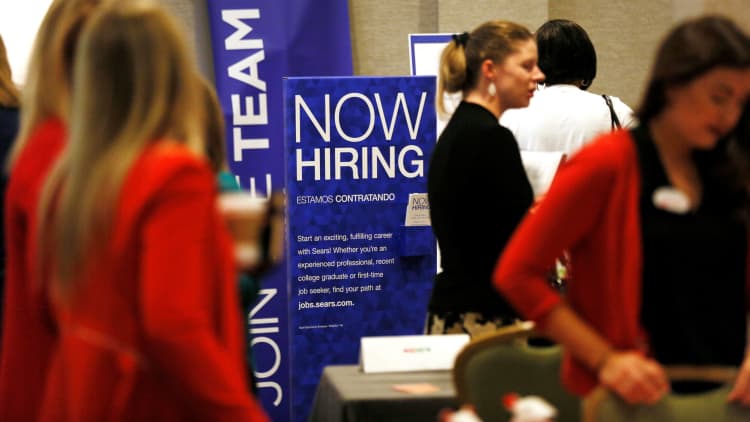
New college graduates looking for work now are finding a tighter labor market than they expected even a few months ago.
The unemployment rate for recent college grads reached 5.8% in March, up from 4.6% the same time a year ago, according to an April report from the Federal Reserve Bank of New York.
Job postings at Handshake, a campus recruiting platform, are down 15% over the past year, while the number of applications has risen by 30%.
Christine Cruzvergara, chief education strategy officer at Handshake, says new grads are finding a “tough and competitive” market.
“There’s a lot of uncertainty and certainly a lot of competition for the current graduates that are coming into the job market,” she said.
How federal job cuts hurt the Class of 2025
While the job creation in the U.S. has continued to show signs of strength, policy changes have driven the uncertainty.
President Donald Trump has frozen federal hiring and done mass firings of government workers. Evercore ISI, an investment bank, estimated earlier this month that 350,000 federal workers have been impacted by cuts from Department of Government Efficiency, representing roughly 15% of federal workers, with layoffs set to take effect over the coming months.
“In early January, the class of 2025 was on track to meet and even exceed the number of applications to federal government jobs,” Cruzvergara said. When the executive orders hit in mid-January there was “a pretty steep decline all of a sudden, she said.
“The federal government is one of the largest employers in this country, and also one of the largest employers for entry-level employees as well,” said Loujaina Abdelwahed, senior economist at Revelio Labs, a workforce intelligence firm.
Employment uncertainty related to tariffs, AI
On-again, off-again tariff policies have created uncertainty for companies, with a third of chief executive officers in a recent CNBC survey expecting to cut jobs this year because of the import taxes.
Job losses from artificial intelligence technology are also a concern.
A majority, 62%, of the Class of 2025 are concerned about what AI will mean for their jobs, compared to 44% two years ago, according to a survey by Handshake. Graduates in the humanities and computer science are the most worried about AI’s impact on jobs.
“I think it’s more about a redefinition of the entry level than it is about an elimination of the entry level,” Cruzvergara said.
Postings for jobs in hospitality, education services, and sales were showing monthly growth through March, according to Revelio Labs. But almost all industries, with the exception of information jobs, saw pullbacks in April.
How to land a job in a tough market
For new grads hunting for a job, experts advise keeping a positive mindset.
“Employers don’t want to hire someone that they feel like is desperate or bitter or upset,” said Cruzvergara. “They want to hire someone that still feels like there’s a lot of opportunity, there’s a lot of potential.”
Here are two tactics that can help with your search:
1. Look at small firms — they may provide big opportunities
Companies with fewer than 250 employees may offer better opportunities to grow and learn than bigger “brand name” firms, according to Revelio Labs.
A new study by Revelio found that five years into their careers, graduates had comparable salary progression, promotion timelines, and managerial prospects — regardless of the size of their first employer. However, people who started their careers at small companies were 1.5 times more likely to become founders of their own companies later in their careers.
The study looked at individuals who earned bachelor’s degrees in the U.S. between 2015 and 2022, following their career paths post-graduation.
While some young workers may have entered start-ups with the goal of starting their own firm in the future, Abdelwahed said there’s often an opportunity at smaller companies to be given responsibilities beyond the job’s role.
“Because the company’s small and the work needs to get done, so they just start to develop this entrepreneurship drive,” Abdelwahed said.
2. Network and use informational interviews
Experts also urge recent grads to reach out to people working in industries that pique their interest.
“Take an interest in someone else. Ask them questions about how they got to where they are, what they’ve learned, what you should know about that particular industry, what are emerging trends or issues that are facing them in the field right now,” said Cruzvergara.
This approach can help you sound more knowledgeable in the application and interviewing process.
— CNBC’s Sharon Epperson contributed reporting.
SIGN UP: Money 101 is an 8-week learning course on financial freedom, delivered weekly to your inbox. Sign up here. It is also available in Spanish.

Personal Finance
Next-Generation Retirement Planning: Managing Longevity Risk and Variable Income Streams


U.S.- Canada Trade Talks Collapse; Carney Says Retaliatory Tariffs Begin September 8

Flock Cameras and the Future of Public Security

AI Infrastructure Boom Hits Physical Limits: Power, Financing, and Supply Chain Strain

Armanino adds Strategic Accounting Outsourced Solutions

New 2023 K-1 instructions stir the CAMT pot for partnerships and corporations

Tax Strategy: Employee Retention Credit update
-

 Stock News1 week ago
Nvidia Earnings Preview: What Wall Street Expects From the AI Bellwether’s Q2 Report
-

 Accounting1 week ago
SEC’s Semiannual Reporting Proposal Faces Investor Pushback: What CFOs Need to Know
-

 Stock News1 week ago
Nvidia Q2 FY2027 Earnings beats Wall Street Expectation with Record $96.2 Billion Revenue
-

 Finance1 week ago
Treasury Bond Volatility Forces Bessent to Double Debt Buyback Size as Yields Swing
-
 Technology5 days ago
AI Infrastructure Boom Hits Physical Limits: Power, Financing, and Supply Chain Strain
-
 Technology3 days ago
Flock Cameras and the Future of Public Security
-
 Economics3 days ago
U.S.- Canada Trade Talks Collapse; Carney Says Retaliatory Tariffs Begin September 8