
Personal Finance
How kids from rich families learn about money


Institut auf dem Rosenberg, a private boarding school in St. Gallen, Switzerland.
Courtesy: Institut auf dem Rosenberg
With a sticker price of more than $160,000 a year, Institut auf dem Rosenberg in St. Gallen, Switzerland, may be one of the most expensive boarding schools in the world. So, it’s only fitting that students learn about money.
But rather than focusing on basic budgeting and managing credit, finance classes at the elite Swiss institution cover wealth creation, philanthropy, family businesses and succession management.
“Being able to educate these future leaders gives us the privilege to pioneer course concepts,” said Bernhard Gademann, president of the school. “Everybody should know about interest rates, inflation, share investment portfolios — nobody teaches this.”
More from Personal Finance:
‘Recession pop’ is in: How music hits on economic trends
Why a job is ‘becoming more compelling’ for teens
More Americans are struggling even as inflation cools
In one of the most popular classes, which covers wealth creation and finance, students manage hypothetical $1 million portfolios and present their investment picks to the mock board of a family office — private companies that wealthy families establish to handle their investment management.
Classroom discussions, for students ages 12-18, cover various asset classes, risk versus reward and the power of compounding.
Too often, these topics are left out of traditional curriculums because they are considered “nonacademic,” Gademann said. However, these ideas overlap with the same concepts taught in math and biology, among other subjects.
Bernhard Gademann with students in a class.
Courtesy: Institut auf dem Rosenberg
“It’s truly important to understand the dynamics, the implications and why it’s relevant because it touches every aspect of your daily life,” Gademann said. “All of these things are interconnected, and wealth creation shouldn’t be ignored.”
“Not being able to provide [students] with this information and training is really stealing an opportunity for them being successful,” he added.
The lifetime benefit of a financial education
While most students don’t have access to these types of classes, more U.S. high schools are tackling financial literacy.
As of 2024, more than half of all states already require or are in the process of requiring high school students to take a personal finance course before graduating, according to the latest data from Next Gen Personal Finance, a nonprofit focused on providing financial education to middle and high school students.
Research shows taking a financial education class in high school does pay off.
In fact, there is a lifetime benefit of roughly $100,000 per student from completing a one-semester course in personal finance, according to a report by consulting firm Tyton Partners and Next Gen.
Much of that financial value comes from learning how to avoid high-interest credit card debt and leveraging better credit scores to secure preferential borrowing rates for key expenses, such as insurance, auto loans and home mortgages, according to Tim Ranzetta, co-founder and CEO of Next Gen and a member of the CNBC Global Financial Wellness Advisory Board.
However, often what students are most interested in is investing. “Students are at the edge of their seats when you ask them about building wealth and becoming a millionaire,” said Yanely Espinal, Next Gen’s director of educational outreach.
As a result, teachers and schools are starting to prioritize those lessons because they have the highest engagement among students of all of the personal finance topics, Espinal said. “Hook them where they are most interested.”
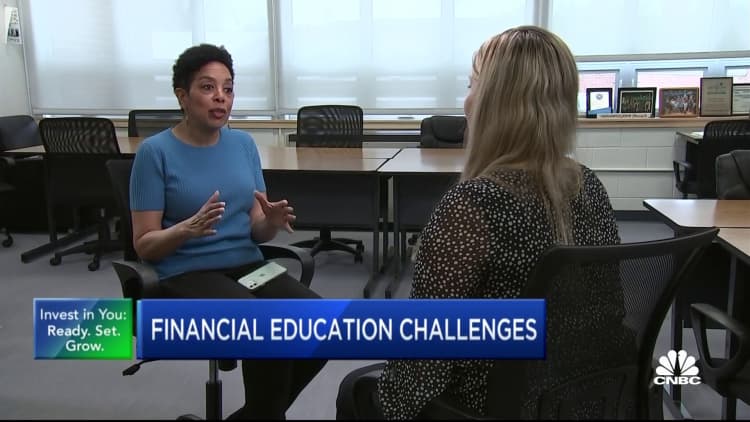
Still, “when you teach investing, focus on the long term,” advised Espinal, who is also a member of the CNBC Global Financial Wellness Advisory Board. And budgeting, banking, paying for college, taxes, credit management and the psychology of money are equally important, she said.
“Let’s not leave financial education to TikTok,” she said. “We have to get serious about creating a formal education.”
Let’s not leave financial education to TikTok.
Yanely Espinal
director of educational outreach at Next Gen
Many studies also show there is a strong connection between financial literacy and financial well-being.
Students who are required to take personal finance courses starting from a young age are more likely to tap lower-cost loans and grants when it comes to paying for college and less likely to rely on private loans or high-interest credit cards, according to a 2018 report by Christiana Stoddard and Carly Urban for the National Endowment for Financial Education.
Further, students with a financial literacy course under their belt have better average credit scores and lower debt delinquency rates as young adults, according to 2016 data from the Financial Industry Regulatory Authority’s Investor Education Foundation, which seeks to promote financial education.
In addition, a study by the Brookings Institution in 2018 found that teenage financial literacy is positively correlated with asset accumulation and net worth by age 25.
Among adults, those with greater financial literacy find it easier to make ends meet in a typical month, are more likely to make loan payments in full and on time, and less likely to be constrained by debt or be considered financially fragile.
They are also more likely to save and plan for retirement, according to data from the TIAA Institute-GFLEC Personal Finance Index based on research, which has been conducted annually since 2017.
Meanwhile, in the U.S., the trend toward in-school personal finance classes is continuing to gain steam.
There are another 50 personal finance education bills pending in 20 states, according to Next Gen’s bill tracker.


Personal Finance
Next-Generation Retirement Planning: Managing Longevity Risk and Variable Income Streams


S&P 500 September Outlook: Tech Rally Holds Index at 7,600

India Unveils ‘Saptadhara’ Reform Agenda Targeting Technology, Youth Skilling, and Growth

S&P 500 Outperforms Amid Strong Corporate Earnings as Treasury Yields Cap Equity Multiples

Armanino adds Strategic Accounting Outsourced Solutions

New 2023 K-1 instructions stir the CAMT pot for partnerships and corporations

Tax Strategy: Employee Retention Credit update
-

 Stock News1 week ago
Nvidia Q2 FY2027 Earnings beats Wall Street Expectation with Record $96.2 Billion Revenue
-

 Technology6 days ago
AI Infrastructure Boom Hits Physical Limits: Power, Financing, and Supply Chain Strain
-

 Economics4 days ago
U.S.- Canada Trade Talks Collapse; Carney Says Retaliatory Tariffs Begin September 8
-

 Technology4 days ago
Flock Cameras and the Future of Public Security
-

 Insights2 hours ago
Climate Resilience and Offshore Wind and Land Restoration Milestones
-
 Stock News30 minutes ago
S&P 500 September Outlook: Tech Rally Holds Index at 7,600
-

 Accounting2 hours ago
Mandatory ESG Reporting Standards Demand Standardized Non-Financial Audit Trails
-
 Finance1 hour ago
S&P 500 Outperforms Amid Strong Corporate Earnings as Treasury Yields Cap Equity Multiples