Connect with us

Personal Finance

How Savvy Ladies uses AI to help boost women’s financial literacy

Published

on

Aire Images | Moment | Getty Images

Most Americans consider money to be a private topic, and women are among those most reluctant to engage in financial conversations.

But not asking the questions they need help with can hold them back financially, experts say.

One women-focused nonprofit has launched a new way to help them get faster answers to their queries through the use of an online AI chatbot.

The organization, Savvy Ladies, was founded more than 20 years ago by Stacy Francis, a certified financial planner and president and CEO of Francis Financial in New York City.

After seeing her grandmother stay in an abusive situation because she lacked financial resources, Francis created the nonprofit with the goal of helping other women avoid similar situations.
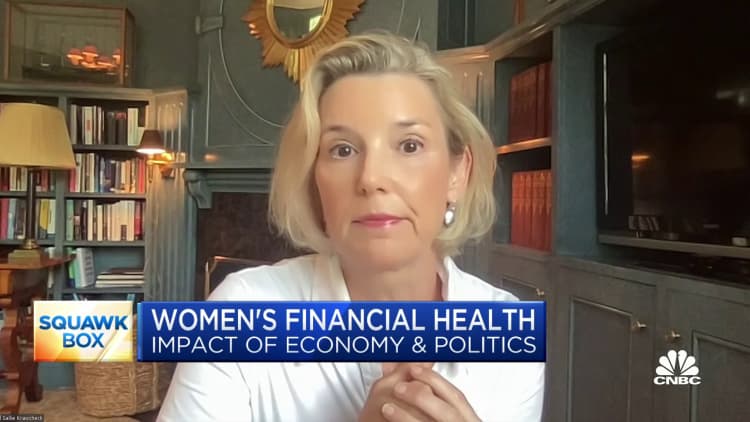
Ellevest's Sallie Krawcheck explains the factors impacting women's financial health

The new chatbot — provided through Microsoft Copilot — allows visitors to the Savvy Ladies website to type in their financial questions and receive immediate answers curated from the website’s content written by CFPs and other financial professionals.

“We want to make sure that we are able to help anyone, any woman who has a question,” said Francis, who is also a member of CNBC’s FA Council. “This is something that she can go on literally at 3 a.m. and be able to get her question answered.”

That first engagement always closes with a prompt via the Savvy Ladies’ helpline for a one-on-one conversation with a professional who can provide advice and guidance.

“We want everyone to learn and grow in their knowledge, but still feel that they’re they can come and ask their own individual question and get matched,” said Judy Herbst, executive director of Savvy Ladies.

AI tools can’t replace financial advice

Artificial intelligence language models may play an important and evolving role in financial literacy, said Michael Roberts, the William H. Lawrence professor of finance at the Wharton School of the University of Pennsylvania.

But today’s tools are still developing and are a complement to — rather than a replacement of — our own personal financial knowledge and decision making, he said.

More from Women and Wealth:

Here’s a look at more coverage in CNBC’s Women & Wealth special report, where we explore ways women can increase income, save and make the most of opportunities.

“To use these tools, you have to be able to engage with them; but to be able to engage with them, you have to be able to know what questions to ask, [and] how to ask them,” Roberts said. “And you have to be able to understand the responses coming back at you.”

Due to the fast rate of progress in this space, it’s hard to forecast where these tools will be even in another year or two, Roberts said.

Individual investors are already showing signs they are starting to embrace these tools.

Investors are more likely to trust advice from generative AI tools than from social media, according to a survey released last year from the CFP Board, a professional organization representing professional financial planners.

Yet they are more likely to be comfortable acting on that advice once it has been verified by a financial planner, the results found.

Technology experts who sit on Savvy Ladies’ board hope the new chatbot will help expand the nonprofit’s reach.

“We live in a world where you scroll TikTok or you scroll Instagram and you want an instant answer,” said Julia Rodgers, CEO of Hello Prenup and a Savvy Ladies board member.

“It’s very important for nonprofits like Savvy Ladies to keep up with that so that we can continue to deploy those services to those in need,” she said.

Since Savvy Ladies launched the tool, the chat bot has received questions regarding how to establish a monthly budget, build better credit and earn more money, according to Herbst.

The nonprofit is still refining the chatbot, she said. One goal is to make its voice match the organization’s mission.

“It’s a navigator, but we want it to be a soft-spoken female voice that comes through,” Herbst said.


Don’t miss these exclusives from CNBC PRO

Continue Reading

Personal Finance

Maximizing Returns in High Rate Climate and market uncertainty

Published

on

Maximizing Returns in High-Rate Climate

In the macroeconomic environment of late July 2026, personal cash management requires an active, structured approach to wealth preservation. With central bank benchmark rates remaining elevated to ensure long-term disinflation, conservative yield-bearing vehicles—such as short-term U.S. Treasury bills, money market funds, and high-yield savings accounts (HYSAs)—continue to offer reliable nominal returns between 4% and 5%. For individual investors, maximizing net returns requires moving beyond passive checking accounts and executing a disciplined cash laddering strategy.

Leaving substantial liquid capital in traditional bank deposits creates an invisible drag on personal net worth due to ongoing inflation. By implementing a tiered liquidity framework, individuals can split emergency cash reserves and short-term capital allocations across rolling maturities. Allocating cash into 4-week, 8-week, and 13-week Treasury bills creates a continuous cycle of maturing liquidity, allowing investors to continuously reinvest capital at prevailing market yields while maintaining immediate access to emergency funds.

Tax efficiency represents a critical dimension of high-yield cash optimization. For high-earning individuals residing in states with substantial local income taxes, direct holdings in short-term U.S. Treasury instruments often deliver superior net post-tax yields compared to standard commercial bank HYSAs. Because interest earned on federal Treasury bills is strictly exempt from state and local taxation, investors can retain a larger portion of their compounding interest gains without taking on additional credit or market risk.

Ultimately, personal wealth accumulation in mid-2026 relies on intentional capital deployment. Cash should be managed as a productive asset class that generates consistent, risk-free returns. Regularly auditing account yield terms, automating recurring transfers, and leveraging tax-advantaged fixed-income instruments ensures that personal liquidity remains fully optimized against macroeconomic fluctuations.

Continue Reading

Personal Finance

Algorithmic Wealth Management: Balancing Automated Financial Planning with Human Oversight

Published

on

Balancing Automated Financial Planning with Human Oversight

The personal finance industry in July 2026 is experiencing a technological evolution, driven by the wide deployment of next-generation algorithmic wealth management tools. Modern digital financial platforms have expanded far beyond basic automated index investing; today’s robo-advisors utilize real-time tax-loss harvesting, dynamic portfolio rebalancing, and hyper-personalized spending analysis to optimize retail investor outcomes. However, as these digital solutions become ubiquitous, investors face the crucial challenge of balancing automated execution with human strategic judgment.

The core advantage of automated financial planning platforms lies in their ability to remove emotional bias from investment execution. During periods of market volatility or localized sector realignments, automated algorithms systematically rebalance portfolios back to target asset allocations without falling victim to panic selling or speculative enthusiasm. Furthermore, integrated cash-flow monitoring algorithms analyze individual spending patterns in real time, automatically sweeping surplus income into designated retirement or debt-liquidation accounts to accelerate net worth accumulation.

Despite these operational advantages, algorithmic tools have inherent structural limitations when addressing complex, highly personalized financial life events. Decisions involving multi-generational estate planning, highly complex tax strategies, small business exits, or nuanced real estate transactions require contextual human judgment that software models cannot replicate. Relying solely on automated models without periodic human professional review can result in misaligned risk profiles or overlooked tax liabilities during major life transitions.

The optimal approach for personal financial planning in late 2026 is a hybrid advisory model. Individuals should utilize automated platforms for routine asset allocation, continuous tax optimization, and low-cost passive index tracking, while engaging qualified human financial advisors for periodic strategic planning, estate structuring, and qualitative risk evaluations. This dual approach ensures maximum cost efficiency and disciplined execution while retaining essential strategic guidance.

Continue Reading

Personal Finance

High-Yield Optimization: Structuring Personal Cash Reserves in a Sustained Rate Environment

Published

on

Structuring Personal Cash Reserves in a Sustained Rate Environment

In the financial environment of mid-2026, personal cash management has re-emerged as a vital component of holistic wealth building. With central bank policy rates holding firm to maintain long-term price stability, yield-bearing instruments such as money market funds, high-yield savings accounts (HYSAs), and short-term Treasury bills continue to offer compounding returns around 4% to 5%. For individual investors, effectively structuring cash reserves requires shifting away from passive bank deposits toward active yield optimization.

A frequent pitfall in personal asset management is leaving substantial liquid capital in traditional checking or low-yield savings accounts, where real returns are continuously eroded by baseline inflation. By implementing a disciplined ‘cash ladder’ strategy—allocating liquid funds across tiered maturities using ultra-short Treasury instruments and FDIC-insured high-yield accounts—individuals can secure maximal yields while retaining immediate liquidity for emergency expenses or tactical investment opportunities.

Simultaneously, investors must evaluate the tax efficiency of their cash holdings based on their tax bracket and geographic location. For high earners situated in states with high local income taxes, direct holdings in short-term U.S. Treasury bills often yield a higher net post-tax return than standard high-yield savings accounts, as Treasury interest is strictly exempt from state and local taxation. Understanding these nuanced tax distinctions allows individuals to capture significant incremental gains without taking on additional market risk.

Ultimately, personal financial health in late 2026 hinges on intentional liquidity management. Cash reserves should not be viewed merely as static emergency funds, but as a dynamic asset class that contributes positively to net worth growth. Regularly auditing yield terms, automating cash transfers, and optimizing for post-tax efficiency ensures that personal capital remains fully productive across all economic conditions.

Continue Reading

Trending