
Personal Finance
How to review your insurance policy

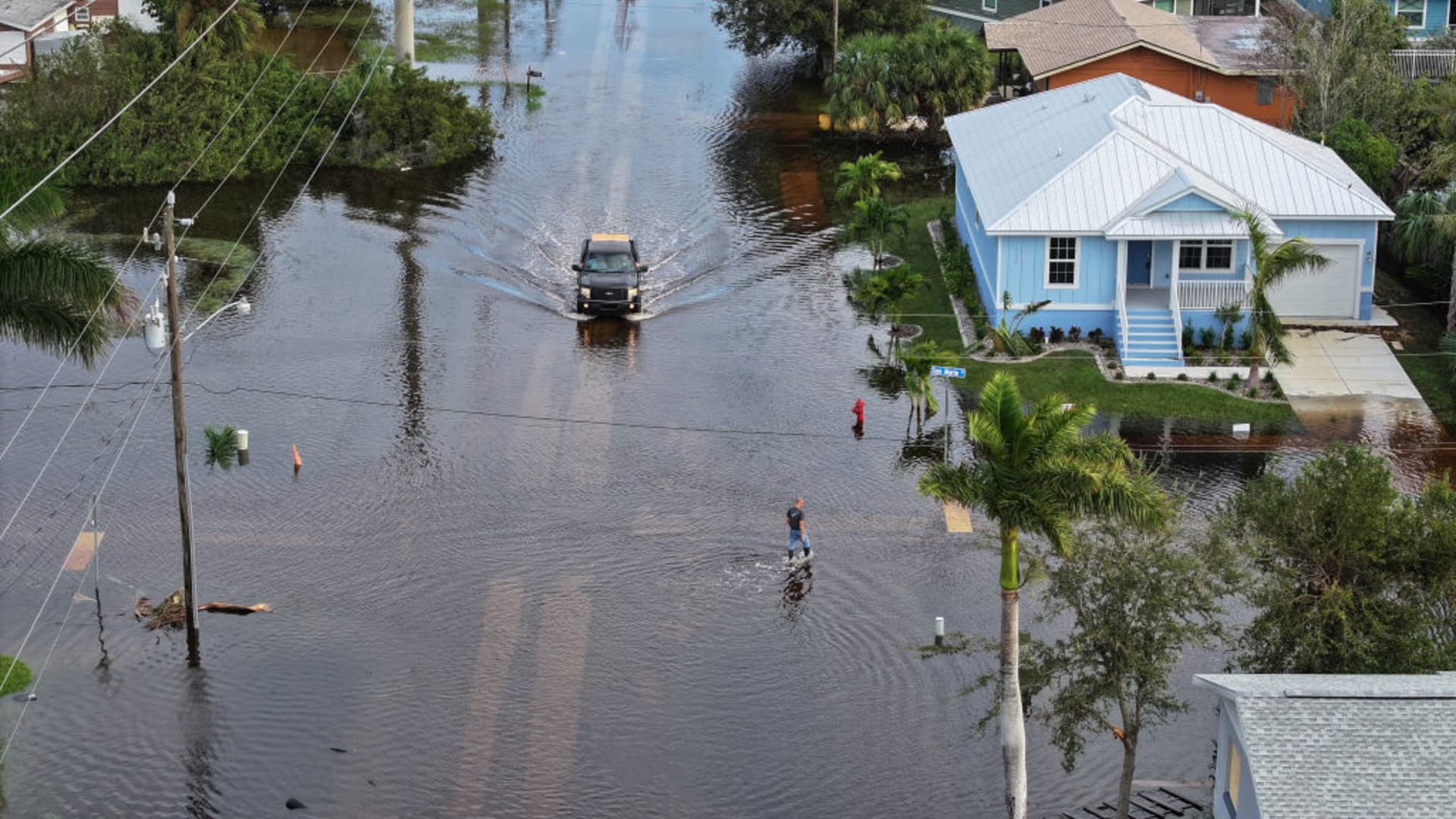
PUNTA GORDA – OCTOBER 10: In this aerial view, a person walks through flood waters that inundated a neighborhood after Hurricane Milton came ashore on October 10, 2024, in Punta Gorda, Florida. The storm made landfall as a Category 3 hurricane in the Siesta Key area of Florida, causing damage and flooding throughout Central Florida. (Photo by Joe Raedle/Getty Images)
Joe Raedle | Getty Images News | Getty Images
It’s officially hurricane season, and early forecasts indicate it’s poised to be an active one.
Now is the time to take a look at your homeowners insurance policy to ensure you have enough and the right kinds of coverage, experts say — and make any necessary changes if you don’t.
The National Oceanic and Atmospheric Administration predicts a 60% chance of “above-normal” Atlantic hurricane activity during this year’s season, which spans from June 1 to November 30.
The agency forecasts 13 to 19 named storms with winds of 39 mph or higher. Six to 10 of those could become hurricanes, including three to five major hurricanes of Category 3, 4, or 5.
You should pay close attention to your insurance policies.
Charles Nyce
risk management and insurance professor at Florida State University
Hurricanes can cost billions of dollars worth of damages. Experts at AccuWeather estimate that last year’s hurricane season cost $500 billion in total property damage and economic loss, making the season “one of the most devastating and expensive ever recorded.”
“Take proactive steps now to make a plan and gather supplies to ensure you’re ready before a storm threatens,” Ken Graham, NOAA’s national weather service director, said in the agency’s report.
Part of your checklist should include reviewing your insurance policies and what coverage you have, according to Charles Nyce, a risk management and insurance professor at Florida State University.
“Besides being ready physically by having your radio, your batteries, your water … you should pay close attention to your insurance policies,” said Nyce.
More from Personal Finance:
How child tax credit could change as Senate debates Trump’s mega-bill
This map shows where seniors face longest drives
Some Social Security checks to be smaller in June from student loan garnishment
You want to know four key things: the value of property at risk, how much a loss could cost you, whether you’re protected in the event of flooding and if you have enough money set aside in case of emergencies, he said.
Bob Passmore, the department vice president of personal lines at the American Property Casualty Insurance Association, agreed: “It’s really important to review your policy at least annually, and this is a good time to do it.”
Insurers often suspend policy changes and pause issuing new policies when there’s a storm bearing down. So acting now helps ensure you have the right coverage before there’s an urgent need.
Here are three things to consider about your home insurance policy going into hurricane season, according to experts.
1. Review your policy limits
First, take a look at your policy’s limits, which represents the highest amount your insurance company will pay for a covered loss or damage, experts say. You want to make sure the policy limit is correct and would cover the cost of rebuilding your home, Passmore said.
Most insurance companies will calculate the policy limit by taking into account the size of your home and construction costs in your area, said Nyce. For example, if you have a 2,000 square foot home, and the cost of construction in your area is $250 per square foot, your policy limit would need to be $500,000, he said.
You may risk being underinsured, however, especially if you haven’t reviewed your coverage in a while. Rising building costs or home renovations that aren’t reflected in your insurer’s calculation can mean your coverage lags the home’s replacement value.
Repair and construction costs have increased in recent years, experts say. In the last five years, the cost of construction labor has increased 36.3% while the building material costs are up 42.7%, the APCIA found.
Most insurance companies follow what’s called the 80% rule, meaning your coverage needs to be at least 80% of its replacement cost. If you’re under, you risk your insurer paying less than the full claim.
2. Check your deductibles
Take a look at your deductibles, or the amount you have to pay out of pocket upfront if you file a claim, experts say.
For instance, if you have a $1,000 deductible on your policy and submit a claim for $8,000 of storm coverage, your insurer will pay $7,000 toward the cost of repairs, according to a report by NerdWallet. You’re responsible for the remaining $1,000.
A common way to lower your policy premium is by increasing your deductibles, Passmore said.
Raising your deductible from $1,000 to $2,500 can save you an average 12% on your premium, per NerdWallet’s research.
But if you do that, make sure you have the cash on hand to absorb the cost after a loss, Passmore said.

Don’t stop at your standard policy deductible. Look over hazard-specific provisions such as a wind deductible, which is likely to kick in for hurricane damage.
Wind deductibles are an out-of-pocket cost that is usually a percentage of the value of your policy, said Nyce. As a result, they can be more expensive than your standard deductible, he said.
If a homeowner opted for a 2% deductible on a $500,000 house, their out-of-pocket costs for wind damages can go up to $10,000, he said.
“I would be very cautious about picking larger deductibles for wind,” he said.
3. Assess if you need flood insurance
Floods are usually not covered by a homeowners insurance policy. If you haven’t yet, consider buying a separate flood insurance policy through the National Flood Insurance Program by the Federal Emergency Management Agency or through the private market, experts say.
It can be worth it whether you live in a flood-prone area or not: Flooding causes 90% of disaster damage every year in the U.S., according to FEMA.
In 2024, Hurricane Helene caused massive flooding in mountainous areas like Asheville in Buncombe County, North Carolina. Less than 1% of households there were covered by the NFIP, according to a recent report by the Swiss Re Institute.
If you decide to get flood insurance with the NFIP, don’t buy it at the last minute, Nyce said. There’s usually a 30-day waiting period before the new policy goes into effect.
“You can’t just buy it when you think you’re going to need it like 24, 48 or 72 hours before the storm makes landfall,” Nyce said. “Buy it now before the storms start to form.”
Make sure you understand what’s protected under the policy. The NFIP typically covers up to $250,000 in damages to a residential property and up to $100,000 on the contents, said Loretta Worters, a spokeswoman for the Insurance Information Institute.
If you expect more severe damage to your house, ask an insurance agent about excess flood insurance, Nyce said.
Such flood insurance policies are written by private insurers that cover losses over and above what’s covered by the NFIP, he said.


Personal Finance
Next-Generation Retirement Planning: Managing Longevity Risk and Variable Income Streams


U.S.- Canada Trade Talks Collapse; Carney Says Retaliatory Tariffs Begin September 8

Flock Cameras and the Future of Public Security

AI Infrastructure Boom Hits Physical Limits: Power, Financing, and Supply Chain Strain

Armanino adds Strategic Accounting Outsourced Solutions

New 2023 K-1 instructions stir the CAMT pot for partnerships and corporations

Tax Strategy: Employee Retention Credit update
-

 Stock News1 week ago
Nvidia Earnings Preview: What Wall Street Expects From the AI Bellwether’s Q2 Report
-

 Accounting1 week ago
SEC’s Semiannual Reporting Proposal Faces Investor Pushback: What CFOs Need to Know
-

 Stock News1 week ago
Nvidia Q2 FY2027 Earnings beats Wall Street Expectation with Record $96.2 Billion Revenue
-

 Finance1 week ago
Treasury Bond Volatility Forces Bessent to Double Debt Buyback Size as Yields Swing
-
 Technology5 days ago
AI Infrastructure Boom Hits Physical Limits: Power, Financing, and Supply Chain Strain
-
 Technology3 days ago
Flock Cameras and the Future of Public Security
-
 Economics3 days ago
U.S.- Canada Trade Talks Collapse; Carney Says Retaliatory Tariffs Begin September 8