
Personal Finance
How Trump ‘big beautiful’ tax bill could change in the Senate

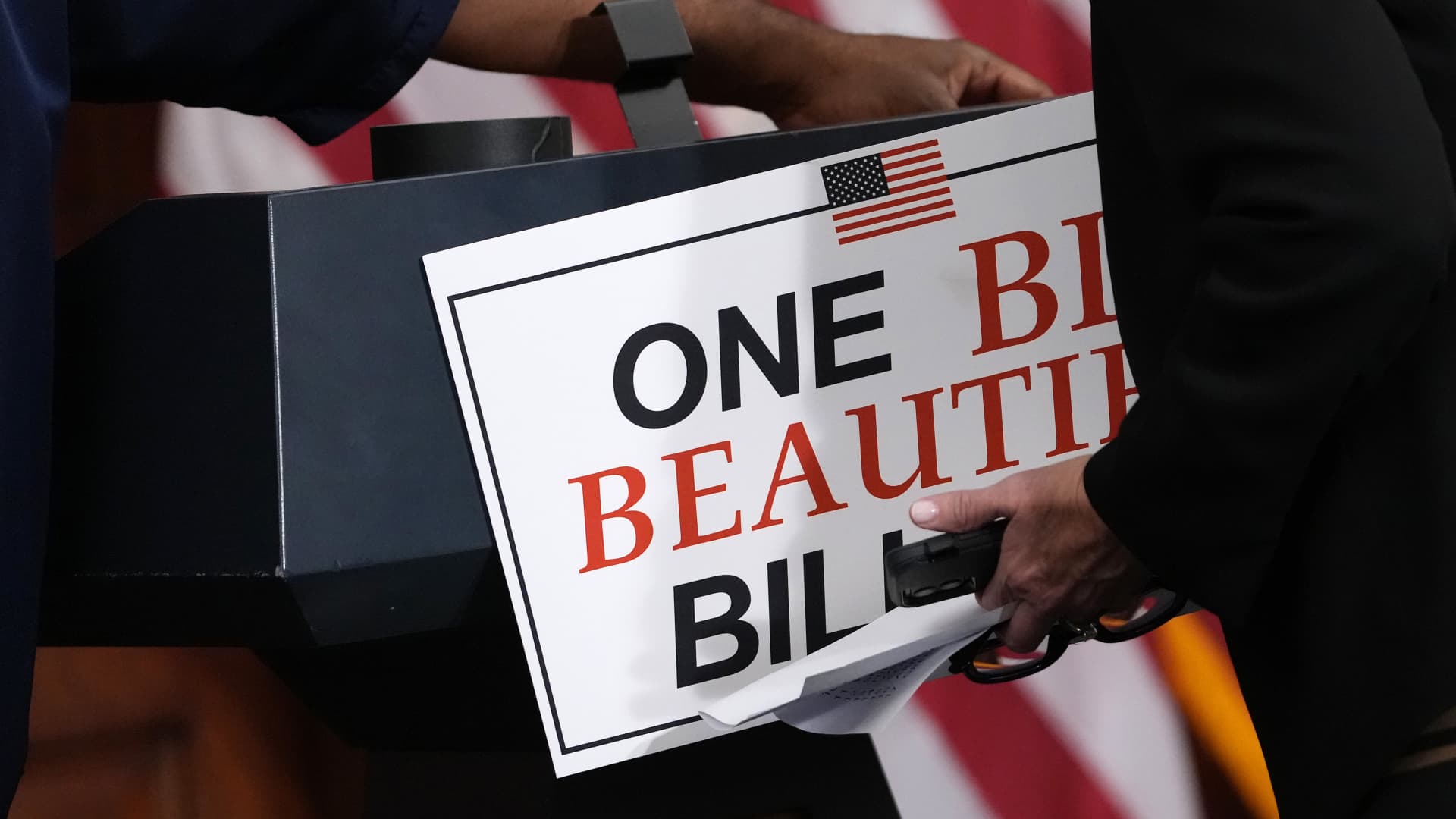
Staff members remove a sign following a press conference after the House passage of the tax and spending bill, at the U.S. Capitol on May 22, 2025 in Washington, DC.
Kevin Dietsch | Getty Images
House Republicans passed a multi-trillion-dollar tax and spending package after months of debate, which included many of President Donald Trump‘s priorities.
Now, policy experts are bracing for Senate changes as GOP lawmakers aim to finalize the “big bill” by the Fourth of July.
If enacted as currently drafted, the House’s “One Big Beautiful Bill Act” would make permanent Trump’s 2017 tax cuts, while adding new tax breaks for tip income, overtime pay and older Americans, among other provisions.
More from Personal Finance:
What the House GOP budget bill means for your money
House bill calls for bigger ‘pass-through’ business tax break
What Medicaid and SNAP cuts in House bill mean for benefits
The House bill also approved historic spending cuts to programs for low-income families, including Medicaid health coverage and SNAP, formerly known as food stamps.
“Overall, the [Senate] bill is not going to be that much different,” said Howard Gleckman, senior fellow at the Urban-Brookings Tax Policy Center.
But there will be “a lot of debate” about the Medicaid provision, as well as other changes, he said.
Here are some other issues to watch during negotiations, policy experts say.
Fiscal hawks could ‘stop the process’
With control of Congress, Republicans are using a process called “budget reconciliation,” which bypasses the Senate filibuster and only needs a simple majority vote to clear the upper chamber.
But some GOP senators have cost concerns about the House-approved bill.
“We have enough to stop the process until the president gets serious about spending reduction and reducing the deficit,” Sen. Ron Johnson, R-Wis., said last week on CNN’s ‘State of the Union.’
An earlier version of the House package could raise the deficit by an estimated $3.8 trillion over the next decade, according to the Congressional Budget Office. However, the agency hasn’t released an updated score to reflect the bill’s last-minute changes.
Other cost estimates for the House-passed reconciliation bill have ranged between $2 to $3 trillion over 10 years.
Under reconciliation, the Senate bill also must follow the “Byrd Rule,” which bans anything unrelated to federal revenue or spending.
After the Senate vote, House lawmakers must approve changes to the bill, which could be tricky with a slim Republican majority.
“That’s where the fight is really going to happen,” Gleckman said.
A lower ‘SALT’ deduction limit
One sticking point during the House debate was the current $10,000 limit on the federal deduction for state and local taxes, known as “SALT,” which is scheduled to sunset after 2025.
Enacted by Trump via the Tax Cuts and Jobs Act, or TCJA, of 2017, the $10,000 cap has been a key issue for certain lawmakers in high-tax states like New York, New Jersey and California.
Before TCJA, filers who itemized tax breaks could claim an unlimited deduction on state and local income taxes, along with property taxes. But the so-called alternative minimum tax reduced the benefit for some higher earners.
After lengthy debate, House Republicans approved a $40,000 SALT limit. If enacted, the higher cap would apply to 2025 and phase out for incomes over $500,000.

But the SALT limit is likely to be lower than $40,000 after Senate negotiations, experts say.
Staying closer to the current $10,000 cap “seems like a very natural place to start,” but the final number could be higher, said Alex Muresianu, senior policy analyst at the Tax Foundation.
Child tax credit could be more generous
The Senate could also expand the child tax credit further, policy experts say.
If enacted in its current form, the House bill would make permanent the maximum $2,000 credit passed via the TCJA, which will otherwise revert to $1,000 after 2025.
The House measure would also make the highest child tax credit $2,500 from 2025 through 2028. After that, the credit’s top value would revert to $2,000 and be indexed for inflation.
But some senators, including Josh Hawley, R-Mo., have called for a bigger tax break. Vice President JD Vance also floated a higher child tax credit during the campaign in August.
With the House-approved tax breaks favoring higher earners, “there’s some recognition that they need to do a little more” for families, Gleckman said.
“That’s going to be a fun one to watch,” he said of the upcoming Senate debate.


Personal Finance
Next-Generation Retirement Planning: Managing Longevity Risk and Variable Income Streams


U.S.- Canada Trade Talks Collapse; Carney Says Retaliatory Tariffs Begin September 8

Flock Cameras and the Future of Public Security

AI Infrastructure Boom Hits Physical Limits: Power, Financing, and Supply Chain Strain

Armanino adds Strategic Accounting Outsourced Solutions

New 2023 K-1 instructions stir the CAMT pot for partnerships and corporations

Tax Strategy: Employee Retention Credit update
-

 Stock News1 week ago
Nvidia Earnings Preview: What Wall Street Expects From the AI Bellwether’s Q2 Report
-

 Accounting1 week ago
SEC’s Semiannual Reporting Proposal Faces Investor Pushback: What CFOs Need to Know
-

 Stock News1 week ago
Nvidia Q2 FY2027 Earnings beats Wall Street Expectation with Record $96.2 Billion Revenue
-

 Finance1 week ago
Treasury Bond Volatility Forces Bessent to Double Debt Buyback Size as Yields Swing
-
 Technology5 days ago
AI Infrastructure Boom Hits Physical Limits: Power, Financing, and Supply Chain Strain
-
 Technology3 days ago
Flock Cameras and the Future of Public Security
-
 Economics3 days ago
U.S.- Canada Trade Talks Collapse; Carney Says Retaliatory Tariffs Begin September 8