
Personal Finance
Investing in Trump Media is an ‘act of faith,’ expert says. Here are risks

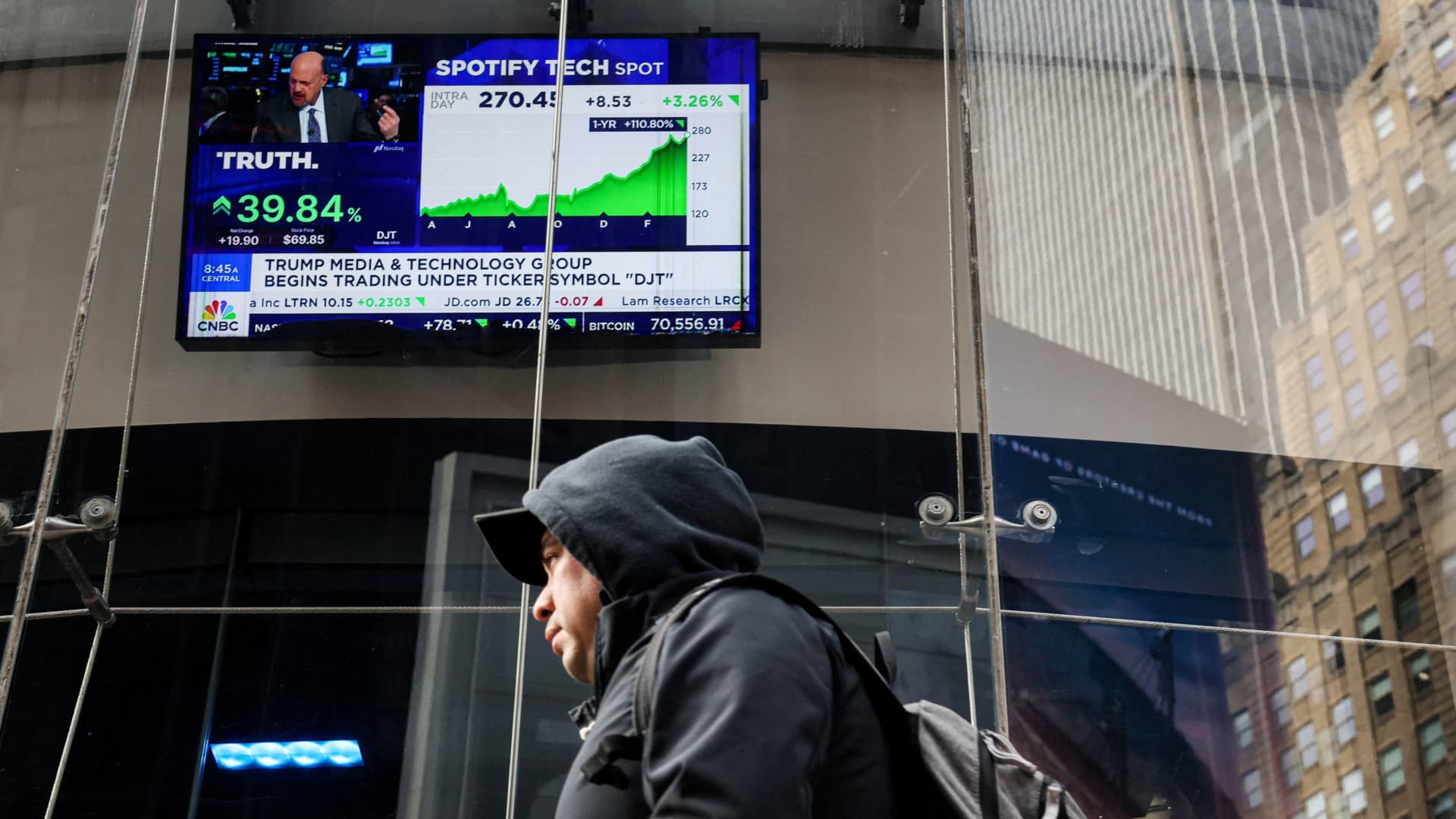
A screen displays trading information about shares of Truth Social and Trump Media & Technology Group outside the Nasdaq MarketSite in New York City on March 26, 2024.
Brendan Mcdermid | Reuters
Trump Media has become the latest stock to watch.
But rather than a meme stock — an investment that becomes popular for individual investors through social media — the company is more of a personality stock, according to John Rekenthaler, vice president of research at Morningstar.
“The reason that people own this stock is because, in one way or another, they support Donald Trump,” Rekenthaler said.
“It’s an act of faith,” he said.
The former president is the majority shareholder in Trump Media, which trades under the initials of his name, DJT, on the Nasdaq. The stock got off to a rocky start this week, with two straight days of losses, though it was up more than 20% on Wednesday afternoon.
The company’s mission statement is to end “Big Tech’s assault on free speech by opening up the internet and giving the American people their voices back,” according to its website.
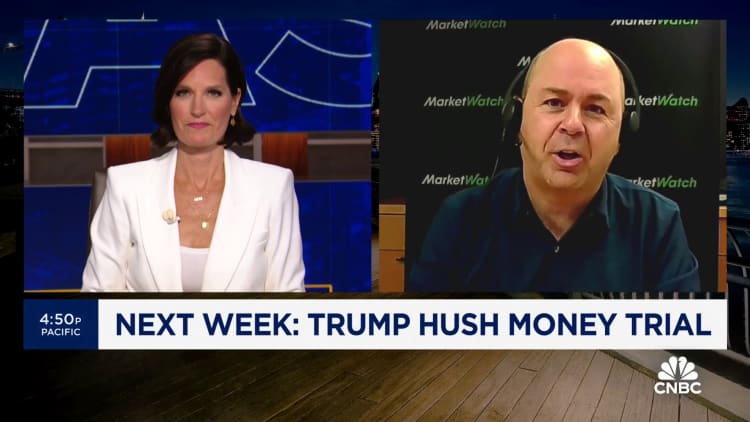
The closest company comparison to Trump Media is Tesla, according to Rekenthaler. He said investors backed Tesla because they believed in Elon Musk, which helped send the company to its peak value in 2021.
A key difference is that Tesla was a “much larger company,” according to Rekenthaler, who on April 10 wrote an op-ed criticizing Trump Media’s valuation.
Trump Media is currently a $4 million business through social media, he said. Meanwhile, the company is currently valued at more than $3 billion, down from around $9 billion when it came out.
“The problem is there is still more room to fall,” Rekenthaler said.
Like investors in any publicly traded company, Trump Media’s shareholders are hoping to eventually redeem their shares for more than what they paid. However, there is no guarantee of that happening, Rekenthaler said.
Other investors have chosen to bet against the stock through short selling. That, too, can be “dangerous,” Rekenthaler said.
“This stock is just so unpredictable,” Rekenthaler said. “It certainly could go up in the short term and hurt the shorts.”
The company responded to a request for comment by referring to its frequently asked questions webpage: Trump Media outlined the risk factors to its business in a recent filing with the Securities and Exchange Commission tied to its public stock listing. Among them are risks related to the former president, including his reputation and popularity; the possibility of his death, incarceration or incapacity; or the possibility that his relationship with the company could be discontinued or limited.
More from Personal Finance:
FAFSA ‘fiasco’ could cause decline in college enrollment
People are spending hundreds a month on dating apps
The strong U.S. job market is in a ‘sweet spot,’ economists say
Investing in a company that is tied to a prominent celebrity carries certain risks, noted Preston D. Cherry, PhD, founder and president of Concurrent Financial Planning in Green Bay, Wisconsin.
The alignment with a well-known figure can lead you to trust a company more as a result, said Cherry, who’s also a certified financial planner. But if the celebrity and company part ways — as with Adidas and Ye, also known as Kanye West, or Weight Watchers and Oprah — that can affect the investment prospects.
Moreover, investors may get caught up in the enthusiasm around a newly public stock, Cherry said.
“Retail investors have a sense of FOMO or fear of missing out specifically with popular IPOs [initial public offerings],” Cherry said.
That can lead to those companies becoming overvalued when they come out as a result of that hype, he said.
Because the early-stage company’s stock may be highly volatile, average investors may face a lot of danger if they’re tempted to day trade or short it, said CFP Ted Jenkin, CEO and founder of oXYGen Financial, a financial advisory and wealth management firm based in Atlanta.
“These kinds of stocks are speculative at best,” Jenkin said.
Both Cherry and Jenkin are members of the CNBC FA Council.


Personal Finance
Next-Generation Retirement Planning: Managing Longevity Risk and Variable Income Streams


U.S.- Canada Trade Talks Collapse; Carney Says Retaliatory Tariffs Begin September 8

Flock Cameras and the Future of Public Security

AI Infrastructure Boom Hits Physical Limits: Power, Financing, and Supply Chain Strain

Armanino adds Strategic Accounting Outsourced Solutions

New 2023 K-1 instructions stir the CAMT pot for partnerships and corporations

Tax Strategy: Employee Retention Credit update
-

 Stock News1 week ago
Nvidia Q2 FY2027 Earnings beats Wall Street Expectation with Record $96.2 Billion Revenue
-
 Technology5 days ago
AI Infrastructure Boom Hits Physical Limits: Power, Financing, and Supply Chain Strain
-
 Technology3 days ago
Flock Cameras and the Future of Public Security
-
 Economics3 days ago
U.S.- Canada Trade Talks Collapse; Carney Says Retaliatory Tariffs Begin September 8