
Personal Finance
Is this a good time to buy gold? Experts weigh in

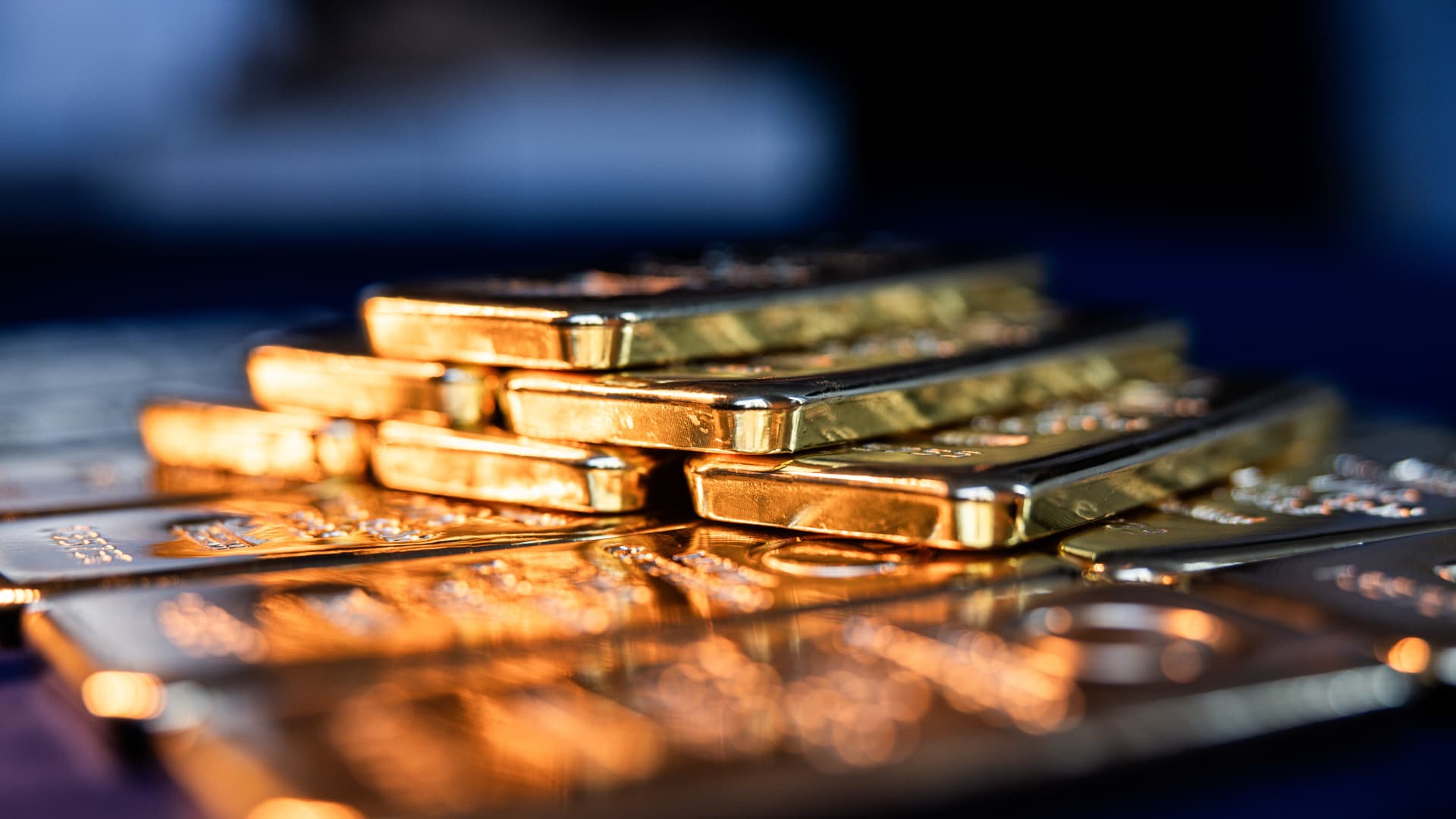

Gold is often considered a safe-haven investment because it typically acts as a hedge in times of political and financial uncertainty. Prices are currently soaring amid fears of a global trade war and its potential to push the U.S. economy into recession.
However, some analysts think gold prices may have peaked.
“We’re probably close to maximum optimism on gold at this point,” said Sameer Samana, head of global equities and real assets at the Wells Fargo Investment Institute. Investors who chase returns may find themselves regretting it later.
“It’s so overbought,” Samana said. “Buying gold right now, you’re coming a little late to the party. It doesn’t mean it’s over, but you’re not early.”
So far this year, gold prices have notched more than a dozen record highs and are currently trading above $3,000.
Gold prices pop on tariff escalation
Gold futures prices were up about 21% year-to-date as of noon ET on Friday and 30% higher compared to the price a year ago. Prices have popped about 7% this week alone, on pace for the best week since March 2020.
By comparison, the S&P 500 is down about 11% in 2025 and up about 1% in the past year.
President Donald Trump imposed steep country-specific tariffs on Wednesday, but ultimately delayed them for 90 days. However, a trade war between the U.S. and China — our third-largest trade partner — escalated as each nation engaged in a tit-for-tat tariff increase.
As of Friday morning, the U.S. had put a 145% tariff on imports from China, which hit back with a 125% levy on U.S. goods.
While some analysts think gold prices are close to topping out, others think there’s room to run.
“Even though gold prices are at an all-time high, the reality is that in the next couple of years it could accelerate,” said Jordan Roy-Byrne, founder of The Daily Gold, an online resource for gold, silver and mining stocks.
How to invest in gold
Akos Stiller/Bloomberg via Getty Images
Experts often recommend getting investment exposure to gold through an exchange-traded fund that tracks the price of physical gold, as part of a well-diversified portfolio, rather than buying actual gold coins or bars.
“For most [investors], I would say a gold bullion-backed ETF makes the most sense,” Samana said. SPDR Gold Shares (GLD) and iShares Gold Trust (IAU) are the two largest gold ETFs, according to ETF.com.
Financial advisors generally recommend limiting gold exposure to the low-single-digit percentage, perhaps up to 3% or so, of one’s overall portfolio.
Gold tends to perform “okay” when investors are worried about inflation or stagflation, Samana said — fears sparked by the Trump administration’s recent tariff policies. However, it “rarely does well” during recessions, which is when bonds “really show their value,” he said.
Buying physical gold
Alternatively, buying physical gold, or bullion, including bars and coins, “is a financial insurance position, as opposed to part of your portfolio,” explained Roy-Byrne.
Consumers, especially, seem to like that idea. When Costco started selling 1-ounce bars last year, revenue soared, with Wells Fargo analysts estimating that the wholesaler generated up to $200 million a month from gold sales alone.

“Amidst the recent stock market turbulence, we’re seeing renewed interest in tangible, physical assets that exist outside traditional financial structures,” according to Tim Schmidt, the founder of Gold IRA Custodians, an online resource for buying gold.
But buying physical gold during uncertain times may not make much sense for investors unless they are extremely anxious the financial system might implode — at which point physical gold can theoretically help people barter for goods and services, Samana said.
Buying gold jewelry
Fine jewelry is a different story. The baseline value of gold jewelry is tied to its precious metal content, according to Schmidt. Higher-karat pieces, or 18K and up, contain more precious metal and typically retain value better, though they may be less durable for everyday wear.
“High-quality jewelry … can offer both personal enjoyment and potential financial benefits when selected carefully,” he said.
Craftsmanship and artistry also play a key role in pieces that could appreciate over time, particularly with hallmarks from top brands, such as Cartier, Van Cleef & Arpels and Tiffany & Co.
Buying gold right now, you’re coming a little late to the party. It doesn’t mean it’s over, but you’re not early.
Sameer Samana
head of global equities and real assets at the Wells Fargo Investment Institute
One year ago, Tiffany’s chief executive officer Anthony Ledru said high-quality jewelry may even be considered “recession proof.”
“People have been investing in jewelry since ancient times,” Schmidt said. “There’s something psychologically reassuring about holding an investment in your hand, especially during periods when markets seem disconnected from economic realities.”
What financial advisors say about gold
Gold prices extended their gains on Wednesday, following a record high in the previous session, as investors sought the comfort of the safe-haven metal in anticipation of the potential impact of U.S. reciprocal tariffs.
Akos Stiller | Bloomberg | Getty Images
“We have clients who currently hold positions in gold. These are typically individuals with substantial assets across various industries and sectors, using gold as a means of portfolio diversification and balance,” said Winnie Sun, co-founder and managing director of Sun Group Wealth Partners, based in Irvine, California.
Even in the face of heightened uncertainty largely due to tariff-induced market swings, “we are not proactively recommending that clients add to their gold positions at this time,” said Sun, a member of CNBC’s Financial Advisor Council. “Instead, we suggest maintaining higher cash reserves, fully funding emergency savings, and reallocating as needed based on evolving financial goals.”
Lee Baker, a CFP based in Atlanta, says more clients are worried that tariffs will hinder economic growth and have recently been asking about alternative investments in gold. “Often during times of chaos there is a ‘flight to safety,’ so in a time like this we are seeing some movement to gold as a part of the fear trade.”
According to Baker, who is the founder, owner and president of Apex Financial Services and a member of CNBC’s FA Council, “incorporating gold, and other commodities, is a good idea in general.”
He recommends adding gold ETFs to client portfolios, although “there have been occasions where we have utilized gold stocks in the form of investing in mining companies or gold-related company mutual funds.”
As for physical gold, “if it makes you feel good to go grab an ounce at Costco or wherever, do it,” he said. But with that comes the additional responsibility and costs of storing, insuring and safekeeping those holdings, he added.


Personal Finance
Next-Generation Retirement Planning: Managing Longevity Risk and Variable Income Streams


U.S.- Canada Trade Talks Collapse; Carney Says Retaliatory Tariffs Begin September 8

Flock Cameras and the Future of Public Security

AI Infrastructure Boom Hits Physical Limits: Power, Financing, and Supply Chain Strain

Armanino adds Strategic Accounting Outsourced Solutions

New 2023 K-1 instructions stir the CAMT pot for partnerships and corporations

Tax Strategy: Employee Retention Credit update
-

 Stock News1 week ago
Nvidia Earnings Preview: What Wall Street Expects From the AI Bellwether’s Q2 Report
-

 Accounting1 week ago
SEC’s Semiannual Reporting Proposal Faces Investor Pushback: What CFOs Need to Know
-

 Stock News1 week ago
Nvidia Q2 FY2027 Earnings beats Wall Street Expectation with Record $96.2 Billion Revenue
-

 Finance1 week ago
Treasury Bond Volatility Forces Bessent to Double Debt Buyback Size as Yields Swing
-
 Technology5 days ago
AI Infrastructure Boom Hits Physical Limits: Power, Financing, and Supply Chain Strain
-
 Technology3 days ago
Flock Cameras and the Future of Public Security
-
 Economics3 days ago
U.S.- Canada Trade Talks Collapse; Carney Says Retaliatory Tariffs Begin September 8