Connect with us

Personal Finance

Judge blocks Biden’s new student loan forgiveness plan before launch

Published

on

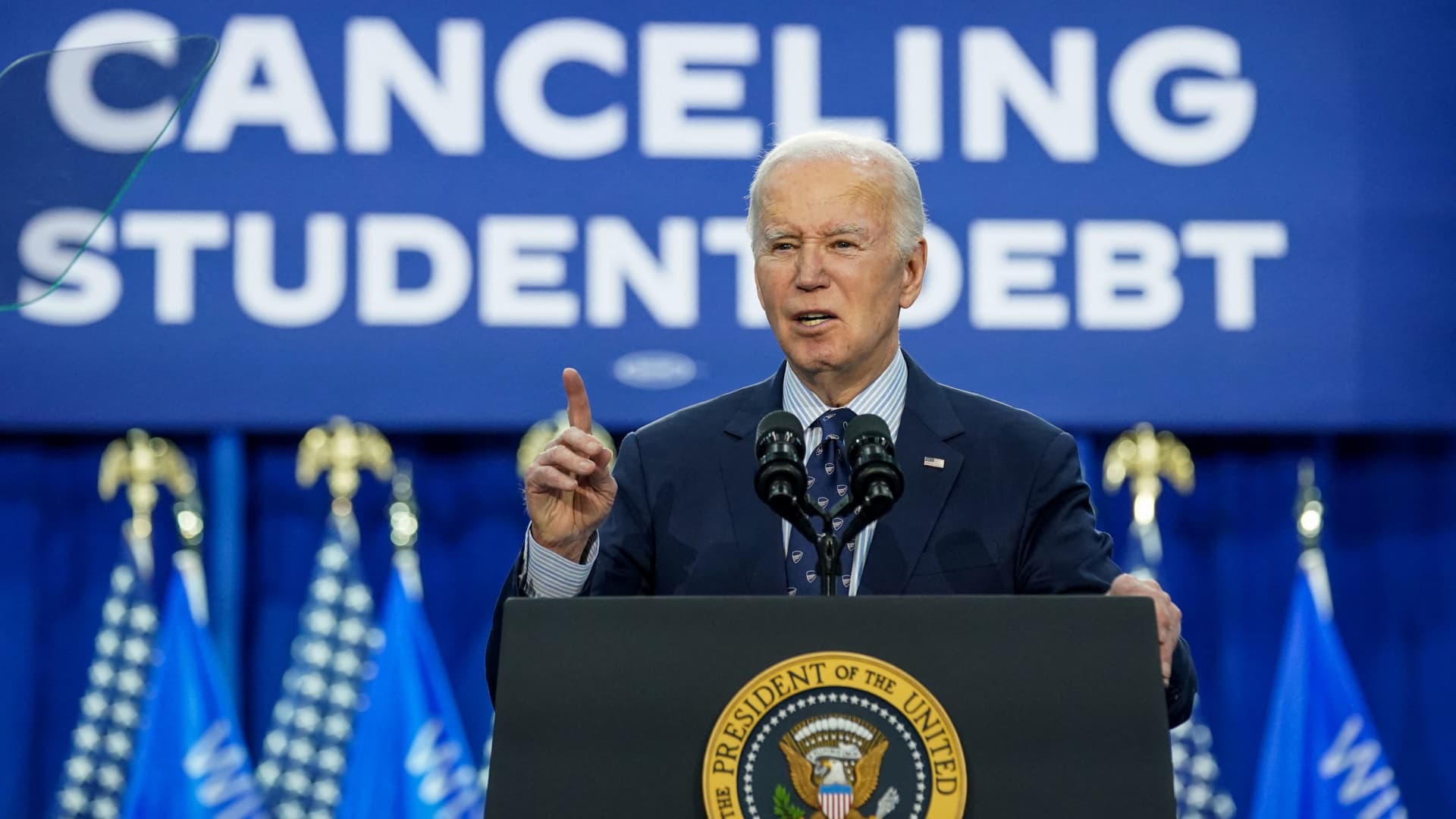
U.S. President Joe Biden speaks as he announces a new plan for federal student loan relief during a visit to Madison Area Technical College Truax Campus, in Madison, Wisconsin, U.S, April 8, 2024. 

Kevin Lamarque | Reuters

Earlier this summer, millions of federal student loan borrowers got a promising email. The Biden administration informed them that debt forgiveness was on the way and that they may be eligible.

However, before the U.S. Department of Education could publish its final rule on the debt relief and start to carry out its new sweeping loan forgiveness plan, a Republican-led challenge has managed to at least temporarily block the relief.

Here’s what we know so far.

Relief plan blocked until at least mid-September

On Sept. 5, U.S. District Judge Randal Hall in Augusta, Georgia, issued a temporary restraining order against President Joe Biden‘s second effort to cancel student debt for millions of Americans. The Biden administration had previously tried to offer sweeping student debt forgiveness in 2022.

Hall, appointed by former Republican President George W. Bush, was responding to a lawsuit against the relief package brought by seven Republican-led states a few days earlier. The states — Alabama, Arkansas, Florida, Georgia, Missouri, North Dakota and Ohio — said the U.S. Department of Education’s new debt cancellation effort, like its previous attempts, is illegal.

More from Personal Finance:
The ‘rent-first’ lifestyle is catching on
‘Recession pop’ is in: How music hits on economic trends
More Americans are struggling even as inflation cools

Hall said the states had made a convincing case that the department was overstepping its authority, and blocked the Biden administration from moving forward with its plan until a Sept. 18 hearing.

“The court has only issued a temporary restraining order and the scope of the order is not clear,” said Luke Herrine, an assistant professor of law at the University of Alabama.

It appears the administration can still proceed with finalizing the rule and preparing to cancel the debt, Herrine said. But it likely won’t be able to start forgiving the loans until the courts decide on the rule’s legality, which could take months, experts say.

The Department of Education did not immediately respond to a request for comment.

We are overly reliant on student loans to fund higher education, says NACAC CEO Angel Perez

In June 2023, the Supreme Court ruled that Biden’s attempt to cancel around $400 billion in federal student debt was unconstitutional. Immediately after, Biden vowed to find another way to deliver relief to borrowers.

Biden’s first attempt to forgive student debt was through an executive action. This time, his administration has pursued the regulatory process, a lengthier route that it hoped would make its relief package more immune to legal challenges.

It was not expected to publish its final rule on its revised student loan forgiveness plan, which could impact more than 25 million Americans, until October. However, in their lawsuit, the state attorneys general said they had discovered evidence that the Education Department had ordered federal loan servicers to begin erasing the loans as early as Sept. 3.

Yet it’s unlikely the Biden administration would break the rules of the regulatory process timeline, legal experts said.

“I strongly doubt that this allegation is true,” Herrine said.

Most likely, the administration had told the loan servicers to prepare to forgive the debt once the rule is finalized, he said.

Borrowers in limbo, again

As things stand, most of the Biden administration’s hopes to deliver relief to borrowers ahead of the 2024 presidential election are now stalled.

That may be part of the point, Herrine said.

“The GOP knows that student debt cancellation is popular and they want to prevent the Biden administration from doing popular things,” Herrine said.

Don’t miss these insights from CNBC PRO

Continue Reading

Personal Finance

Maximizing Returns in High Rate Climate and market uncertainty

Published

on

Maximizing Returns in High-Rate Climate

In the macroeconomic environment of late July 2026, personal cash management requires an active, structured approach to wealth preservation. With central bank benchmark rates remaining elevated to ensure long-term disinflation, conservative yield-bearing vehicles—such as short-term U.S. Treasury bills, money market funds, and high-yield savings accounts (HYSAs)—continue to offer reliable nominal returns between 4% and 5%. For individual investors, maximizing net returns requires moving beyond passive checking accounts and executing a disciplined cash laddering strategy.

Leaving substantial liquid capital in traditional bank deposits creates an invisible drag on personal net worth due to ongoing inflation. By implementing a tiered liquidity framework, individuals can split emergency cash reserves and short-term capital allocations across rolling maturities. Allocating cash into 4-week, 8-week, and 13-week Treasury bills creates a continuous cycle of maturing liquidity, allowing investors to continuously reinvest capital at prevailing market yields while maintaining immediate access to emergency funds.

Tax efficiency represents a critical dimension of high-yield cash optimization. For high-earning individuals residing in states with substantial local income taxes, direct holdings in short-term U.S. Treasury instruments often deliver superior net post-tax yields compared to standard commercial bank HYSAs. Because interest earned on federal Treasury bills is strictly exempt from state and local taxation, investors can retain a larger portion of their compounding interest gains without taking on additional credit or market risk.

Ultimately, personal wealth accumulation in mid-2026 relies on intentional capital deployment. Cash should be managed as a productive asset class that generates consistent, risk-free returns. Regularly auditing account yield terms, automating recurring transfers, and leveraging tax-advantaged fixed-income instruments ensures that personal liquidity remains fully optimized against macroeconomic fluctuations.

Continue Reading

Personal Finance

Algorithmic Wealth Management: Balancing Automated Financial Planning with Human Oversight

Published

on

Balancing Automated Financial Planning with Human Oversight

The personal finance industry in July 2026 is experiencing a technological evolution, driven by the wide deployment of next-generation algorithmic wealth management tools. Modern digital financial platforms have expanded far beyond basic automated index investing; today’s robo-advisors utilize real-time tax-loss harvesting, dynamic portfolio rebalancing, and hyper-personalized spending analysis to optimize retail investor outcomes. However, as these digital solutions become ubiquitous, investors face the crucial challenge of balancing automated execution with human strategic judgment.

The core advantage of automated financial planning platforms lies in their ability to remove emotional bias from investment execution. During periods of market volatility or localized sector realignments, automated algorithms systematically rebalance portfolios back to target asset allocations without falling victim to panic selling or speculative enthusiasm. Furthermore, integrated cash-flow monitoring algorithms analyze individual spending patterns in real time, automatically sweeping surplus income into designated retirement or debt-liquidation accounts to accelerate net worth accumulation.

Despite these operational advantages, algorithmic tools have inherent structural limitations when addressing complex, highly personalized financial life events. Decisions involving multi-generational estate planning, highly complex tax strategies, small business exits, or nuanced real estate transactions require contextual human judgment that software models cannot replicate. Relying solely on automated models without periodic human professional review can result in misaligned risk profiles or overlooked tax liabilities during major life transitions.

The optimal approach for personal financial planning in late 2026 is a hybrid advisory model. Individuals should utilize automated platforms for routine asset allocation, continuous tax optimization, and low-cost passive index tracking, while engaging qualified human financial advisors for periodic strategic planning, estate structuring, and qualitative risk evaluations. This dual approach ensures maximum cost efficiency and disciplined execution while retaining essential strategic guidance.

Continue Reading

Personal Finance

High-Yield Optimization: Structuring Personal Cash Reserves in a Sustained Rate Environment

Published

on

Structuring Personal Cash Reserves in a Sustained Rate Environment

In the financial environment of mid-2026, personal cash management has re-emerged as a vital component of holistic wealth building. With central bank policy rates holding firm to maintain long-term price stability, yield-bearing instruments such as money market funds, high-yield savings accounts (HYSAs), and short-term Treasury bills continue to offer compounding returns around 4% to 5%. For individual investors, effectively structuring cash reserves requires shifting away from passive bank deposits toward active yield optimization.

A frequent pitfall in personal asset management is leaving substantial liquid capital in traditional checking or low-yield savings accounts, where real returns are continuously eroded by baseline inflation. By implementing a disciplined ‘cash ladder’ strategy—allocating liquid funds across tiered maturities using ultra-short Treasury instruments and FDIC-insured high-yield accounts—individuals can secure maximal yields while retaining immediate liquidity for emergency expenses or tactical investment opportunities.

Simultaneously, investors must evaluate the tax efficiency of their cash holdings based on their tax bracket and geographic location. For high earners situated in states with high local income taxes, direct holdings in short-term U.S. Treasury bills often yield a higher net post-tax return than standard high-yield savings accounts, as Treasury interest is strictly exempt from state and local taxation. Understanding these nuanced tax distinctions allows individuals to capture significant incremental gains without taking on additional market risk.

Ultimately, personal financial health in late 2026 hinges on intentional liquidity management. Cash reserves should not be viewed merely as static emergency funds, but as a dynamic asset class that contributes positively to net worth growth. Regularly auditing yield terms, automating cash transfers, and optimizing for post-tax efficiency ensures that personal capital remains fully productive across all economic conditions.

Continue Reading

Trending