
Finance
Klarna CEO Sebastian Siemiatkowski faces biggest test yet: IPO


Sebastian Siemiatkowski, CEO of Klarna, speaking at a fintech event in London on Monday, April 4, 2022.
Chris Ratcliffe | Bloomberg via Getty Images
LONDON — After 20 years in the role as Klarna’s CEO, Sebastian Siemiatkowski is about to face his toughest test yet as the financial technology firm prepares for its blockbuster debut in New York.
Siemiatkowski, 43, co-founded Klarna in 2005 with fellow Swedish entrepreneurs Niklas Adalberth and Victor Jacobsson with the aim of taking on traditional banks and credit card firms with a more user-friendly online payments experience.
Today, Klarna is synonymous with “buy now, pay later” — a method of payment that allows people to buy things and either defer payment until the end of the month or pay off their purchases over a series of equal, interest-free monthly installments.
But while Siemiatkowski has grown Klarna into a fintech powerhouse, his entrepreneurial journey hasn’t been without its challenges — from facing rising competition from rivals such as PayPal, Affirm and Block‘s Afterpay, to an 85% valuation plunge.
Nevertheless, Siemiatkowski hasn’t taken those challenges lying down and the outspoken co-founder isn’t shy to challenge criticisms in the run up to an IPO that could value it at $15 billion.
‘Crazy enough’
In October 2024, CNBC met with Siamiatkowski during a visit the Swedish entrepreneur made to London. For a businessman who’s faced a rollercoaster ride of ups and downs over his two-year CEO tenure, Klarna’s chief has a calm air to him.

“Independently of all the cycles and everything we’ve gone through with the company, at any point in time I ask myself, do I still think that Klarna can become the next Google in size, that we can become a hundreds of billions dollar market company, or a trillion dollars,” Siemiatkowski told CNBC. “I still am crazy enough to think that’s achievable.”
Once a pandemic-era darling valued at $46 billion in a SoftBank-led funding round, Klarna saw its valuation plummet 85% in 2022 to $6.7 billion as rising inflation and interest rates dented investor sentiment on high-growth technology firms.
But the firm has attempted to rebuild that eroded value in the years that have followed.
Klarna makes money predominantly from fees it charges merchants for providing its payment services, in addition to income from interest-bearing financing plans and advertising revenue.
Financials disclosed in its IPO filing show that Klarna reported revenue of $2.8 billion last year, up 24% year-over-year, and a net profit of $21 million — up from a net loss of $244 million in 2023.
Bullish on AI
After the launch of OpenAI’s generative AI ChatGPT in November 2022, Siemiatkowski quickly pivoted Klarna’s focus to embracing the technology, and especially in a way that could slash costs and enhance the firm’s profitability.
However, Siemiatkowski’s strategy and his comments on AI have also attracted controversy.
Klarna imposed a freeze on hiring in 2023 as it looked to tighten costs. The following year, the company said that its AI chatbot was doing the work of 700 full-time customer service jobs.
Klarna’s CEO then said in August that his company was able to reduce its overall workforce to 3,800 from 5,000 thanks in part to its application of AI in areas such as marketing and customer service.
“By simply not hiring … the company is kind of becoming smaller and smaller,” he told Reuters news agency, adding that jobs were disappearing due to attrition rather than layoffs.
Asked by CNBC about his views on AI and the upset they have caused, Siemiatkowski suggested he was “done apologizing,” echoing comments from Mark Zuckerberg about the Meta CEO’s “20-year mistake” of taking responsibility for issues for which he believed his company wasn’t to blame.
Doubling down, Siemiatkowski added that AI “already today can do a lot of the jobs that people do — but I don’t want to be one of the tech leaders that stands on a stage and says, ‘Don’t worry about it, there’s going to be new jobs,’ because I don’t know what those new jobs are.”
“I just want to be transparent and honest with what I think is happening, and I’d rather be open about that, because I know what these people, the tech leaders are saying when they’re not on public stages, and they’re not saying the exact same things,” he told CNBC in October.
An outspoken CEO
Siemiatkowski is no stranger to defending his company in response to criticisms, especially when challenged over Klarna’s business model of offering short-term financing for all kinds of things from clothing to online takeout.
Last week, Klarna announced a tie-up with DoorDash to offer its flexible payment options on the U.S. food delivery app. However, the move was met with backlash from internet users, who said it risks saddling struggling consumers with more debt.
One X user posted a meme showing personal finance pundit Dave Ramsey with the caption, “what do you mean you have $11k in ‘doordash debt’.”
Siemiatkowski took to X to defend the move, saying that Klarna “offers many payment methods” including the ability to pay in full instantly or defer payment until the end of the month in addition to monthly installments.
“DoorDash offers many products beyond food!” Klarna’s boss said on X in response to the criticisms. “I know we are most famous for pay in 4. But you can use a credit card at DoorDash as well.”
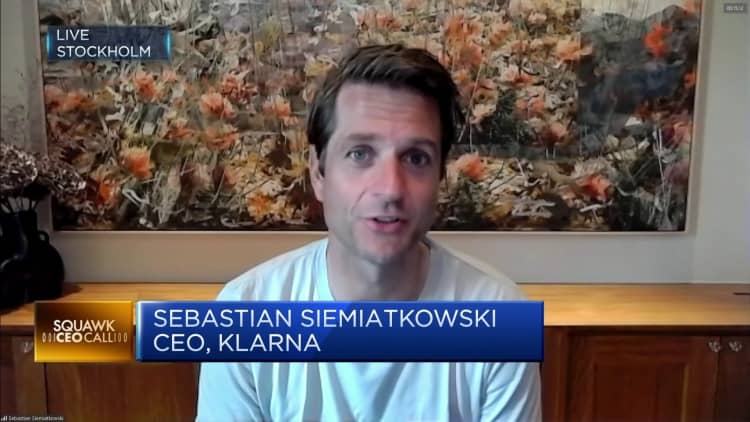
In 2022, the outspoken entrepreneur stressed his company was “superior” to credit cards and “extremely recession-proof” after the firm laid off 10% of its workforce.
As Klarna approaches its stock market debut, investors will likely be scrutinizing his track record and whether he’s still the right person to lead the company longer term.
Lena Hackelöer, CEO of Stockholm-based fintech startup Brite Payments, is someone who’s worked under Siemiatkowski’s leadership, having worked for the company for seven years between 2010 and 2017 in various marketing functions.
She expressed admiration for the Klarna co-founder — and pushed back on suggestions that leadership mismanaged the business during the pandemic era.
“I never thought that they had mismanaged, which is somehow how it was reported,” Hackelöer told CNBC in a November interview. “I think that they were just very much focusing on growth — because that was the direction that investors were giving.”
Rollercoaster ride
Siemiatkowski admits the journey of building Klarna hasn’t always been rosy.
Asked about the biggest challenge he’s ever faced as CEO, Siemiatkowski said that, for him, laying off 10% of Klarna’s workforce in 2022 was the toughest thing he’s ever had to do.
“That was very difficult because I didn’t predict that investor sentiment would shift that fast and people would go from valuing companies like ours so high and then to something so low,” he said.
“That’s obviously very difficult because, then you realize like, ‘OK, s—, I’m going to have to make a change. It’s not going to be sustainable to continue, and I need to protect the consumers, who are stakeholders in the company, the employees, the investors — I need to [do] what’s right for all of my constituents,” Siemiatkowski continued.
Klarna is synonymous with the “buy now, pay later” trend of making a purchase and deferring payment until the end of the month or paying over interest-free monthly installments.
Nikolas Kokovlis | Nurphoto | Getty Images
“But unfortunately, it’s going to affect the smaller group, which happened to be about 10% of our employees.”
Like other tech firms, Klarna grew significantly over the Covid-19 pandemic. In 2020, the firm grew its gross merchandise volume or the total value of all sales processed through its platform, by 46% year-over-year, to $53 billion.
I think anyone who is a little bit sane, that’s not something you take light hearted, right? It’s a tough decision. It makes you cry. I’ve cried.
Sebastian Siemiatkowski
CEO, Klarna
The company also onboarded hundreds of new employees to capitalize and expand on the opportunity it saw from government lockdowns’ impact on consumer behavior and the broader acceleration of e-commerce adoption at that time.
“I think anyone who is a little bit sane, that’s not something you take lighthearted, right?” Klarna’s CEO said, referring to the layoffs. “It’s a tough decision. It makes you cry. I’ve cried.”
However, Siemiatkowski stood by his decision to lay off workers: “I felt like I had an obligation to my constituents, everyone, all of these stakeholders, the company, and I think it was a necessary decision at that point in time.”
The road to IPO
Now, Klarna’s CEO faces his biggest test yet — taking the business he co-founded two decades ago public.
“IPOs are risky for companies as share prices can fluctuate quickly,” Nalin Patel, director of EMEA private capital research at PitchBook, told CNBC via email. “They can be costly and lengthy to arrange with investment banks too.”

Klarna earlier this month filed its prospectus to list on the New York Stock Exchange. The company hasn’t yet set a date for when it will go public, nor has it priced shares.
If it succeeds, the outcome could catapult the net worth of Siemiatkowski and other shareholders including Sequoia Capital, Silver Lake, Mubadala Investment Company, and the Canada Pension Plan Investment Board.
Sequoia is Klarna’s single-largest shareholder with a 22% stake. Siemiatkowski is the second-largest, owning 7% of the business.
A positive IPO outcome would also lift the value of Klarna employees’ stakes, and potentially boost morale after a turbulent few years for the company.
“It’s a balance between finding a fair value for existing investors looking to cash out and new investors seeking a stake in Klarna at a fair price. Overvaluing the company could lead to its valuation falling in the future. While undervaluing it may mean money has been left on the table for those exiting,” Patel said.





Nvidia Q2 FY2027 Earnings beats Wall Street Expectation with Record $96.2 Billion Revenue

Treasury Bond Volatility Forces Bessent to Double Debt Buyback Size as Yields Swing

Nvidia Earnings Preview: What Wall Street Expects From the AI Bellwether’s Q2 Report

Armanino adds Strategic Accounting Outsourced Solutions

New 2023 K-1 instructions stir the CAMT pot for partnerships and corporations

Tax Strategy: Employee Retention Credit update
-
 Economics1 week ago
Nvidia’s Potential $3 Billion SB Energy Investment Could Reshape AI Infrastructure
-

 Economics4 days ago
Top 10 Largest Economies by 2030: IMF & World Bank GDP Projections for Global Powerhouses
-

 Stock News4 days ago
How to understand Intel $15B Stock Offering
-

 Technology1 week ago
U.S.-China AI Competition Intensifies as Washington Pushes Allies to Choose Sides
-
 Stock News1 day ago
Nvidia Earnings Preview: What Wall Street Expects From the AI Bellwether’s Q2 Report
-

 Economics4 days ago
Economic Profile of the United States of America (2026–2030 Horizon)
-
 Leaders3 days ago
Jackson Hole 2026: What the First Symposium Under Fed Chair Kevin Warsh Means for Markets
-
 Economics3 days ago
U.S. National Debt Surpasses $40 Trillion for the First Time: What It Means for the Economy