Technology
Loan Forgiveness: How Student Debt in the U.S. Has Skyrocketed

The amount of student debt held in America is roughly equal to the size of the economy of Brazil or Australia. More than 45 million people collectively owe $1.6 trillion, according to U.S. government data.
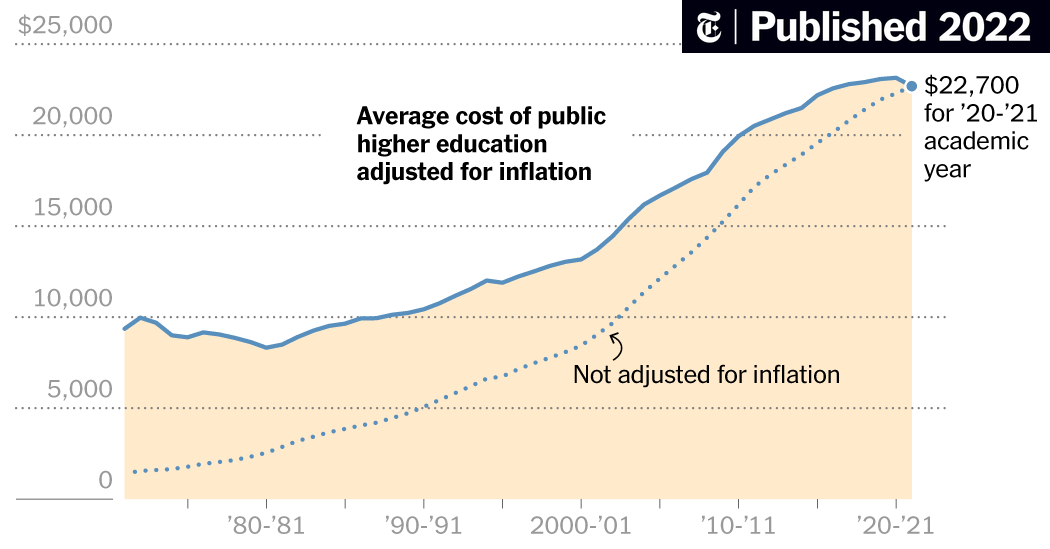
That figure has skyrocketed over the last half-century as the cost of higher education has continued to rise. The growth in cost has substantially been more than the increase in most other household expenses.
The average cost of college has risen faster than inflation

$22,700 for ’20-’21
academic year
Average cost of public
higher education
adjusted for inflation
Not adjusted
for inflation

$22,700
for ’20-’21
academic
year
Average cost of public
higher education
adjusted for inflation
Not adjusted
for inflation

$22,700
for ’20-’21
academic
year
Average cost of public
higher education
adjusted for inflation
Not adjusted
for inflation

$22,700
for ’20-’21
academic
year
Average cost of public
higher education
adjusted for inflation
Not adjusted
for inflation
Source: College Board
Note: Includes costs of tuition, as well as room and board.
The rising cost of college has come at a time when students receive less government support, placing a greater burden on students and families to take out loans in order to fund their education.
Funding from states in particular has steadily declined, accounting for roughly 60 percent of spending on higher education just before the pandemic, according to an analysis by the Urban Institute, down from around 70 percent in the 1970s.
States’ and local government’s share of spending on higher education has been declining
Share of higher education expenditures

State appropriations
and other sources

State appropriations
and other sources
Source: Census Bureau, via Urban Institute
To address the growing crisis, President Biden announced a plan on Wednesday to wipe out significant amounts of student debt for millions of people. It was a step toward making good on a campaign promise to alleviate, as Mr. Biden has said, an unsustainable problem that has saddled generations of Americans.
“The burden is so heavy that even if you graduate,” he said, “you may not have access to the middle-class life that the college degree once provided.”
The typical undergraduate student with loans now finishes school with nearly $25,000 in debt, an Education Department analysis shows.
According to the plan, borrowers will be eligible for $10,000 in debt relief as long as they earn less than $125,000 a year or are in households earning less than $250,000. (Income will be assessed based on what borrowers reported in 2021 or 2020.)
Student debt, however, has a widely disparate impact on different populations.
Black people are increasingly carrying a larger student debt load …
Share of families by race that have an education loan


Source: Federal Reserve
Notes: Black and white groups do not include people who identify as Hispanic. Data are from the Federal Reserve’s survey of consumer finance that is conducted every three years.
… as are millennials, who owe far more than older and younger generations
Total balances of student loans by age


Source: Federal Reserve
As student debt has grown in recent years, people’s ability to repay it has declined.
When the pandemic brought the global economy to a standstill in 2020, President Trump issued a moratorium on student debt payments and forced interest rates down to zero. Mr. Biden adopted similar policies. The moves helped millions of people lower their loan balances and prevented borrowers unable to pay their loans from defaulting on them.
Nonetheless, there has been a sharp increase in the number of people whose loan balances have stayed the same or have grown since the start of the pandemic.
The pandemic moratorium lowered defaults, but balances still loom
Number of borrowers by loan status at the end of each year

+7.5 million borrowers
from 2019 to 2021
Balance is the same
or higher than one year prior
90 days or more
deliquent

Balance is the same or
higher than one year prior
+7.5 million borrowers
from 2019 to 2021
90 days or more
deliquent
Source: New York Federal Reserve
On Wednesday, Mr. Biden announced that the pandemic-era pause on payments would expire at the end of the year. He also reiterated his commitment to providing relief, in particular to lower- and middle-income households. How exactly to do that has been a topic of debate inside the White House and out.
One provision of the program involves an income cap: Debt relief may apply only to individuals or families who earn below a certain amount. The point of that provision, according to the White House, is to make sure no one who earns a high income will benefit from the relief.
An independent analysis from the Wharton School of Business showed that households earning between $51,000 and $82,000 a year would see the most relief — regardless of whether an income cap were applied. This is in part because more people at middle income levels hold student loans.
With or without an income cap, most relief would go to middle-income households

$10,000 per person, income
cap of $125,000 individual
or $250,000 household
$10,000 per person,
no income caps
In the current plan,
14% of the debt relief
will go to the lowest
fifth of earners.
If there were no income cap,
only 2 percentage points
more relief would go to the
top 10 percent of earners.

If there were no income cap
$10,000 per person, income cap of $125,000
individual or $250,000 household
$10,000 per person, no income caps
If there were no income cap, only
2 percentage points more relief would
go to the top 10 percent of earners.
In the current plan,
14% of the debt relief
will go to the lowest
fifth of earners.
Source: Wharton Budget Model
Household income quintiles are from 2022. This analysis takes into account additional relief for Pell Grant recipients.
Millions of people stand to benefit from the relief, but Mr. Biden’s announcement kicked off a heated debate about its merits.
On both sides of the political aisle, analysts and officials have worried about the plan’s effects on inflation, in part because wiping away debt could inject money into the economy. (White House economic advisers made the case that by resuming loan payments and including income caps, the plan would have a negligible effect on rising consumer prices.)
Others have argued that while the relief could help many people, it does not address the underlying problems of how expensive college has become. Some economists have even warned the move could encourage colleges and universities to raise prices with the federal government footing the bill.
“I understand that not everything I’m announcing today is going to make everybody happy,” Mr. Biden said on Wednesday. “But I believe my plan is responsible and fair.”





U.S.- Canada Trade Talks Collapse; Carney Says Retaliatory Tariffs Begin September 8

Flock Cameras and the Future of Public Security

AI Infrastructure Boom Hits Physical Limits: Power, Financing, and Supply Chain Strain

Armanino adds Strategic Accounting Outsourced Solutions

New 2023 K-1 instructions stir the CAMT pot for partnerships and corporations

Tax Strategy: Employee Retention Credit update
-

 Stock News1 week ago
Nvidia Earnings Preview: What Wall Street Expects From the AI Bellwether’s Q2 Report
-

 Accounting1 week ago
SEC’s Semiannual Reporting Proposal Faces Investor Pushback: What CFOs Need to Know
-

 Stock News1 week ago
Nvidia Q2 FY2027 Earnings beats Wall Street Expectation with Record $96.2 Billion Revenue
-

 Finance1 week ago
Treasury Bond Volatility Forces Bessent to Double Debt Buyback Size as Yields Swing
-
 Technology4 days ago
AI Infrastructure Boom Hits Physical Limits: Power, Financing, and Supply Chain Strain
-
 Economics2 days ago
U.S.- Canada Trade Talks Collapse; Carney Says Retaliatory Tariffs Begin September 8
-
 Technology2 days ago
Flock Cameras and the Future of Public Security