
Accounting
Looking ahead with Barry Melancon

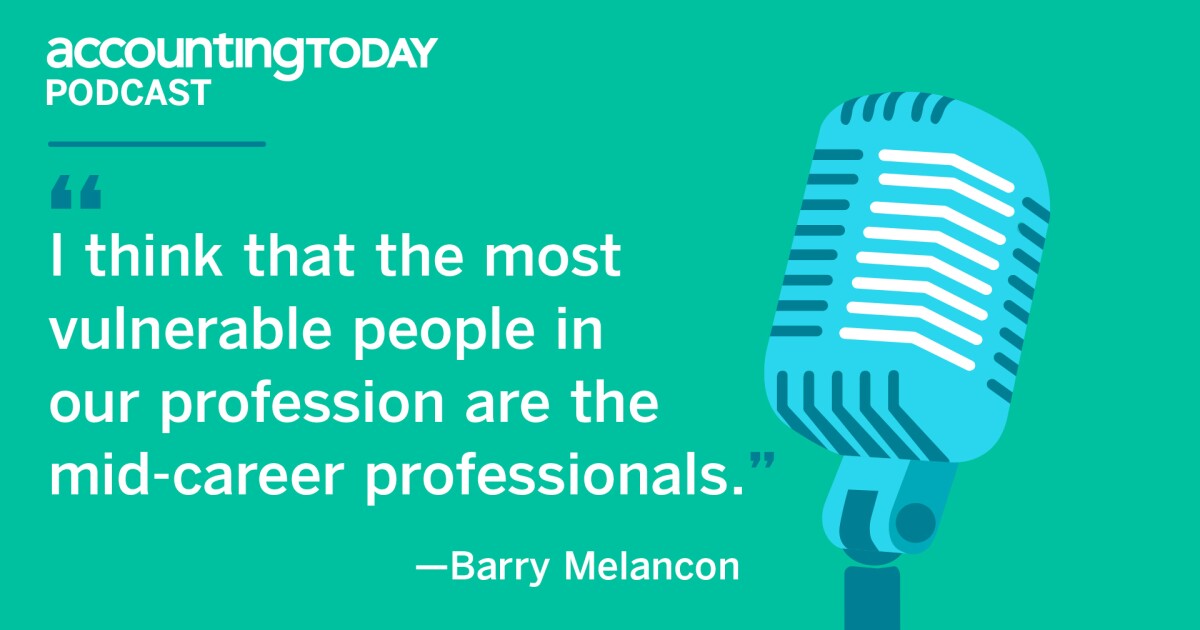

On the eve of his retirement, longtime AICPA chief Barry Melancon turns his eagle-eye to the future, talking about the challenges and opportunities facing the profession, and what it needs to do to get ready for both.
Transcription:
Transcripts are generated using a combination of speech recognition software and human transcribers, and may contain errors. Please check the corresponding audio for the authoritative record.
Dan Hood (00:03):
Welcome to On the Air with Accounting Today. I’m editor-in-chief Dan Hood. The accounting profession will mark a major milestone at the end of this year. I’m with Barry Melancon, the longtime head of the AICPA steps down. After 30 years, we’re lucky enough to have him join us to look back over his time leading the profession. Last episode we focused on how things have changed and how he changed things since he became president and CEO of the Institute in 1995. And in this episode, we’re going to look to the future. Barry, thanks for joining us.
Barry Melancon (00:28):
Dans great to be with you and I can’t wait for this topic. The future is my favorite topic and I think the future is just going to be fantastic for our profession and man, it’s certainly changing so rapidly, the whole world that we live in. So talking about the future is an exciting moment, so thank you for having me.
Dan Hood (00:46):
Yeah, we’re excited about it. I will say you’ve been a member of our Top 100 Most Influential People list for a million years, and we always ask the members of that list to say who they think is influential. They routinely name you as the top of that, and almost inevitably the most common reason they cite is your ability to look forward for the profession and see what’s coming down the pike and where the profession should be headed and what’s coming at it and all that sort of stuff. So I’m psyched to talk about it with you. Maybe we can start, I don’t want to be gloomy, but maybe we’ll start with some of the challenges facing the profession. Then later on we’ll get to some of the reasons why the profession, the future, excuse me, is really bright for the profession I think. But for now, why don’t we talk a little bit about the challenges.
Barry Melancon (01:26):
Well, Dan, before we do that, if I could just because that introduction was so great and you talk about people saying I’m the most influential or whatever, it’s not really me. It’s the collective us, the collective staff, our member volunteers. I spoke about at our last AICPA council meeting in October, which was my last AICPA council meeting is that you are who are around you basically. And that’s not perfect grammar, but the reality is each of us is a factor of people around you and it’s been so fortunate for me to be around so many amazing people. And so the notion of seeing into the future is very much an inexact science and picking that up from everyone and different people’s perspectives and sort of cobbling that together to connect it dots is maybe what I think I can do pretty well. But it is that collection of thinking.
(02:20):
So yes, there are gloomy topics that people want to talk about. Look, we live in a world that’s got certainly unpredictable economics. We have major conflicts around the world. We have major uncertainty as to what AI is going to do as it relates to changing employment and changing how people even think about work and life balance and what work is defined even as all of those things, demographic challenges in many different places in the world, not all places, but many different places, certainly in the United States, but I don’t really see them as overly gloomy. Obviously we don’t want conflict battles between people. We want that solved and hopefully our leaders working with leaders and else place in the world will solve that. But I do think our ability to change is our biggest challenge because it’s moving so fast. The expectations of the public are changing so rapidly and we talked about it in the last podcast, but this notion of seeing our role in a much broader sense of broader business information, if we don’t do that, I think there is a bit of gloominess in that perspective because sort of our core services will have greater and greater and greater impact from the technologies that are being delivered.
(03:39):
And I think on a global stage, our ability to find a role as the United States of America and sort of emphasize our global profession is a critical component. And as a country, as people, we have to continue to change and we can’t really hold onto the past. The world technology’s not, the economy’s not going to let us do that. I think those are the biggest challenges out there
Dan Hood (04:04):
Right now. You’ve repeatedly warned, I’ve heard you repeatedly warned people that the pace of change is never going to get any slower than it is now where it’s only going to accelerate, which is going to require that sort of nimbleness that you talked about.
Barry Melancon (04:16):
That’s correct. It never will be, and people are stressed out over the speed today, but the reality is it’s never going to be as slow as it is today. That’s the world, and that’s not just like ai. It’s not unique to our profession, but our profession, if we’re going to be that prime profession in the business world and the individual elements of lifestyle and what people’s sort of own financial situation is, we have to be ready for that. And our ability to train people and our ability to be adaptive in that is so critically important. And sort of what comes with that, Dan, is this notion we have this DNA of wanting to be right. We don’t like giving advice where we can’t sort of answer the question completely. We talked about PPP and Covid in the earlier, and we actually did that very well. There was a lot of uncertainty and we thrived in that as a profession and we have to continue to thrive with that uncertainty because we aren’t going to live in a world where as a profession we can give absolute answers and that uncertainty is something that we have to deal with from a competency perspective.
Dan Hood (05:32):
Well, let’s talk about that a little bit because the notion of what people need to do to be ready for the future always sort of fascinates me. Obviously as you say, that’s one area where getting comfortable with that level of uncertainty, with a range of possibilities as opposed to a single specific concrete answer is something that some accountants are getting comfortable with, I think. But that as a profession, maybe as a whole need to do more on. What are the things do you think accountants need to do to get ready for this future?
Barry Melancon (06:02):
To me, it’s about competencies and business models. So if you’re in corporate, it’s the business model change of whatever entity you’re in and whatever industry you’re in. And in public practice it’s how do you change business models? And the notion that business models of the whole was predominantly a pyramid shape leverage model since the 1940s, that model is probably not going to sustain itself. And that business model is a lot about the agility and a lot about taking risk in that environment, but still being objective and who people want to turn to because you’re competent. And then that competency adds to, we’ve got to change competencies. And so if I was, and I have talked to many of room of young professionals, but I think this commitment to changing my competencies is absolutely essential. And Dan, you’ve heard me say this, I think the most vulnerable in our profession is the mid-career professional people who are entering our profession.
(07:02):
They’re digital natives. They’ve come through life really with a different mindset towards that. The people who are ready to retire, the notion of having to change has got a smaller delta than the person who’s got 20 years or so left to work. The amount of change, can you imagine what the profession will look like in 20 years? It’s my job to think about that, and it’s really, really, really hard to think about really what that could be. I do know it’s going to be much different. I do know it’s going to go through several iterations and our ability to be comfortable in that and to adapt to our skill sets, for instance in ai, but not only ai, to connect the dots, to be strategic, to take risk actually I think is really, really important. And that’s going to be what we have to be able to get our arms around
Dan Hood (07:57):
Right worth. I think, and this will pivot to my next question, it’s worth remembering that all these skills in terms of change management and being ready to change your skillset, to update your skill sets, what is it to learn to unlearn and to relearn all those sorts of things. It’s not just about the challenges that are coming down the pike, right? It’s not just about that. It’s about the opportunities. There are a tremendous number of opportunities facing the profession. And maybe to gloom us a little bit, let’s talk about some of those. As you look forward, what do you think are some of the big opportunities for accountants?
Barry Melancon (08:32):
Well, first off, I think, let’s say again, from a public practice or an employer perspective, either one, businesses and people’s individual finance is just full of uncertainties. And so they’re turning to us to help think through those things, to think through that notion of where it might go and to be knowledgeable in that space, I think that’s the number one, to be a settling rational voice, but still to be open to these changes that will happen. So there’s no entrepreneur out there, even those in ai, that the businesses that are in ai, they just have this high degree of uncertainty. How do I build the business? What’s the right amount of risk? It is just endless the types of discussions that are going on not to dismiss because there’s even greater old line industries of how much change and how can we change that. I like to start with the process of thinking about how the world’s going to change because we can get very narrow about, oh my God, this is happening to our profession, or this is happening to my client in X industry.
(09:40):
Look, I think in 10 years we’re going to have gone through major debates of what is the definition of work and what’s the expectation of work from a society? There’s all sorts of scenario plans that you can go through, but if you sat down with a client or a wealthy individual and you talked about those elements and just really had honest questions and somewhat admitting that you don’t know all the answers, but helping people think through those things, I think there’s huge value through the trusted advisor role to really do that. And firms that can structure themselves in a way that could deliver on that, I think they’re going to build loyalty with clients that these changes take place. That’ll be really, really, really hard to lose because it’s that handholding and this high degree of uncertainty that people really value and businesses really value.
Dan Hood (10:32):
I mean, if you think about it, if accountants are concerned about and confused about and uncertain about the future, you can only imagine how much more so their clients are concerned about and confused by and uncertain about the future. And so the values you say of having that handholding, that guide through it would be enormous. I’d like to talk just briefly about the opportunity in sustain. You mentioned sustainability a little bit, but the whole ESG space, particularly around assurance, but there’s also an enormous advisory opportunity there as well. Maybe we talk just briefly about that.
Barry Melancon (11:03):
Well, a lot of people in our profession and certainly a lot of the largest firms are gravitating to the advisory part. I prefer to start with the assurance part because I do think we are moving to a world and let’s admit that’s going to slow down in the United States because of the results of the elections in November. That’s just a true statement. However, there are market forces in play. There are international regulations that are in play that is still going to cause this to happen, and it’s also going to move down channels. So most of the time I talk to practitioners and say, I’m at a smaller firm or my clients are smaller businesses, it’s not going to happen. That’s just not true. The reality is that big business would market forces and certainly if they do business outside of the United States, that’s going to be a major emphasis.
(11:47):
And so I think the assurance part is going to be a major part and getting our arms around that, that’s just assurance and audit or coming out of Sarbanes Oxley assurance and internal controls or in these emerging areas of controls that are not even sarbanes oxley related. I think it has been a huge expansion of the profession. And so I do think firms, this is probably first or larger firms, but not just the big four, a top 100, a top 200. I think the notion of assurance in this space I think is really important. And that continuous, the sort of notion of the annuitized type of service consulting is important as well. And some will go down that path. But I do think that that may be shorter lived than what assurance will be in that space. Now, why is it important? Look, I’ve been very active in this space, but I wouldn’t say I am a way out there environmentalist.
(12:51):
I’m a person who is I think very practical in that I think there are nature aspects that are playing out that man does not have anything to do with. And I just think that we need to sit back as sort of people who occupy the planet earth today and do as best we can. Not everything is the same cause and effect that everybody speaks about that is really out there, but there is some cause and effect. There is some implication. And I think as a role, as a profession, we have an obligation to have sort of a role in that space, not because it’s politically correct, but because it is happening in the world. All you have to do is see some of the pictures of plastics in the ocean and say, man, we ought to be able to do some stuff associated with this. But at the same time, I’m a boater. I boat on Long Island salmon. 10,000 years ago it was a glacier. It didn’t melt because of what man did. So there is a balance in this notion, and I think a voice at the profession in that space of balance is sort of what we’re known for.
Dan Hood (13:55):
And certainly to bring some practical perspective to it and also, I mean take it even to a more basic level, even if regardless of what your feelings are about cause effect, the environment, all that sort of stuff, the markets are beginning to demand and will continue to demand. Governments are putting these requirements in place, there’s going to be requirements for these things, whether you agree with them or not, and best that they be done by people who know best that the assurance around them be provided by people who know how to do that,
Barry Melancon (14:24):
Right? You could say, well, I philosophically and politically don’t believe a state ought to have income tax, but yet there are other states that have income tax. You got to help your client deal with that. Or I don’t necessarily agree with an alternative minimum tax, or I don’t necessarily agree with the rate that is in our income tax structure, but you still have the professional obligation to help your clients deal with those issues. And it’s no different in this sustainability space where the market is causing things to happen. If you’re a business that is public, it’s certainly a big business. Or if you’re a business that’s very important in someone’s either supply chain or customer chain. They’re going to have obligations as businesses try to comply with this. Now, I think the profession has a voice, and this has been our voice. We need a global set of answers so that it’s not so burdensome on businesses to comply. It needs to not be overly complicated, that it’s almost impossible to comply, and there’s an element of crawl, walk, run. We can’t expect perfection in this process day one, but at the same time, we ought to be the voice that doesn’t allow people to say anything in so-called greenwashing that has no accountability in this space. That’s a role that we play in a almost immeasurable number of areas over history. Why wouldn’t we play that role in this space?
Dan Hood (15:44):
It’s all about trust. It’s awesome. There are two particular areas I want to dive into in a second, but we’ve got to take a quick break first. Alright, and we’re back talking about the future with Barry Melancon of the AICPA. We’ve talked broadly about some challenges and some opportunities particularly around ESG, but also tax we’ve talked about as a place where the profession is particularly well poised. I want to talk about two specific issues areas, let’s call ’em that you had talked about. Maybe start with private equity. You had mentioned a little bit about the need to change models. Obviously private equity is playing a role there in helping accounting firms figure out what new models to explore on. What sort of impact do you think it’s going to have on the profession? And I’ll let you choose the timeframe if you want. Is it next couple of years longer term? And realizing again that this is a weird area that no one really, I don’t think anyone has a strong handle on it, but as you look at it, what’s your take on the potential impact for PE on accounting?
Barry Melancon (16:48):
Well, first off on private equity, Dan, I’ve always been a person who believes that different models can work just because someone decided partnership models with the right model 80 years ago. It doesn’t mean that that’s the only thing that can happen today. I think we, let’s just just have a level set. We have some large firms that have maintained and are totally committed to the traditional partnership model vis as example mergers of two very large firms in the US and then on a global basis that are partnership model. They seem to be very happy with that structure. And we have large firms that have gone private equity. We have a BDO that went ESOP. So different models to me is a good thing for the profession because then people who follow on to what people have done sort of in a first phase or an early phase could see what they think works best and they can choose for their firm or where they take their firm, they can choose based on that knowledge.
(17:44):
And I think that that’s a good thing for the profession, not a bad thing for the profession. Now all of that is with the caveat that we have to follow the rules in the assurance space. We have to be committed to that trust quotient that the profession owns in the marketplace. And we have to defend with sort of every fiber of our bodies and every fiber of our professional commitment. That is critically important. Now, specifically to private equity, I think we have to be honest about some of the forces that, I mean, I think the aging population of people in some of these firms with retirement, the US model is a high pay partners retiring model is a big part. I think the profession for decades has not been a fair market value profession. You could buy in a formulaic price that a firm might set and you retired at a formulaic price.
(18:38):
That’s not a fair market value notion. And clearly with the way the market has changed in general for all types of businesses, fair market value is very prevalent, funded by private equity, venture capital, et cetera. And so I think the profession being part of that is true. I think if we got together 10 years from now, the predominance of firms is still going to be traditional partnerships. So let’s not get overly carried away with how much this is happening in this particular space. Now that all being said, I’ve spoken to many young people in our profession who love the fact about private equity because they can get ownership or pieces of ownership either in direct ownership or structured in effect of different units that allow them to participate. They’re enamored by that rather than waiting 10, 12, 15 years to be a partner in a firm. So young people in some ways gravitate to that.
(19:40):
Some other young people don’t and they could find firms that are having the traditional model in that space. I do think it requires private equity is going to change how tightly managed a firm is. It’s going to definitely have specific KPIs on profitability and I obviously we have to make sure that profitability doesn’t drive bad behavior. But the reality is, is that being better run and deploying capital and being more strategic about how we provide services, how we build accountabilities into those services, there’s nothing wrong with that. Now, how does it all play out? The number one question I get with private equity is firms are going to flip and where does it all end? Barry, where does it all end? I have my own sort of theory on it. I have shared it with private equity people most of the time. Not every time I’ve gotten sort of knots that people give in that space and admit.
(20:39):
So what I say is, look, let’s be honest, some are not going to work. I mean, going down this path, not everything works. Not everybody gets it all right. I think flips constant flips will have sort of an end in sight. And I think at some point firms will sell off pieces, parts maybe a cast practice or maybe a piece of a tax practice instead of flipping the whole term. But I think maybe a whole firm, I think maybe the most important point, what I believe, and maybe a lot of private equity people won’t necessarily believe this, but some do. I believe private equity’s investment in our profession will actually cause private equity to change. Private equity has our profession is very well run by great people. Firms make a nice living for people who have a long career in our profession. And I think private equity is going to evolve.
(21:35):
We have an excess supply over demand of private equity in this country, not only this country, many countries in the world, and the fact that a firm can do a better job of running itself and use capital differently and actually produce consistent profitability, which the profession historically has done. There’s nothing wrong with a private equity fund being focused on providing institutional investors and family offices a consistent rate of return. And it’s not always about a flip. I understand private equity has always been about a flip for the most part. But you look at Berkshire Hathaway as a public company, they do a pretty good job of buying companies on the big end and holding them. And so I think private equity, some private equity is going to follow suit with that because they’re going to understand how that trusted role, that trusted advisor role of the profession and that continued support of the work with clients produces longer term plays than rather shorter term plays.
(22:40):
And so I think we’ll see some with a lot of flips and I think we’ll see some not so many flips. And I think that’ll be part of the next three to five year evolution of private equity. I could be dead wrong on that, but I’m pretty confident that we’re going to see some of that because I just think the profession is sort of a different vertical than what private equity. I know they bought other professionals verticals, but the CPA practice is such an annuitize repeat relationship business that I think that continuity is going to play a dividend in that process that they might not anticipate or might not have anticipated. I think it will cause some behavior to change.
Dan Hood (23:25):
I love the idea of the accounting profession overhauling private equity and changing that would be fascinating.
Barry Melancon (23:32):
Maybe not, maybe not every aspect of equity
Dan Hood (23:34):
Wholesale change, it’s going to a wholesale change.
Barry Melancon (23:36):
No, no, no. Private equity will probably still do its other thing, but I think in our space we will see some evolution by private equity.
Dan Hood (23:45):
It’s going to be very exciting to watch. We only have a couple of seconds left. I just want to ask, as you look forward, what advice would you give a young person joining the profession?
Barry Melancon (23:56):
The best advice that I got within the first 30 days of me becoming CEO was actually from a big, at that time, six CEO, who I had never met before. And his very simple advice in the first five minutes of a meeting with him, it was actually Larry Weinbach, who’s now deceased, but he was CEO of Anderson, which was the largest professional service firm in the world at the time. And he said, Barry, look, I don’t know you, but people put you in this role. And only thing I can advise to you is to be yourself. I’ve tried to live by that every day. And I would say that to a young person, you’ve picked accounting or you’ve thought about picking accounting because of certain attributes that you see in the profession and certain attributes you have, and you have to be true to yourself. So that’s the first part.
(24:43):
But secondly, I think passion is very important. People always talk about my passion for the profession. I think this profession is just amazing and it’s so needed in society as a whole. And we really haven’t spoken about AI impact maybe as much as we could, but I think we need young people in it, and they have to have a passion about the purpose of this profession and this sort of trusted advisor role, which I’m sure people get tired of hearing, but there’s no trust in society today or very little of it. And we have a large inventory of trust. And so buying into that as a young person, what a great career to be associated with hundreds of thousands of people who abide by that and who, yes, we have weak links, and inevitably any group of people has weak links. But so many people in our profession, they’re the salt of the earth and the salt of their communities, and they want to do the right things and they commit themselves to competencies to do it, to be part of that, what a fulfilling and rewarding career that you can have.
(25:49):
So those are the things that I would tell a young person on the topic of that. And then I would add to a topic we discussed earlier, and you have to be committed to agile change and changing your competencies. Don’t believe you’re entering this profession and it’s static. Nothing in the world is static, but because we want to be this trusted professionals, we have to have an extra dose of willingness to change, in my opinion. And if you can balance that trust with that extra dose of change, you can have a really successful and fulfilling career. And if you study the history of the profession a little bit, you can see how valuable we are to making people successful. Dan, we use for our own organization this tagline that we say we support or we create trust, opportunity, and prosperity. And that’s really the profession does. We create trust in things, we create opportunities for people. Look, our profession is critically important in emerging economies, an emerging economy going to sort of a developing economy. The development of a profession is a key component of that because of trust. So trust, opportunity and prosperity. Not prosperity for ourselves, but prosperity for society as a whole. And if you just think about those three words, just how fulfilling that can be, and I encourage people to think about that.
Dan Hood (27:18):
Excellent. It’s a great thing to think about going forward, a great view of the future. Barry Melancon, thank you so much,
Barry Melancon (27:24):
Dan. It’s always great to be with you, and I want to thank you for the relationship. I’m sure we’ll have a continued relationship going forward, at least I hope so. But the reality is that communication today and getting messages out is very difficult information clutter, and you obviously are an independent journalist, an independent publication, but the reality is that you’ve really focused on some of these really important issues in the profession, had been a vehicle of that. And I just wanted to personally thank you for that on behalf of the AICPA and the profession.
Dan Hood (27:58):
Well, thank you. It’s always a pleasure getting the message out and working with you all because you have a strong vision to the future and a strong vision to the direction of the profession, and it makes our job very easy. We just turn around and say, here’s what they said. So thank you for all that, and thank you for your leadership over the past three decades. Barry Melancon of the AICPA. Thanks again, and thank you all for listening. This episode of On the Air was produced by Accounting Today with audio production by Kelly Malone Yee. Ready to review us on your favorite podcast platform and see the rest of our content on accounting today.com. Thanks again to our guest, and thanks you for listening.





U.S.- Canada Trade Talks Collapse; Carney Says Retaliatory Tariffs Begin September 8

Flock Cameras and the Future of Public Security

AI Infrastructure Boom Hits Physical Limits: Power, Financing, and Supply Chain Strain

Armanino adds Strategic Accounting Outsourced Solutions

New 2023 K-1 instructions stir the CAMT pot for partnerships and corporations

Tax Strategy: Employee Retention Credit update
-

 Stock News1 week ago
Nvidia Earnings Preview: What Wall Street Expects From the AI Bellwether’s Q2 Report
-

 Accounting1 week ago
SEC’s Semiannual Reporting Proposal Faces Investor Pushback: What CFOs Need to Know
-

 Stock News1 week ago
Nvidia Q2 FY2027 Earnings beats Wall Street Expectation with Record $96.2 Billion Revenue
-

 Finance1 week ago
Treasury Bond Volatility Forces Bessent to Double Debt Buyback Size as Yields Swing
-
 Technology4 days ago
AI Infrastructure Boom Hits Physical Limits: Power, Financing, and Supply Chain Strain
-
 Economics2 days ago
U.S.- Canada Trade Talks Collapse; Carney Says Retaliatory Tariffs Begin September 8
-
 Technology2 days ago
Flock Cameras and the Future of Public Security